
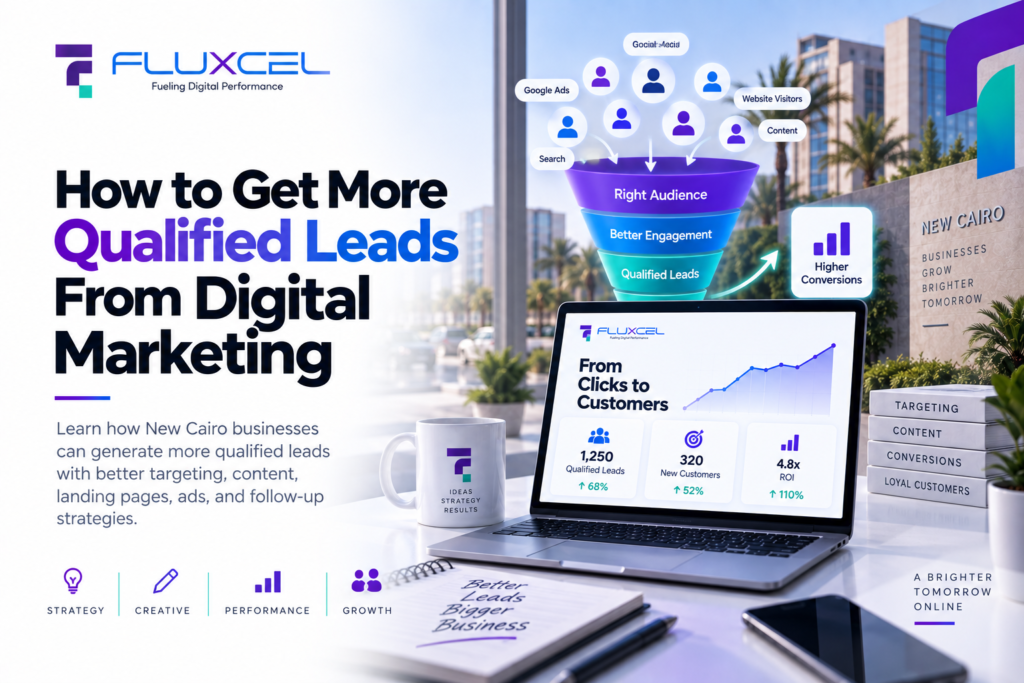
Generating leads sounds simple.
Launch an advertising campaign, send people to a landing page, collect their contact details, and pass them to the sales team.
But anyone who has managed digital campaigns knows the reality can be very different.
You may generate hundreds of leads and still hear the same feedback from sales:
“They aren’t interested.”
“They don’t have the budget.”
“They aren’t answering.”
“They were just asking about the price.”
The problem isn’t always the number of leads. Sometimes, it’s the quality of those leads.
A successful digital marketing strategy shouldn’t simply fill a spreadsheet with phone numbers. It should attract people who have a genuine need, understand the offer, and have a reasonable chance of becoming customers.
For businesses searching for a Digtial marketing agency new cairo, lead quality should be just as important as lead volume.
Here’s how to improve it.
What Makes a Lead “Qualified”?
Not every person who fills out a form is a potential customer.
Someone might submit their details because they’re curious about the price. Another person may need your service but isn’t ready to buy for another six months.
A qualified lead usually has a stronger combination of:
- Genuine interest
- Relevant need
- Appropriate budget
- Purchase authority
- Suitable location
- Realistic timeline
- Intent to take the next step
The exact definition depends on your business.
For a real estate company, qualification may involve budget, preferred location, property type, and purchasing timeline.
For a B2B service provider, it could involve company size, decision-making authority, requirements, and budget.
Before trying to generate “better leads,” marketing and sales need to agree on what a better lead actually looks like.
Stop Targeting the Largest Possible Audience
More people doesn’t automatically mean more opportunities.
Broad targeting can increase reach and sometimes lower your cost per lead, but it can also bring people who have little connection to what you’re offering.
The goal isn’t to reach everyone.
It’s to reach enough of the right people.
Build Audiences Around Real Customer Behavior
Start by analyzing your existing customers.
Look for patterns:
- Where are they located?
- What services do they purchase?
- What problems bring them to you?
- How did they originally discover your business?
- What questions do they ask before buying?
- How long does it take them to make a decision?
This information can help you create more relevant audiences and messaging.
A Digtial marketing agency new cairo strategy can also combine location, search intent, interests, remarketing data, and customer behavior rather than depending on one targeting method.
Your Creative Can Qualify the Audience
Targeting isn’t only controlled by advertising settings.
Your creative does some of the targeting too.
Imagine you’re advertising a premium service.
If the advertisement focuses only on an attractive image and says “Contact Us Today,” almost anyone might click.
But if the advertisement clearly explains the service, who it’s designed for, its main benefits, and what customers should expect, some unsuitable prospects will naturally filter themselves out.
That can be a good thing.
Don’t Hide Important Information
Businesses sometimes make advertising intentionally vague because they want more people to submit their details.
This may increase lead volume while reducing quality.
Instead, provide enough information to help people decide whether the offer is relevant.
Depending on the business, that could include:
- Starting prices
- Service areas
- Product categories
- Minimum requirements
- Key features
- Expected timelines
- Who the service is designed for
You don’t need to explain everything in one advertisement.
You simply need to give people enough context to make an informed next move.
Match the Message to Customer Intent
Someone watching an Instagram Reel isn’t necessarily thinking the same way as someone searching Google for a specific service.
Their intent is different.
Your marketing should reflect that.
High-Intent Customers
People actively searching for a product, service, solution, or business often have stronger immediate intent.
Search campaigns and SEO can help capture these opportunities.
Your message can be more direct because the customer already understands what they’re looking for.
Lower-Intent Customers
On social media, you may be introducing the need before introducing the solution.
Instead of immediately asking someone to “Book Now,” you may need to educate them first.
Use content to explain the problem, demonstrate the benefit, answer objections, and build trust.
Then move the audience toward conversion.
Understanding intent can dramatically improve both lead quality and customer experience.
Build Landing Pages Around One Clear Offer
You’ve attracted the right person.
They clicked your advertisement.
Now they arrive on your website.
This is where another common problem appears: too much information and no clear direction.
A campaign landing page should have a focused purpose.
Make the Value Clear Immediately
Visitors should quickly understand:
What are you offering?
Why does it matter to them?
Why should they trust you?
What should they do next?
Support the offer with relevant information, benefits, testimonials, examples, FAQs, and a clear CTA.
Avoid sending every advertising campaign to your homepage unless the homepage genuinely provides the best journey.
Someone clicking an advertisement for a specific service should ideally arrive on a page about that service.
Relevance improves both user experience and conversion quality.
Use Forms to Improve Lead Quality
Short forms usually generate more submissions.
But more isn’t always better.
If your sales team needs certain information to determine whether someone is a serious prospect, consider asking for it before the lead is submitted.
Ask Useful Qualification Questions
Depending on your business, you could ask:
- Which service are you interested in?
- What’s your approximate budget?
- When are you planning to start?
- Where are you located?
- What’s your company size?
- What type of solution do you need?
Don’t turn the form into an interrogation.
Every additional field creates friction.
Ask only questions that help your team understand or prioritize the opportunity.
This is an area where a Digtial marketing agency new cairo campaign should balance conversion volume with commercial value.
Speed Up Your Lead Follow-Up
You can generate an excellent lead and still lose it through slow follow-up.
People often contact several businesses when they’re ready to buy.
If one company responds quickly while another waits until the following day, the first company has an obvious advantage.
Build a clear process for new inquiries.
For example:
Lead received → Automatic confirmation → Sales notification → First contact → Follow-up → Qualification → Opportunity
Automation can help with notifications and initial communication, but the human element still matters.
A personalized conversation can reveal needs and objections that no automated form can fully capture.
Connect Marketing and Sales Data
Marketing teams often measure cost per lead.
Sales teams care about customers.
Those two perspectives need to connect.
Suppose Campaign A generates:
100 leads at EGP 150 per lead.
Campaign B generates:
50 leads at EGP 250 per lead.
Campaign A initially appears stronger.
But what happens if Campaign A generates five customers while Campaign B generates fifteen?
Suddenly, the more expensive lead source may actually be much more valuable.
That’s why businesses should track leads beyond the initial form submission.
Whenever possible, connect:
Campaign → Lead → Qualified Lead → Opportunity → Customer → Revenue
This allows marketing decisions to be based on actual business results rather than surface-level advertising metrics.
Retarget People Who Aren’t Ready Yet
Not everyone converts immediately.
Someone may visit your website today, compare competitors tomorrow, talk to their business partner next week, and make a decision later.
If you disappear after their first visit, you may lose the opportunity.
Retargeting can keep your brand visible to people who have already shown interest.
You can use retargeting to show:
- Customer testimonials
- Case studies
- Product demonstrations
- FAQs
- Educational videos
- Limited offers
- Service benefits
The goal isn’t to bombard people with the same advertisement.
It’s to give them additional reasons to trust your business and return when they’re ready.
Focus on Customers, Not Just Leads
The cheapest lead isn’t necessarily the best lead.
And the campaign generating the most form submissions isn’t automatically your strongest campaign.
The real question is:
Which marketing activities are creating valuable customers?
To answer that, businesses need better targeting, stronger messaging, conversion-focused landing pages, thoughtful qualification, fast follow-up, and communication between marketing and sales.
A Digtial marketing agency new cairo businesses choose should look beyond lead volume and understand what happens after the lead enters the sales process.
At Fluxcel, we focus on building digital journeys designed around real business outcomes — not just bigger numbers on an advertising dashboard.