
Digital marketing can become complicated surprisingly quickly.
One month, everyone is talking about short-form video. The next, businesses are focused on AI, SEO, influencer marketing, automation, or a new advertising platform.
With so many options available, it’s easy for businesses to fall into a simple trap: doing more marketing without having a clear marketing strategy.
You might be posting regularly on Instagram, running Meta Ads, investing in Google Ads, writing blogs, and sending email campaigns. But if those activities aren’t connected to a larger goal, they can consume time and budget without producing consistent results.
A successful strategy isn’t about being active everywhere. It’s about knowing where to focus, who you’re trying to reach, what you want them to do, and how you’ll measure whether it’s working.
For businesses looking for a Digtial marketing agency new cairo, this strategic foundation should come before campaigns, content calendars, or advertising budgets.
Here’s how to build it.
Start With the Business Goal, Not the Platform
One of the biggest mistakes in digital marketing is starting with the channel.
“We need TikTok.”
“We should run Google Ads.”
“We need to post more Reels.”
Maybe you do. But the first question should always be: What are we trying to achieve?
Your marketing strategy should begin with a business objective.
That might be:
- Increasing monthly online sales
- Generating qualified leads
- Booking more appointments
- Increasing showroom visits
- Launching a new product
- Entering a new market
- Improving customer retention
- Building awareness for a new brand
Once you know the destination, choosing the right channels becomes much easier.
A business trying to generate immediate inquiries may require a very different strategy from one introducing a new brand to the Egyptian market.
Define the Audience You Actually Want
Knowing your audience means more than saying:
“Our customers are men and women between 25 and 45.”
That’s a demographic description, not a marketing strategy.
You need to understand what makes those people act.
Think About the Situation Behind the Search
Ask yourself:
What happened immediately before this person started looking for my product or service?
For example, someone searching for a dentist may have developed tooth pain.
Someone researching digital marketing agencies may be frustrated with poor campaign performance.
Someone searching for office space in New Cairo may be expanding their company.
The situation creates the intent.
Understanding that intent allows you to create much stronger advertising, landing pages, content, and offers.
A good Digtial marketing agency new cairo strategy should therefore focus on customer motivations, pain points, objections, and buying behavior — not demographics alone.
Understand Your Customer Journey
Not every potential customer is ready to buy immediately.
Some are discovering your brand.
Others are researching solutions.
Some are comparing you with competitors.
And a smaller group is ready to make a decision.
Your marketing should account for all of them.
Stage 1: Awareness
At this point, customers may not know your business exists.
Your goal is to earn attention.
Useful channels can include:
- Social media
- Video content
- Display advertising
- Influencer collaborations
- Educational content
- Brand campaigns
Your message should focus on something relevant to the customer’s interests or problems.
Stage 2: Consideration
Now the customer understands the problem and is exploring options.
This is where educational content becomes powerful.
Case studies, service pages, comparison content, FAQs, testimonials, demonstrations, and detailed videos can help potential customers evaluate your business.
Stage 3: Conversion
The customer is closer to making a decision.
Make the next step simple.
Give them clear options to call, buy, book, request a quotation, visit your location, or send a message.
Reducing unnecessary friction at this stage can significantly improve results.
Choose Channels Based on Customer Behavior
Businesses sometimes feel they need to be active on every digital platform.
They don’t.
Being average on six platforms isn’t necessarily better than being excellent on three that your customers actually use.
The right channel mix depends on your business.
Google Can Capture Existing Demand
Search marketing works particularly well when customers are actively looking for a solution.
Someone searching “accounting services New Cairo” is showing stronger commercial intent than someone casually scrolling through social media.
SEO and Google Ads can help businesses capture this demand.
Social Media Can Create Demand
Meta, Instagram, TikTok, and other social platforms can introduce customers to brands, products, and services they weren’t actively searching for.
This makes social media particularly useful for awareness, storytelling, visual products, education, and retargeting.
Email and CRM Can Develop Existing Opportunities
Don’t focus entirely on finding new customers.
Businesses often have databases filled with previous customers, inquiries, website sign-ups, and abandoned leads.
Email, CRM, remarketing, and automation can help businesses continue those relationships.
The strongest strategy usually involves channels supporting one another rather than operating separately.
Build Content Around Customer Needs
Businesses often ask:
“What should we post this week?”
A better question is:
“What does our customer need to know this week?”
That small change can completely improve your content strategy.
Create Different Types of Content
Your content shouldn’t have one job.
Build a healthy mix of:
Educational content — answers questions and explains problems.
Trust content — shows reviews, testimonials, projects, results, or expertise.
Brand content — communicates personality, culture, and values.
Engagement content — encourages conversations and participation.
Conversion content — gives customers a reason to take action.
If every post is promotional, audiences can quickly lose interest.
If nothing is promotional, however, people may enjoy your content without understanding what you sell.
Balance matters.
Make Your Website Part of the Strategy
A website shouldn’t sit separately from your marketing campaigns.
It’s often where customers make their final judgment about your business.
Imagine seeing a professional advertisement, clicking through, and landing on a slow, confusing, outdated website.
The campaign did its job.
The website lost the opportunity.
Focus on Conversion
Review your website from a customer’s perspective.
Can visitors immediately understand what you offer?
Is navigation simple?
Does the website load quickly?
Does it work properly on mobile?
Are there strong trust signals?
Is the CTA obvious?
Can customers contact you easily?
A Digtial marketing agency new cairo strategy should consider the experience after the click just as seriously as the advertisement that generated it.
Set a Budget Based on Priorities
Digital marketing budgets shouldn’t be divided randomly between platforms.
Start with the business objective and determine which activities are most likely to influence it.
Your budget may need to cover:
- Paid media
- Content production
- Graphic design
- Video production
- SEO
- Website development
- Marketing technology
- Influencer collaborations
- CRM and automation
You don’t necessarily need to invest heavily in every category.
Prioritize based on your current business stage.
A new company may need more investment in awareness and brand building, while an established company with strong traffic may benefit more from conversion optimization and retargeting.
Track the Numbers That Matter
Data is only useful when it helps you make decisions.
Having dozens of metrics on a dashboard doesn’t automatically mean you understand performance.
Choose KPIs that connect directly to your goals.
For lead generation, you might track:
- Cost per qualified lead
- Lead-to-customer conversion rate
- Cost per acquisition
- Landing page conversion rate
For e-commerce, you may focus on:
- Conversion rate
- Average order value
- Customer acquisition cost
- Revenue
- Return on ad spend
- Repeat purchase rate
For awareness campaigns, reach, impressions, video views, engagement, branded searches, and website visits may be more relevant.
Context is important.
There isn’t one marketing metric that works for every business.
Review and Optimize Regularly
Your strategy shouldn’t be written in January and forgotten until December.
Customer behavior changes.
Competitors change.
Advertising costs change.
Platforms change.
Your own business priorities change.
Set regular periods to review performance and ask:
- Which channels are generating results?
- Which campaigns attract qualified customers?
- Where are people dropping out?
- Which content is influencing action?
- What should we stop doing?
- Where should we invest more?
Sometimes growth comes from launching something new.
Other times, it comes from improving something you already have.
Build a Strategy Before You Build More Campaigns
Digital marketing becomes much easier to manage when every activity has a reason for existing.
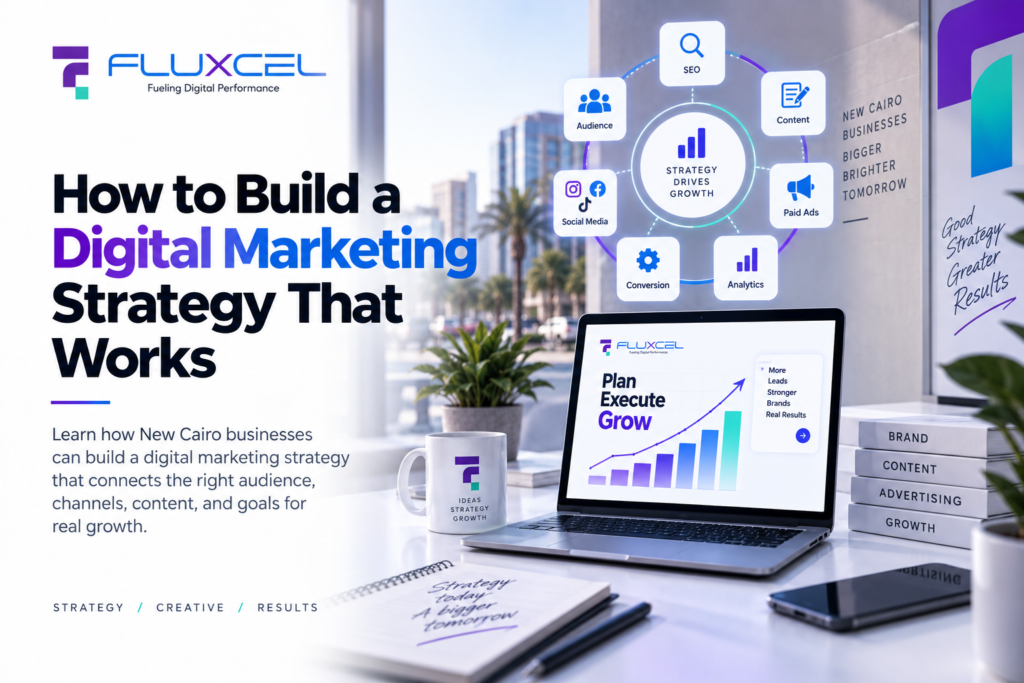
Your SEO should support customer searches. Your content should answer real questions. Your advertising should reach the right audiences. Your website should convert interest. Your CRM should support follow-up. And your reporting should tell you what happens after all of that activity.
That’s what turns individual marketing tactics into a strategy.
Choosing a Digtial marketing agency new cairo businesses can work with shouldn’t simply be about finding someone to post content or manage an advertising account. Look for an approach that connects marketing activity to customer behavior and measurable business objectives.
At Fluxcel, we build digital strategies around the complete journey — from the first impression to the final conversion and beyond.