
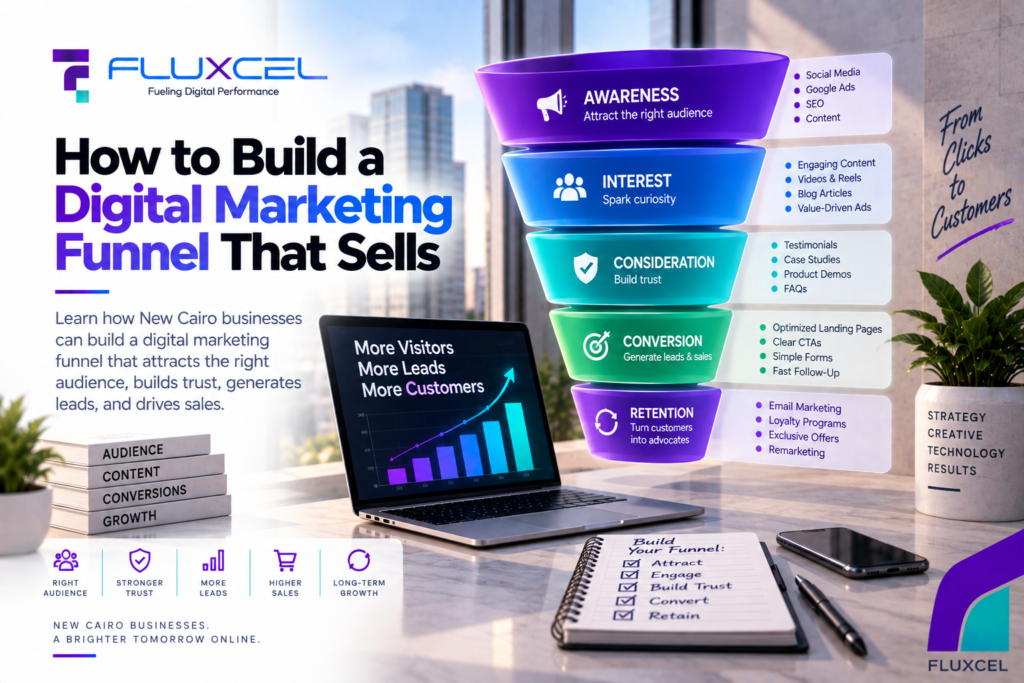
Most customers don’t see one advertisement and immediately buy.
They discover a business, explore its content, visit its website, compare alternatives, check reviews, think about the decision, and perhaps return days or weeks later.
That journey is your marketing funnel.
The problem is that many businesses focus heavily on getting attention at the top of the funnel while giving much less thought to what happens afterward.
They run ads.
They post content.
They generate website traffic.
But there isn’t a clear system for moving those people from “I’ve seen this brand” to “I’m ready to buy.”
For businesses working with a Digtial marketing agency new cairo, building a strong funnel means connecting advertising, content, SEO, websites, retargeting, and follow-up around the way customers actually make decisions.
Here’s how to create one.
What Is a Digital Marketing Funnel?
A digital marketing funnel represents the different stages someone goes through before becoming a customer.
A simple version looks like this:
Awareness → Interest → Consideration → Conversion → Retention
Not everyone who discovers your business will reach the bottom.
That’s normal.
Your job is to make each stage strong enough to move the right people forward.
Awareness
The customer discovers your business.
Interest
Something makes them curious enough to learn more.
Consideration
They begin evaluating whether your solution is right for them.
Conversion
They take the desired action.
Retention
You continue the relationship after the first purchase.
The marketing strategy should support all five stages.
Stage 1: Attract the Right Audience
A successful funnel doesn’t start with maximum reach.
It starts with relevant reach.
You want your brand to appear in front of people who have a reasonable chance of becoming customers.
Depending on your business, discovery can happen through:
- Google Search
- TikTok
- YouTube
- SEO
- Influencers
- Blog content
- Referral traffic
- Paid advertising
Different channels capture different types of intent.
Someone searching Google for a specific service may already understand their need.
Someone scrolling through Instagram may not even realize they need your product yet.
Your creative and message should reflect that difference.
Stage 2: Give People a Reason to Stay Interested
Attention disappears quickly.
Getting someone to stop scrolling is only the beginning.
Now you need to give them a reason to remember your business.
This is where content becomes important.
Educate Before You Sell
Instead of filling your channels with constant promotions, create content that helps customers understand their problems and possible solutions.
This could include:
- Tips
- Educational videos
- FAQs
- Guides
- Comparisons
- Industry insights
- Product demonstrations
- Common mistakes
- Customer questions
Useful content creates another reason for customers to interact with your business before they’re ready to purchase.
A Digtial marketing agency new cairo funnel should therefore use content to develop interest rather than relying entirely on direct sales messages.
Stage 3: Build Enough Trust to Be Considered
Now the customer knows your business.
But they probably know your competitors too.
This stage is where people begin asking:
Why should I choose you?
Your marketing needs to answer that question with evidence.
Show Proof
Trust-building content can include:
- Customer testimonials
- Reviews
- Case studies
- Previous projects
- Before-and-after examples
- Client logos
- Certifications
- Results
- Team expertise
- Product demonstrations
Avoid simply telling people that your company is professional.
Show them.
A real customer story is often more convincing than another advertisement claiming your business provides “the best quality.”
Stage 4: Make the Conversion Easy
When someone is finally ready to act, don’t create unnecessary obstacles.
This sounds obvious, but conversion journeys are often surprisingly complicated.
Customers click an advertisement and land on the homepage.
They search for the service.
They find the service page.
They look for pricing.
They try to find the contact button.
They complete a long form.
At every step, you’re giving them another opportunity to leave.
Reduce Friction
Your conversion experience should be simple.
Depending on your objective, the primary CTA might be:
Get a Quote
Book an Appointment
Shop Now
Schedule a Consultation
Call Us
Send a WhatsApp Message
Make that action easy to find.
The landing page should also reinforce why the customer should take it.
Your Landing Page Is a Critical Part of the Funnel
Advertising can bring the right customer to your website.
A weak landing page can lose them immediately.
Your landing page should continue the conversation started by the campaign.
If your ad says:
“Get a Free Consultation.”
The landing page should clearly explain that consultation.
Not your entire company history.
Not ten unrelated services.
The offer they clicked.
A Strong Landing Page Usually Needs
- A clear headline
- A relevant offer
- Customer-focused benefits
- Trust signals
- Supporting visuals
- FAQs
- A simple CTA
The objective is clarity.
Customers shouldn’t need to figure out what happens next.
Use Retargeting to Bring People Back
Most customers won’t convert during their first interaction.
That’s why retargeting is such an important part of the funnel.
Someone may visit your website, get distracted, and leave.
Another person may need to compare three companies.
Someone else may simply need more time.
Retargeting lets you continue the conversation.
Don’t Show Everyone the Same Ad
Use customer behavior to create more relevant messages.
For example:
Blog visitors → Show educational content.
Service-page visitors → Show a case study.
Product viewers → Show reviews or product benefits.
Cart abandoners → Remind them about the product.
Previous leads → Show additional proof or an updated offer.
Each interaction should help the customer move one step forward.
Don’t Forget the Follow-Up Stage
A funnel doesn’t end when someone submits a lead form.
Marketing has created an opportunity.
Now the business needs to convert it.
Response speed matters.
So does consistency.
Build a clear process:
Lead Received → Confirmation → Sales Contact → Qualification → Follow-Up → Customer
Without this process, marketing investment can easily be wasted.
A Digtial marketing agency new cairo strategy should therefore look beyond cost per lead and understand how those leads progress through the sales process.
Turn Customers Into Repeat Customers
Many funnels stop at the first sale.
That’s a missed opportunity.
Someone who already purchased from your business knows your brand and has already overcome the initial trust barrier.
Depending on your business model, you can continue the relationship through:
- Email marketing
- Loyalty programs
- Repeat purchase campaigns
- Upselling
- Cross-selling
- Referral programs
- Customer-exclusive offers
- Re-engagement campaigns
Retention can make your entire marketing funnel more profitable.
Instead of constantly paying to acquire new customers, you’re also generating additional value from relationships you’ve already built.
Measure Every Stage of the Funnel
If you only measure the final sale, it can be difficult to understand why performance changes.
Track each important stage.
For example:
Reach → Click → Website Visit → Lead → Qualified Lead → Customer → Repeat Customer
Then calculate conversion rates between them.
If your ads receive strong engagement but few clicks, your CTA may need improvement.
If people click but don’t convert, investigate the landing page.
If you generate leads but few become customers, examine lead quality and sales follow-up.
This makes optimization much more focused.
Find the Biggest Leak Before Spending More
Imagine pouring water into a bucket with holes.
Adding more water isn’t the best first solution.
Fixing the holes is.
Marketing works similarly.
Before increasing your budget, identify where potential customers are disappearing.
Perhaps you need:
- Better targeting
- Stronger creative
- More trust
- A better landing page
- Faster follow-up
- Stronger retargeting
- A clearer offer
Fixing one major funnel problem can sometimes produce more growth than launching several new campaigns.
Build a Funnel That Connects Your Marketing
Digital marketing becomes much more powerful when every channel has a role.
SEO can capture demand.
Social media can create awareness.
Content can educate.
Testimonials can build trust.
Paid advertising can accelerate reach.
Retargeting can bring interested customers back.
Landing pages can convert.
CRM and follow-up can turn opportunities into sales.
Retention campaigns can increase customer value.
That’s the difference between running disconnected marketing activities and building an actual growth system.
Choosing a Digtial marketing agency new cairo businesses can work with should therefore involve more than asking who can manage your ads or social media. The bigger question is whether those activities connect into a journey that helps customers move toward a decision.