
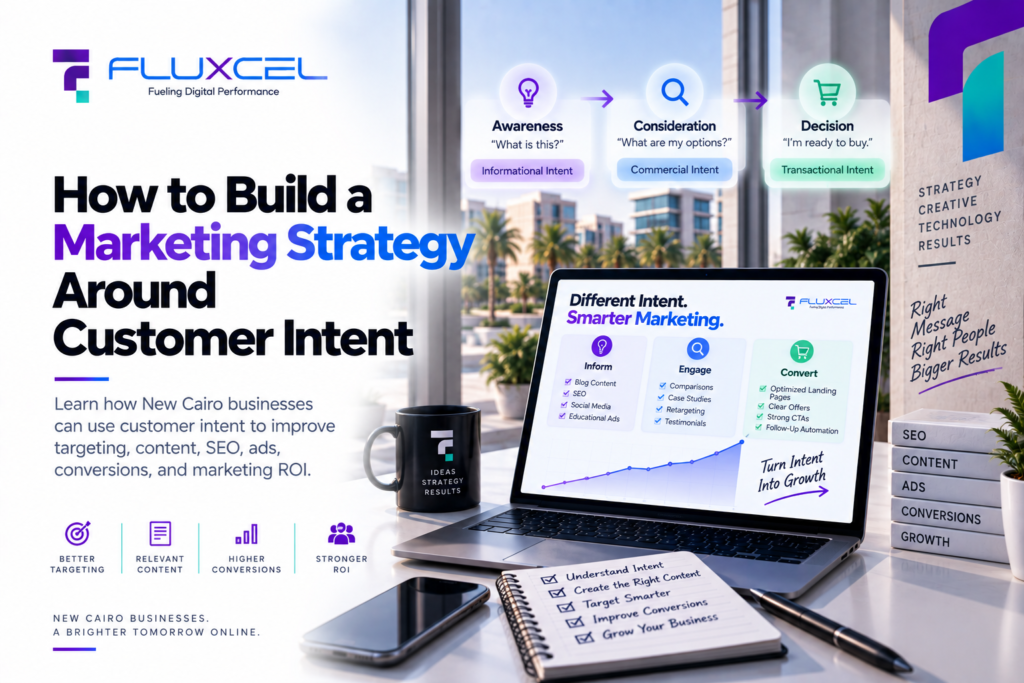
Not every person who sees your business online wants the same thing.
One person might be discovering your brand for the first time. Another might be comparing your services with three competitors. Someone else may already know exactly what they want and simply needs a final reason to contact you.
Yet many businesses market to all three people in exactly the same way.
The same advertisement.
The same landing page.
The same call-to-action.
The same message.
That’s where customer intent becomes important.
Customer intent is about understanding what someone is trying to accomplish at a specific moment and creating a marketing experience that matches that need.
For businesses working with a Digtial marketing agency new cairo, building campaigns around customer intent can help improve targeting, content relevance, lead quality, and ultimately conversions.
Instead of asking only, “Who is our audience?” start asking:
“What does our audience want right now?”
What Is Customer Intent?
Customer intent describes the purpose behind someone’s online behavior.
Think about these three searches:
“What is SEO?”
“SEO vs Google Ads for small business”
“Digital marketing agency New Cairo”
All three people are interested in digital marketing, but they’re clearly at different stages.
The first person wants information.
The second is evaluating options.
The third may be actively searching for a provider.
If you send all three visitors to the same generic page, you’re ignoring valuable context.
Understanding intent allows you to create a more relevant journey.
Stop Treating Your Entire Audience as One Group
Traditional audience targeting often focuses heavily on demographics.
Age.
Gender.
Location.
Job title.
Income.
Interests.
These factors can certainly help, but they don’t always explain whether someone is ready to act.
Two people with nearly identical demographic profiles can have completely different intentions.
One may be ready to purchase today.
The other may have no intention of buying for months.
Add Behavior to Your Audience Strategy
Look at signals such as:
- Search queries
- Pages visited
- Content viewed
- Products explored
- Videos watched
- Forms started
- Previous purchases
- Email engagement
- Website visits
- Advertising interactions
These behaviors can reveal much more about what a customer currently wants.
Understand the Different Levels of Intent
Customer intent isn’t simply “interested” or “not interested.”
It develops throughout the buying journey.
Informational Intent
At this stage, someone is looking for answers.
They may search:
“How does digital advertising work?”
“What is performance marketing?”
“How much should a business spend on marketing?”
They’re probably not ready for a sales conversation yet.
Useful content might include:
- Blog articles
- Guides
- Educational videos
- FAQs
- Infographics
- Social media explainers
Your goal here is to be helpful and establish credibility.
Commercial Investigation
Now the person understands the problem and is comparing possible solutions.
They might search:
“SEO vs paid advertising”
“Best CRM for small businesses”
“How to choose a marketing agency”
Content for this stage can include:
- Comparisons
- Case studies
- Service guides
- Testimonials
- Detailed videos
- Results
- FAQs about your process
You’re helping customers evaluate their options.
Transactional Intent
This audience is much closer to action.
They might search:
“Book dental appointment New Cairo”
“Buy supplements online Egypt”
“Digital marketing agency near me”
The message can now become more direct.
Give people clear CTAs such as:
- Request a Quote
- Book Now
- Talk to Our Team
- Get Started
- Shop Now
- Schedule a Consultation
A Digtial marketing agency new cairo strategy should recognize these different levels instead of pushing the same sales message to everyone.
Build Your SEO Strategy Around Search Intent
SEO isn’t just about finding keywords with high search volume.
You need to understand why people search those keywords.
Imagine your business ranks for a keyword generating thousands of monthly searches.
Sounds great.
But if those visitors are looking for information unrelated to your commercial offering, the traffic may have limited business value.
Match the Page to the Search
Different searches should lead to different types of pages.
For example:
Informational search → Blog
Service-related search → Service page
Product search → Product page
Local search → Location page
Brand search → Homepage or relevant branded page
This improves the user experience because visitors immediately find content aligned with what they expected.
It also helps your website build a more logical SEO structure.
Match Paid Ads to Customer Intent
Paid advertising becomes much more effective when your message reflects where customers are in their journey.
Someone who has never heard of your business may need context.
Someone who visited your pricing page yesterday probably doesn’t.
Cold Audiences Need a Reason to Care
For new audiences, start with the problem, desire, or opportunity.
Educational videos, problem-focused creatives, strong hooks, and useful content can introduce your brand naturally.
Warm Audiences Need More Proof
People who already interacted with your business may respond better to:
- Testimonials
- Case studies
- Customer reviews
- Demonstrations
- FAQs
- Competitive advantages
High-Intent Audiences Need a Clear Next Step
When someone demonstrates strong buying intent, reduce distractions.
Give them the information and CTA needed to move forward.
This might mean booking, purchasing, calling, requesting a quotation, or starting a consultation.
Create Content for Questions Customers Actually Ask
One of the easiest ways to understand customer intent is to talk to the people closest to your customers.
Ask your sales team.
Ask customer service.
Review WhatsApp conversations.
Look at comments.
Study Google searches.
Read customer emails.
What questions appear repeatedly?
Those questions are valuable content opportunities.
Turn Questions Into a Content System
Suppose customers repeatedly ask:
“How much does the service cost?”
You could create:
- A pricing guide
- A short video explaining pricing factors
- A social media carousel
- An FAQ section
- A sales email
- A blog article
One genuine customer question can produce multiple useful pieces of content.
This makes your marketing more relevant because it is based on real demand rather than assumptions.
Design Landing Pages for Specific Intent
A landing page shouldn’t try to speak to everyone.
The more specific the campaign, the more specific the landing experience should usually be.
Imagine a business offers five different services.
If someone clicks an advertisement for Service A but lands on a homepage showing all five services equally, you’re making that person work unnecessarily.
Instead, continue the conversation they already started.
Keep the Journey Consistent
Your:
Ad → Headline → Offer → Content → CTA
should feel connected.
If the advertisement promises a free consultation, the landing page should immediately explain the consultation.
If the ad promotes a particular product, that product should be immediately visible.
If the search is location-specific, reinforce that location where appropriate.
Consistency reduces uncertainty.
Use Retargeting Based on Behavior
Not every website visitor should receive the same retargeting advertisement.
Their behavior gives you clues about their intent.
Someone who read one blog article may still be researching.
Someone who visited three service pages and the contact page may be much closer to conversion.
Someone who added a product to their cart has demonstrated even stronger intent.
Create Different Follow-Up Messages
You can retarget:
Blog readers with additional educational content.
Service-page visitors with testimonials or case studies.
Product viewers with product benefits or reviews.
Cart abandoners with reminders.
Previous customers with complementary products or services.
This makes remarketing feel more relevant and less repetitive.
Use Intent to Improve Lead Quality
Customer intent isn’t only useful for increasing conversion rates.
It can also improve lead quality.
When campaigns clearly explain what the business offers, who it’s for, and what customers should expect, unsuitable prospects may naturally filter themselves out.
That can reduce total lead volume.
But that’s not necessarily a bad thing.
Would you rather receive 200 inquiries that produce five customers or 80 inquiries that produce twenty?
Marketing should optimize for business value, not simply the largest number on a dashboard.
A Digtial marketing agency new cairo businesses work with should therefore analyze what happens after leads are generated.
Connect Intent Data With Sales Feedback
Your sales team has information that advertising platforms can’t always provide.
They know why customers purchase.
They know common objections.
They know why leads disappear.
They know what customers misunderstood before contacting the company.
Use that information.
Marketing can then adjust:
- Targeting
- Messaging
- Qualification questions
- Landing pages
- Content
- Offers
- Campaign structure
When marketing and sales share information, your understanding of customer intent becomes much stronger.
Measure the Journey, Not Just the Click
Customer intent changes over time.
Someone who discovers your business today may become a customer three weeks later.
If you evaluate every campaign only by immediate conversions, you may miss part of the journey.
Look at the wider picture:
First Interaction → Engagement → Website Visit → Return Visit → Lead → Qualified Lead → Customer
Different channels may contribute at different stages.
Social media might introduce the brand.
SEO might bring the customer back.
Retargeting might provide reassurance.
Google Search might capture the final conversion.
Understanding these interactions helps you make smarter budget decisions.
Build Marketing Around What Customers Actually Want
The strongest digital strategies aren’t built entirely around platforms.
They’re built around people.
Customer intent helps businesses understand what their audience needs at different moments and create a more relevant path forward.
That means creating educational content for people researching, proof for people comparing, and clear offers for people ready to act.
It also means connecting SEO, paid advertising, content, landing pages, retargeting, and sales around the same customer journey.
Choosing a Digtial marketing agency new cairo businesses can partner with should therefore involve more than finding someone who knows how to use advertising platforms. The strategy should begin with understanding the behavior behind the clicks.
At Fluxcel, we build digital strategies around customer behavior, intent, data, and measurable business objectives — connecting every touchpoint to create a clearer path from discovery to conversion.