
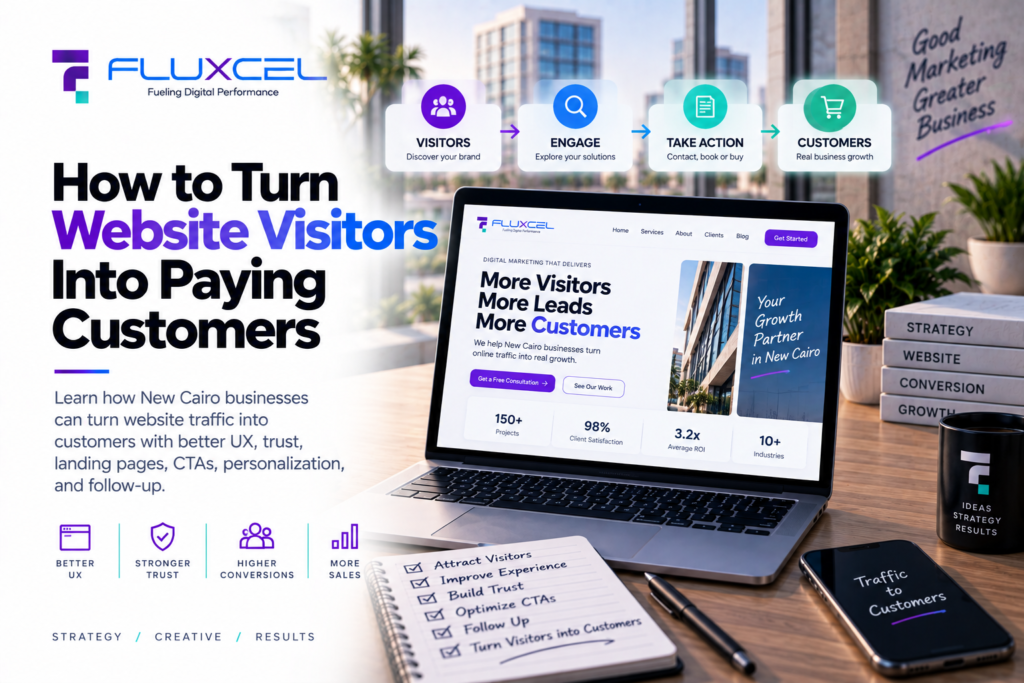
Getting people to your website is an achievement.
You invested in Google Ads, SEO, social media, content, or other campaigns. People discovered your business, clicked through, and arrived on your website.
Then they left.
No call. No WhatsApp message. No form submission. No purchase.
For many businesses, the problem isn’t a lack of traffic. It’s what happens after the traffic arrives.
A website can attract thousands of visitors every month and still contribute very little to revenue if the experience doesn’t give people enough reason to stay, trust the business, and take action.
That’s why website performance shouldn’t be measured only by sessions and page views. The bigger question is whether those visits are turning into meaningful business opportunities.
For companies searching for a Digtial marketing agency new cairo, conversion optimization should be considered part of the marketing strategy — not something that happens separately after campaigns are launched.
Here’s how businesses can turn more website visitors into actual customers.
Understand Why People Are Visiting Your Website
Not every visitor arrives with the same intention.
Someone clicking a Google Search ad may already be looking for a specific service.
A visitor coming from Instagram might be discovering your brand for the first time.
Another person may have visited your website three times and returned because they’re finally ready to make a decision.
Treating all these visitors exactly the same can reduce your chances of converting them.
Match the Experience to the Traffic Source
Start by understanding where your traffic comes from:
- Google organic search
- Google Ads
- Meta Ads
- TikTok
- Email campaigns
- Referral websites
- Direct traffic
Then analyze what those visitors do.
Which traffic sources generate the longest sessions?
Which visitors explore service pages?
Which audiences complete forms?
Which campaigns eventually generate customers?
Traffic becomes much more useful when you understand the behavior behind it.
Make Your Value Clear Immediately
Visitors shouldn’t need to scroll through half your homepage to understand what your business does.
Your first screen should answer several basic questions:
What do you offer?
Who is it for?
Why should I care?
What should I do next?
If those answers aren’t clear, potential customers may leave before discovering the rest of your website.
Avoid Generic Headlines
A headline such as:
“Welcome to Our Website”
doesn’t give visitors a reason to continue.
Neither does:
“Providing Innovative Solutions Since 2015.”
Instead, communicate the value customers can expect.
The exact wording depends on your business, but the principle remains the same: focus on what matters to the visitor.
Clear messaging reduces the amount of thinking required to understand your offer.
Improve Your Website Speed
People don’t enjoy waiting for websites.
Large images, unnecessary scripts, heavy animations, poorly optimized videos, and technical problems can slow pages down significantly.
And every additional delay creates another opportunity for someone to leave.
Start With the Basics
Businesses can improve performance by:
- Compressing large images
- Removing unnecessary apps or plugins
- Optimizing video content
- Reviewing third-party scripts
- Using reliable hosting
- Improving mobile performance
- Fixing technical errors
Speed isn’t only a technical concern.
It’s part of the customer experience.
If someone arrives from a fast-moving platform like Instagram and waits several seconds for the landing page to load, the campaign may lose them before the message even appears.
Design for Mobile Customers First
Your website might look perfect on a desktop monitor.
But how does it feel on a phone?
Customers often discover businesses, compare services, read reviews, and make purchases directly from mobile devices.
Buttons that are too small, text that’s difficult to read, intrusive pop-ups, and poorly formatted pages can create unnecessary friction.
Test the complete journey on mobile.
Can customers easily navigate?
Can they submit a form?
Can they tap the phone number?
Can they open WhatsApp?
Can they complete checkout?
Can they read the content without constantly zooming?
A Digtial marketing agency new cairo strategy should consider mobile conversion from the beginning rather than treating mobile optimization as an afterthought.
Build Trust Throughout the Website
Customers rarely make decisions based on your offer alone.
They also evaluate whether they trust the company behind it.
Imagine discovering two businesses offering similar services.
One website has generic stock photography, little information, and no evidence of previous customers.
The other includes genuine reviews, real projects, clear company information, and examples of its work.
Which one feels safer to contact?
Use Strong Trust Signals
Depending on your business, these might include:
- Google reviews
- Customer testimonials
- Case studies
- Real project photos
- Client logos
- Certifications
- Awards
- Team information
- Clear contact details
- Guarantees
- Secure payment information
Don’t hide all your proof on one page.
Place relevant trust signals close to important decision points.
A testimonial next to a service CTA, for example, may be more useful than a testimonial buried somewhere in the website footer.
Create Focused Landing Pages
Sending every advertising campaign to your homepage isn’t always the best strategy.
Imagine advertising a specific service.
Someone clicks because they’re interested in that exact service.
Then they’re sent to a homepage where they need to navigate through five other services to find it.
You’ve created unnecessary work.
Continue the Conversation
If an advertisement promotes a specific service, build the landing experience around it.
The page should include:
- A relevant headline
- The main customer problem
- Your solution
- Key benefits
- Supporting proof
- Frequently asked questions
- A clear CTA
The transition from advertisement to landing page should feel natural.
Customers should immediately recognize that they’ve arrived in the right place.
Give Every Page a Clear Next Step
Sometimes websites provide plenty of information but never clearly tell visitors what to do.
Don’t make customers guess.
Use calls-to-action that match the page and customer intent.
For example:
Request a Quote
Book a Consultation
Shop Now
Schedule an Appointment
Call Our Team
Send Us a WhatsApp Message
Don’t Overload Visitors With Choices
More options aren’t always better.
If every section has five different CTAs competing for attention, the visitor may become distracted.
Determine the primary action you want customers to take and make it easy to find.
Secondary actions can still exist, but they shouldn’t compete equally with your main conversion goal.
Reduce Friction in Your Forms
Forms can quietly destroy conversion rates.
Businesses sometimes ask potential customers for far more information than they actually need.
Name.
Email.
Phone.
Address.
Company.
Job title.
Budget.
Industry.
Message.
How they found you.
And five other questions.
By the time the visitor reaches the bottom, they’ve reconsidered whether contacting you is worth the effort.
Ask Only What You Need
There’s a balance between lead volume and qualification.
For a simple inquiry, fewer fields may encourage more people to contact you.
For a high-value B2B service, a few additional qualification questions might save your sales team time.
The right form depends on the business.
But every field should have a reason for being there.
Use Retargeting to Bring Visitors Back
Most website visitors won’t convert during their first session.
That doesn’t necessarily mean they aren’t interested.
They may be researching.
Comparing competitors.
Waiting for payday.
Discussing the purchase with someone else.
Or simply getting distracted.
Retargeting gives you another opportunity to continue the conversation.
A visitor who already knows your brand doesn’t necessarily need to see the same awareness advertisement again.
Instead, show them something that helps with the next decision.
That could be:
- A customer testimonial
- A case study
- A product demonstration
- An FAQ
- A limited offer
- A specific benefit
- A reminder about a product they viewed
A good Digtial marketing agency new cairo strategy should treat website visitors as different audiences based on their behavior rather than putting everyone into one retargeting campaign.
Follow Up Quickly After a Conversion
Getting someone to submit a form isn’t the finish line.
It’s the beginning of the sales conversation.
If the customer contacts three companies and your business takes several hours to respond, the website may have converted successfully while the business still loses the sale.
Create a clear process for new inquiries.
For example:
Form Submitted → Confirmation → Sales Alert → First Contact → Follow-Up → Qualification
Automation can help make sure leads aren’t forgotten.
But personal communication becomes especially important once a prospect has questions or needs reassurance.
Analyze Where Visitors Drop Off
Your website provides valuable clues about what customers are doing.
Use analytics to identify where the journey breaks.
Look at:
- Landing page performance
- Conversion rates
- Traffic sources
- Form completion
- Checkout abandonment
- Popular pages
- Exit pages
- Device performance
- User journeys
If one page receives significant traffic but almost nobody takes the next step, investigate why.
Maybe the CTA isn’t clear.
Maybe the offer isn’t convincing.
Maybe the page loads slowly.
Maybe visitors need more information before making a decision.
Analytics tells you where something is happening.
You still need customer understanding and testing to determine why.
Test Instead of Guessing
Sometimes a small website change can produce a meaningful improvement.
But don’t rely entirely on opinions.
Test alternatives.
You might experiment with:
- Headlines
- CTA wording
- Page layouts
- Images
- Offers
- Forms
- Testimonials
- Pricing presentation
- Landing page structures
The objective isn’t to redesign your website every month.
It’s to continuously remove friction from the customer journey.
Over time, improving several small conversion points can produce much stronger results without requiring a huge increase in traffic.
Make Every Website Visit More Valuable
Generating more website traffic is useful, but traffic alone doesn’t grow a business.
The website needs to turn attention into action.
Clear messaging helps visitors understand your value. Strong design makes the experience easier. Trust signals reduce uncertainty. Relevant landing pages continue the conversation. Clear CTAs guide the next step. Retargeting brings potential customers back. Fast follow-up helps turn opportunities into revenue.
When all of those pieces work together, your website becomes more than an online presence.
It becomes a sales and growth tool.
Choosing a Digtial marketing agency new cairo businesses can work with should therefore involve looking beyond advertising and traffic generation. The website experience, conversion journey, tracking, and follow-up process all influence the final result.