
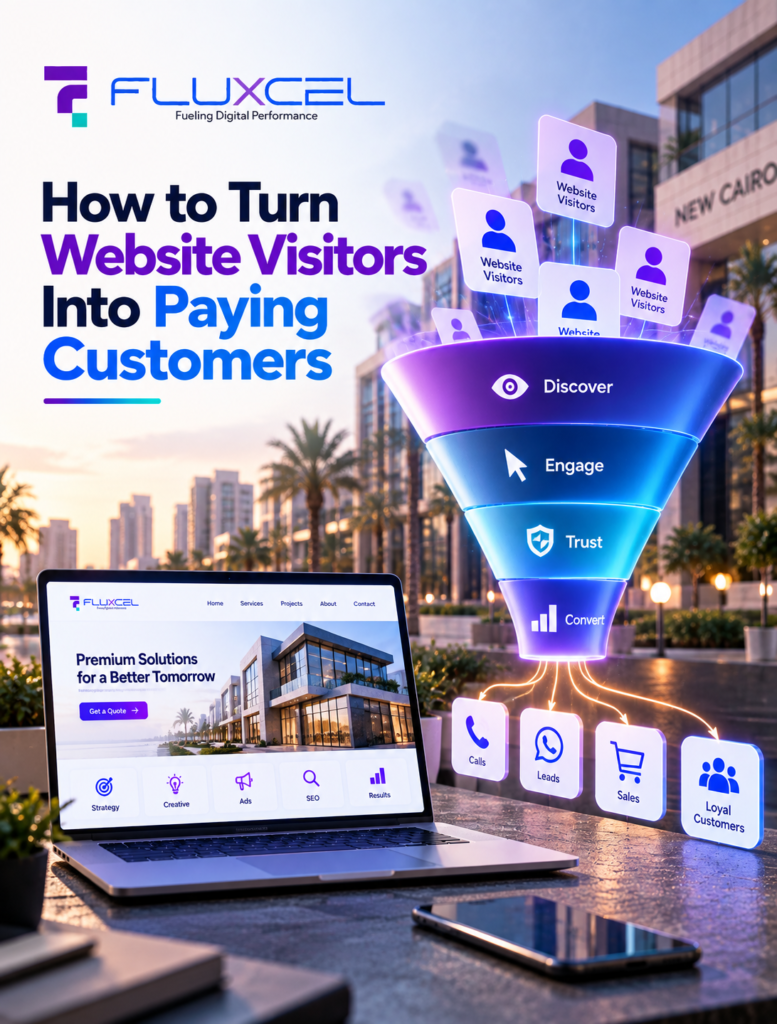
Getting people to visit your website is only part of digital marketing.
The real challenge begins after they arrive.
A business might invest heavily in SEO, Google Ads, Meta campaigns, and social media to generate thousands of website visits every month. But if those visitors leave without calling, messaging, booking, requesting a quote, or making a purchase, traffic alone has little business value.
For companies competing in New Cairo, where customers can compare several businesses within minutes, your website needs to do more than look professional. It needs to help visitors understand your value, trust your business, and confidently take the next step.
A Digital marketing agency New Cairo businesses work with should therefore focus not only on bringing people to a website but also on what happens after the click.
Why Website Traffic Doesn’t Always Lead to Sales
More traffic sounds like the obvious answer when a business wants more customers.
Sometimes it is.
But imagine doubling your website traffic while maintaining a very low conversion rate. You may simply be doubling the number of people who visit and leave.
Before spending more money to attract additional visitors, businesses should understand why existing traffic is not converting.
Common problems include:
- Slow website speed
- Confusing navigation
- Weak messaging
- Poor mobile experience
- Unclear calls-to-action
- Complicated forms
- Lack of trust signals
- Irrelevant traffic
- Weak product or service pages
The objective is to identify and remove these barriers.
Make Your Value Clear Immediately
When someone reaches your website, they should not need to spend a minute figuring out what your company does.
Your first screen matters.
A visitor should quickly understand three things:
What do you offer?
Why should they care?
What should they do next?
Avoid Generic Website Messaging
Statements such as:
“Welcome to our website.”
“We provide the highest quality.”
“We are your trusted partner.”
may sound professional, but they communicate very little.
Instead, focus on the customer’s needs.
A stronger message connects your service with an outcome.
If you help companies generate qualified leads, say that.
If you offer premium offices in New Cairo, make that clear.
If you provide same-day appointments, highlight the convenience.
Clarity usually converts better than cleverness.
Understand Where Your Visitors Come From
Not every website visitor arrives with the same intention.
Someone clicking a Google Search Ad may already be actively looking for your service.
Someone arriving from Instagram may only be discovering your brand.
A visitor reading an educational blog may still be researching.
These audiences should not necessarily receive exactly the same experience.
Match Landing Pages With Campaign Intent
Suppose your advertisement promotes a specific service.
The click should ideally lead to a page focused on that service—not your general homepage.
The headline, visuals, benefits, and CTA should continue the message from the advertisement.
This creates consistency.
When the ad promises one thing and the landing page immediately delivers it, visitors are less likely to feel confused.
Make Mobile Experience a Priority
For many businesses, a large percentage of digital traffic comes from mobile devices.
That means your website cannot simply be a desktop design squeezed onto a smaller screen.
Test the actual customer experience.
Can visitors easily read the text?
Are buttons large enough to tap?
Does the page load quickly?
Can someone fill out a form without struggling?
Is the WhatsApp or call button easy to find?
Are images slowing down the page?
A poor mobile experience can waste traffic generated by otherwise successful campaigns.
Use Strong Calls-to-Action
One of the simplest conversion improvements is making the next step obvious.
Do not assume visitors know what you want them to do.
Tell them.
Depending on your business, your CTA might be:
- Book an Appointment
- Request a Quote
- Shop Now
- Call Us
- Send a WhatsApp Message
- Schedule a Consultation
- View Available Units
- Get Started
Focus on One Primary Action
Too many choices can create unnecessary friction.
If a page asks visitors to subscribe, download something, call, message, browse another service, follow Instagram, and request a quotation all at once, the main objective becomes unclear.
Decide which action matters most and make it prominent.
Secondary options can still exist, but they should not compete with the primary conversion goal.
Build Trust Throughout the Website
Before buying, customers naturally ask themselves:
Can I trust this company?
Your website should help answer that question.
Add Relevant Trust Signals
Depending on your industry, these may include:
- Customer reviews
- Testimonials
- Previous clients
- Case studies
- Certifications
- Project examples
- Real team photos
- Contact information
- Business location
- Guarantees
- Secure payment methods
The stronger the purchase commitment, the more important trust becomes.
A customer choosing an expensive service will usually need more reassurance than someone buying a low-cost product.
Improve Your Service and Product Pages
Your pages should do more than list features.
They should help customers make decisions.
Explain the Benefit Behind the Feature
Suppose a product has a specific technical feature.
Why should the customer care?
Translate technical details into practical value.
Instead of simply saying:
“24/7 support.”
Explain the benefit:
“Get support whenever you need it, without waiting for normal business hours.”
The feature provides information.
The benefit provides a reason to care.
Strong pages usually communicate both.
Keep Forms Simple
Every additional form field creates a little more work for the visitor.
Sometimes additional information is necessary for lead qualification, but businesses should avoid asking for information they do not actually need.
If your sales team only requires:
- Name
- Phone number
- Service of interest
you may not need a 15-field form.
Shorter forms can make it easier for interested visitors to take the first step.
More detailed information can be collected later during the sales process.
Use Content to Answer Objections
Potential customers often hesitate because they still have unanswered questions.
Good website content can address those concerns before the customer contacts you.
Consider creating sections around:
Pricing
If you cannot publish exact prices, explain what affects the cost.
Process
Show customers what happens after they contact you.
Timing
Explain how long the service, delivery, or implementation usually takes.
Frequently Asked Questions
Answer the questions your sales team receives repeatedly.
This helps visitors feel more informed and can reduce unnecessary friction in the decision-making process.
Bring Interested Visitors Back
A visitor leaving your website does not always mean the opportunity is lost.
Many customers need multiple interactions before converting.
Retargeting can reconnect your brand with people who previously showed interest.
For example, you could create audiences based on:
- All website visitors
- Specific service-page visitors
- Product viewers
- Cart abandoners
- Previous leads
- High-intent page visitors
The follow-up message should reflect what they already know about your business.
Someone who visited a specific service page may respond better to a testimonial or case study than another generic brand-awareness advertisement.
Track Conversions Properly
You cannot improve what you cannot measure.
Businesses sometimes focus heavily on traffic while failing to track the actions that matter.
A Digital marketing agency New Cairo businesses partner with should help ensure that important website events are measured correctly.
Depending on the business, these might include:
- Form submissions
- Phone calls
- WhatsApp clicks
- Purchases
- Appointment bookings
- Add-to-cart actions
- Quote requests
- Downloads
Once these actions are tracked, businesses can understand which campaigns and traffic sources are actually producing results.
Look Beyond Conversion Rate
Conversion rate is important, but it should not be viewed alone.
Suppose one traffic source converts at 8% but generates low-value customers.
Another converts at 4% but consistently produces customers with significantly higher order values.
The second channel could be more valuable.
This is why marketing data should eventually connect with business outcomes such as revenue and customer quality.
Useful metrics include:
- Conversion rate
- Cost per conversion
- Qualified lead rate
- Customer acquisition cost
- Average order value
- Lead-to-sale rate
- Revenue by channel
This gives businesses a more complete view of performance.
Test Instead of Guessing
Sometimes small website changes can produce meaningful improvements.
But decisions should ideally be based on evidence rather than personal preference.
Businesses can test elements such as:
- Headlines
- CTA wording
- Page layouts
- Forms
- Offers
- Images
- Testimonials
- Landing page copy
Not every test will produce a dramatic improvement.
The advantage comes from continuous learning.
Small gains in conversion rate can become especially valuable when your website receives significant traffic.
Connect Marketing, Website, and Sales
Website optimization should not happen in isolation.
Your advertisements influence who visits.
Your website influences who converts.
Your sales process influences who becomes a customer.
If any part of that journey is weak, overall performance suffers.
This is why working with a Digital marketing agency New Cairo companies can partner with should involve more than simply managing advertising platforms.
The bigger opportunity is improving the entire path between the first click and the final sale.
Turn More of Your Existing Traffic Into Revenue
Businesses often assume growth requires more traffic, more content, or a bigger advertising budget.
Sometimes the bigger opportunity is already sitting inside the traffic you have.
Improving your messaging, mobile experience, landing pages, trust signals, CTAs, tracking, and follow-up process can help turn more existing visitors into genuine business opportunities.
The goal is not simply to attract clicks.
It is to create a digital journey that makes taking the next step easy.
At Fluxcel Digital Marketing Agency, we build digital strategies around the complete customer journey—from attracting the right audience to improving conversion and measuring the business results that follow.