
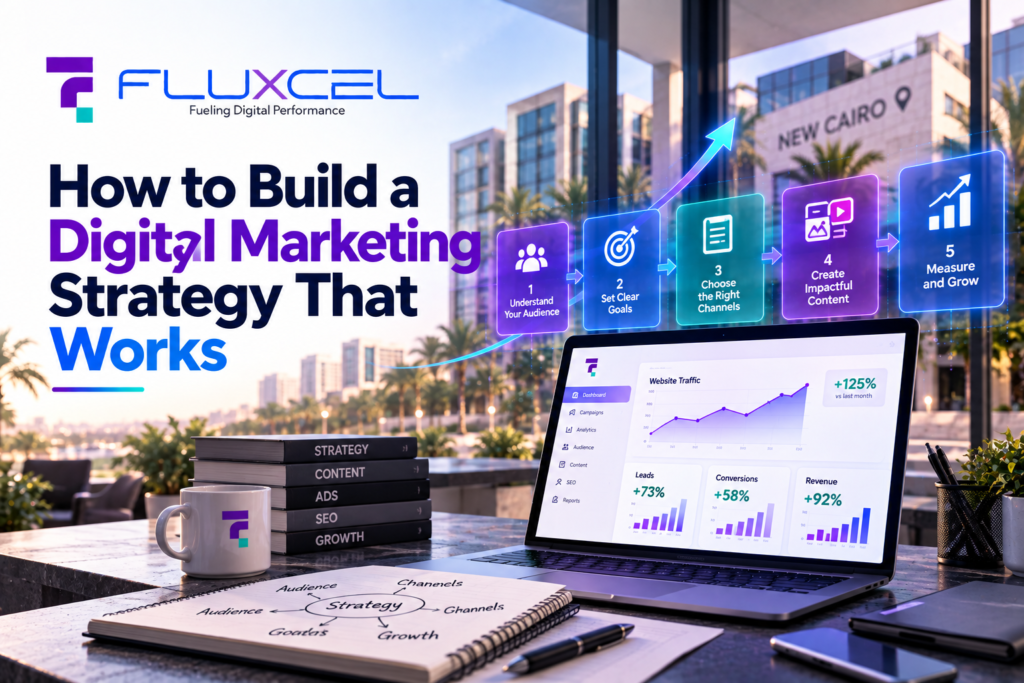
Digital marketing can become complicated very quickly.
One month, a business focuses on Instagram. The next month, it starts Google Ads. Then TikTok becomes the priority. More content gets produced, budgets increase, new campaigns launch—and yet the business still struggles to answer one basic question:
Is our digital marketing actually helping us grow?
The problem is often not the channels themselves. It is the lack of a clear strategy connecting them.
A successful digital marketing strategy should give every campaign, platform, piece of content, and advertising budget a specific role. Instead of doing more marketing, the goal is to make every activity work toward the same business objectives.
For companies competing in one of Egypt’s fastest-growing commercial areas, working with a Digital marketing agency New Cairo businesses understand can help turn scattered marketing activities into a structured growth plan.
Start With Business Goals, Not Marketing Channels
A common mistake is beginning with questions like:
“Should we advertise on TikTok?”
“Should we post more Reels?”
“Do we need Google Ads?”
Those questions matter, but they come later.
The first question should be:
What does the business actually need to achieve?
Marketing objectives should connect directly to business goals.
For example, your objective could be to:
- Generate more qualified leads
- Increase online sales
- Drive showroom visits
- Increase appointment bookings
- Enter a new market
- Launch a new product
- Improve customer retention
- Build awareness in New Cairo
Once the goal is clear, choosing the right marketing channels becomes much easier.
Understand Who You’re Trying to Reach
Good marketing becomes difficult when the audience is defined as “everyone.”
Even businesses with products that appeal to a broad market usually have certain customer groups that are more valuable than others.
Build Useful Customer Profiles
You do not need to create complicated documents filled with assumptions.
Start with real information.
Look at your current customers and identify patterns such as:
- Where they live
- Their age range
- What they usually purchase
- How they discovered you
- What questions they ask
- What influences their decisions
- What objections they have
- How long they take to convert
The more clearly you understand the customer, the easier it becomes to create marketing that feels relevant.
Research Your Competitive Landscape
New Cairo has become highly competitive across industries including real estate, healthcare, hospitality, education, fitness, retail, restaurants, and professional services.
Your customers are rarely evaluating your business alone.
They are comparing you with alternatives.
That makes competitor research an important part of strategy.
Look Beyond Competitors’ Follower Counts
Study how competitors position themselves online.
Ask:
What message do they communicate?
Which services do they prioritize?
How strong is their website?
What keywords do they appear for on Google?
What kind of social content generates engagement?
What offers are they promoting?
How do customers review them?
The objective is not to copy competitors.
It is to understand the market and identify opportunities to differentiate your business.
Develop a Clear Brand Position
Why should someone choose your company instead of another business offering something similar?
If that question is difficult to answer, your customers may have the same problem.
Strong positioning gives people a reason to remember your business.
Your positioning could be based on factors such as:
- Expertise
- Convenience
- Premium quality
- Price
- Customer experience
- Innovation
- Specialization
- Speed
- Location
Whatever your advantage is, it should appear consistently throughout your digital presence.
Your website, advertisements, social content, and sales communication should feel like they come from the same brand.
Choose Channels Based on Customer Intent
Being active everywhere is not automatically better.
Every digital platform has strengths and weaknesses.
The right channel depends on your audience and what you want them to do.
Google Search
Google can be highly effective when customers already know what they need.
Someone searching for a service is demonstrating intent.
SEO and Google Search Ads can help businesses appear during these high-intent moments.
Meta
Facebook and Instagram can work across several stages of the customer journey.
They can introduce your brand to new audiences, build familiarity through content, generate leads, drive e-commerce purchases, and retarget previous visitors.
TikTok
TikTok can be powerful when visual storytelling, demonstrations, trends, or creator-style content suit the brand.
However, simply being present on TikTok does not guarantee results. Creative quality and audience fit matter.
For B2B businesses, professional services, corporate solutions, and certain high-value products, LinkedIn can help businesses reach decision-makers in a more professional environment.
A Digital marketing agency New Cairo companies partner with should recommend channels based on the customer journey—not simply because a platform is popular.
Build Content Around Customer Questions
Businesses often struggle with content because they continuously ask:
“What should we post today?”
A better question is:
“What does our customer need to know?”
Customer questions can become an almost endless source of useful content.
If customers frequently ask about price, explain what affects pricing.
If they struggle to understand the difference between two services, create a comparison.
If they worry about the process, show them how it works.
Create Content With Different Purposes
Your content strategy can include:
- Educational posts
- Short-form videos
- Product demonstrations
- Customer testimonials
- FAQs
- Case studies
- Industry insights
- Behind-the-scenes content
- Offers
- Brand stories
Different content serves different stages of the customer journey.
That is much more effective than publishing random posts simply to keep the page active.
Connect Paid Advertising to the Funnel
Advertising should amplify a strategy—not replace one.
Before increasing your media budget, make sure the customer journey makes sense.
Imagine spending thousands of pounds on advertising that sends customers to a confusing landing page.
More budget will not solve that problem.
Instead, consider the full journey:
Ad → Landing Page → Action → Follow-Up → Sale
Every stage matters.
Match Campaigns to Customer Intent
Cold audiences may need educational or problem-focused creative.
People who already know your business may respond better to proof, benefits, testimonials, or comparisons.
Customers who are close to purchasing may need a stronger offer or clearer call-to-action.
This is why one advertisement should not be expected to work equally well for everyone.
Don’t Ignore SEO
Paid advertising provides immediate visibility, but the moment you stop spending, much of that visibility disappears.
SEO works differently.
A strong SEO strategy builds organic visibility over time.
Businesses can create pages targeting relevant services, locations, customer questions, and search terms.
For example, a company targeting customers in New Cairo can build content around searches that combine its service with local intent.
The objective should not be to insert keywords everywhere.
Google and customers both benefit from useful content that genuinely answers the searcher’s question.
Create Landing Pages That Convert
Getting someone to click is only half the job.
The landing page needs to continue the conversation started by the advertisement or search result.
A strong landing page should quickly communicate:
What You’re Offering
Don’t make visitors search for the main message.
Why It Matters
Explain the value rather than simply listing features.
Why They Should Trust You
Use reviews, results, previous clients, certifications, case studies, or other relevant proof.
What They Should Do Next
Use a clear CTA.
Avoid presenting five different actions when one primary action would be enough.
Build a Follow-Up Process
Marketing does not end when a lead arrives.
This is one of the most overlooked parts of digital strategy.
If your company generates leads but waits two days to respond, campaign optimization alone will not fix the problem.
Businesses should define:
- Who receives new leads
- How quickly they should respond
- Which channel they use
- How many follow-ups happen
- How leads are qualified
- How sales outcomes are tracked
Marketing and sales should work together.
Otherwise, valuable opportunities can disappear after the campaign has already done its job.
Measure the Metrics That Affect Growth
Digital marketing platforms provide hundreds of metrics.
You do not need to obsess over all of them.
Focus on numbers connected to your objective.
For lead generation, these may include:
- Qualified leads
- Cost per qualified lead
- Conversion rate
- Cost per customer
- Lead-to-sale rate
For e-commerce, you might prioritize:
- Revenue
- Conversion rate
- Customer acquisition cost
- Average order value
- Return on ad spend
- Repeat purchase rate
Likes and followers can provide useful context, but they should not replace business metrics.
Review and Improve Your Strategy Regularly
A digital marketing strategy is not something you create once and follow forever.
Markets change.
Competitors change.
Customer behavior changes.
Platforms change.
And your own business priorities will evolve.
Regular performance reviews help identify what deserves more investment and what needs improvement.
A strong Digital marketing agency New Cairo businesses work with should continuously use performance data to refine creative, audiences, budgets, landing pages, content, and channel allocation.
Build a Strategy Around Growth, Not Activity
The best digital strategies are not necessarily the ones using the most platforms or producing the most content.
They are the ones where every activity has a reason to exist.
Your audience informs your messaging.
Your goals determine your channels.
Your content builds trust.
Your advertising creates opportunities.
Your website supports conversion.
Your data guides the next decision.
When those pieces connect, digital marketing becomes easier to understand, measure, and scale.
At Fluxcel Digital Marketing Agency, we create customized strategies around each company’s market, goals, audience, and growth opportunities rather than relying on one-size-fits-all marketing packages.