
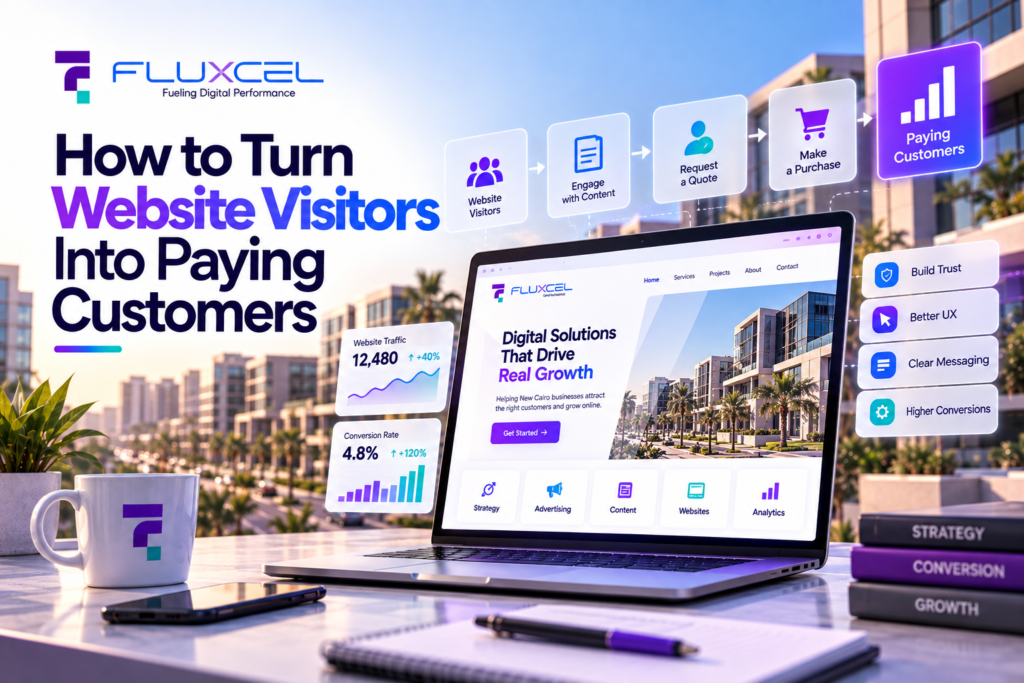
Getting people to your website is only half the job.
You can invest in Google Ads, Meta campaigns, SEO, social media, and content marketing to attract thousands of visitors. But if those visitors arrive and leave without calling, messaging, booking, requesting a quote, or making a purchase, that traffic isn’t creating enough value for your business.
The problem isn’t always your advertising.
Sometimes, the biggest opportunity is what happens after the click.
For businesses in New Cairo, improving website conversion can make existing marketing budgets work harder without necessarily spending more to attract additional traffic.
A Digital marketing agency New Cairo businesses work with should therefore look beyond traffic numbers and understand whether the website is actually helping turn attention into customers.
Traffic Doesn’t Automatically Mean Growth
Website traffic is useful, but it’s easy to focus too heavily on the number of visitors.
Imagine two businesses.
One receives 10,000 website visitors per month and generates 100 inquiries.
Another receives 5,000 visitors but generates 200 inquiries.
The second website has half the traffic but twice the number of potential customers.
That’s why businesses should think about conversion rate, not just traffic.
Your conversion rate tells you how effectively your website encourages visitors to complete an important action.
Depending on your business, that action might be:
- Making a purchase
- Requesting a quotation
- Booking an appointment
- Calling your business
- Sending a WhatsApp message
- Completing a lead form
- Scheduling a consultation
- Registering for a service
The goal isn’t simply to bring more people to your website. It’s to make more of the right visitors take the next step.
Make Your Value Clear Immediately
When someone lands on your website, they shouldn’t need to investigate for several minutes to understand what your company does.
Your first screen should communicate the essentials quickly.
Visitors should be able to answer:
What does this business offer?
Is it relevant to me?
Why should I care?
What should I do next?
If your website starts with vague statements such as “Welcome to our website” or “We provide innovative solutions,” you’re using valuable space without giving customers much information.
Focus on the Customer’s Problem
Strong website messaging usually focuses on the customer’s desired outcome rather than simply describing the company.
Instead of:
“We are a leading provider of professional solutions.”
A stronger message might explain exactly what the service helps customers achieve.
Clarity usually beats cleverness.
Customers should understand your value before they are asked to explore the rest of the website.
Give Every Page a Clear Purpose
Not every page needs to sell directly, but every important page should have a reason to exist.
A service page might encourage visitors to request a consultation.
A product page should help customers decide whether to buy.
A blog can educate visitors and direct them toward a relevant service.
A portfolio page can build confidence before encouraging an inquiry.
When pages don’t have a clear objective, visitors can reach the bottom and wonder:
“What do I do now?”
That’s where calls-to-action become important.
Use Clear Calls-to-Action
Your CTA should tell visitors exactly what happens next.
Examples include:
- Request a Quote
- Book a Consultation
- Shop Now
- Talk to Our Team
- Schedule an Appointment
- Send Us a Message
- Discover Our Services
Avoid placing too many competing actions in the same area.
If visitors have five equally prominent buttons, deciding what to click can become unnecessarily difficult.
Reduce Friction Wherever Possible
Every additional obstacle between interest and action creates an opportunity for a customer to leave.
Consider a lead form.
Do you really need 12 fields before someone can contact you?
If you only need their name, phone number, email, and a brief description of what they need, asking for unnecessary information can make the process feel like work.
The same principle applies to e-commerce.
A confusing checkout, unexpected costs, difficult navigation, or unclear delivery information can interrupt a purchase that was already close to completion.
Review the Journey Yourself
Go through your website like a first-time customer.
Try completing the main conversion action on both desktop and mobile.
Ask:
- Is anything confusing?
- Does anything take too long?
- Are important buttons easy to find?
- Does the form work properly?
- Are contact options obvious?
- Is pricing explained where appropriate?
- Can customers find important information quickly?
Small problems often become invisible when you work with the website every day.
Your customers don’t have that familiarity.
Build Trust Before Asking People to Convert
A visitor might like your service and still hesitate.
Why?
Because interest and trust are different things.
Before giving you their money or contact information, customers often look for evidence that your business is credible.
Your website should provide that evidence.
Add the Right Trust Signals
Depending on your industry, these might include:
- Customer testimonials
- Google reviews
- Client logos
- Case studies
- Previous projects
- Certifications
- Team profiles
- Real business photography
- Product reviews
- Frequently asked questions
Avoid relying entirely on claims such as “high quality” or “trusted service.”
Show customers why they should believe those claims.
For a service company, a detailed case study may be more persuasive than a generic slogan.
For e-commerce, verified reviews and clear product information can reduce uncertainty.
For a local business, strong customer feedback and an established online presence can help reassure new visitors.
Make Mobile Conversion a Priority
A website might look impressive on a large desktop monitor and still perform poorly for customers.
Why?
Because many visitors are browsing from their phones.
Mobile users have less screen space and are often less patient with complicated experiences.
Buttons need to be easy to tap.
Text needs to be readable.
Forms need to work properly.
Menus should be simple.
Pages should load quickly.
A Digital marketing agency New Cairo businesses partner with should consider mobile behavior throughout the entire customer journey, especially when campaigns are heavily driven by social media.
If most of your advertising traffic comes from Instagram or Facebook, there’s a good chance many visitors are opening your website on mobile.
Match Your Landing Page to Your Advertisement
Imagine clicking an advertisement promoting a specific service and landing on a generic homepage.
Now you have to search for the service yourself.
Some visitors will.
Others won’t.
A better approach is to maintain continuity between the advertisement and the destination page.
If your ad talks about a specific service, the landing page should continue that conversation.
The headline, visuals, benefits, and CTA should feel connected to what encouraged the visitor to click.
This is sometimes called message match.
It reduces confusion and reassures users that they’ve reached the right place.
Answer Questions Before Customers Ask Them
Customers often leave websites because important information is missing.
They might wonder:
How does the service work?
Who is it suitable for?
How long does it take?
What happens after I contact you?
Do you serve my area?
What makes you different?
Can I trust the quality?
Instead of waiting for potential customers to contact you with every question, answer common concerns directly on the website.
Use FAQs Strategically
Frequently asked questions shouldn’t simply be added because every website has them.
Use them to address genuine barriers to conversion.
Talk to your sales or customer service team.
Ask which questions prospects repeatedly ask before purchasing.
Those questions can reveal exactly what your website needs to explain better.
Improve Website Speed
Customers expect websites to respond quickly.
A slow page creates friction before visitors even see your offer.
Large images, unnecessary scripts, poorly configured plugins, excessive animations, and technical issues can all affect performance.
Website speed also becomes particularly important when you’re paying for traffic.
If advertising brings someone to your website and the page takes too long to become usable, part of that advertising budget is effectively being wasted.
Keep the experience fast, clean, and focused.
Use Data to Find Conversion Problems
Guessing can only take you so far.
Website analytics can help reveal where visitors are struggling.
Look at metrics such as:
- Conversion rate
- Landing page performance
- Traffic sources
- Engagement
- Form submissions
- Purchases
- Checkout behavior
- Device performance
- Exit patterns
You can then start asking better questions.
If a landing page receives strong traffic but few inquiries, does the page need improvement?
If mobile conversion is much lower than desktop, is there a mobile usability problem?
If one traffic source converts significantly better than another, should your budget allocation change?
Data helps turn those questions into actionable decisions.
Test Before Making Major Assumptions
Sometimes a small change can have a meaningful impact on conversion.
Instead of redesigning your entire website based on assumptions, test individual elements where possible.
You might experiment with:
- Different headlines
- Different CTAs
- Shorter lead forms
- New landing page layouts
- Stronger testimonials
- Different offers
- New product photography
- Different page structures
The objective is continuous improvement.
Even a modest increase in conversion rate can become significant when applied across thousands of visitors.
Don’t Forget What Happens After the Lead
Website conversion doesn’t necessarily end when someone submits a form.
If your team takes two days to respond to an inquiry, you may lose a customer the website successfully generated.
Think about the entire process:
Visitor → Lead → Qualified Lead → Sales Conversation → Customer
Marketing and sales need to connect.
CRM systems, automated confirmations, WhatsApp communication, email follow-ups, and clear internal processes can all help ensure opportunities don’t disappear after conversion.
Get More Value From the Traffic You Already Have
Businesses often assume growth requires more traffic.
Sometimes it does.
But before spending more money attracting additional visitors, it makes sense to ask whether you’re getting enough value from the visitors you already have.
Improve your messaging.
Strengthen trust.
Simplify forms.
Make mobile experiences easier.
Create focused landing pages.
Answer customer questions.
Track conversions.
And continuously test what works.
A strategic Digital marketing agency New Cairo businesses work with should consider the entire journey—from the advertisement or Google search that generates the click to the website experience that turns that visitor into a genuine business opportunity.
At Fluxcel, we don’t look at traffic as the final result. We connect digital advertising, SEO, content, website experience, and conversion strategy around your actual business goals.