
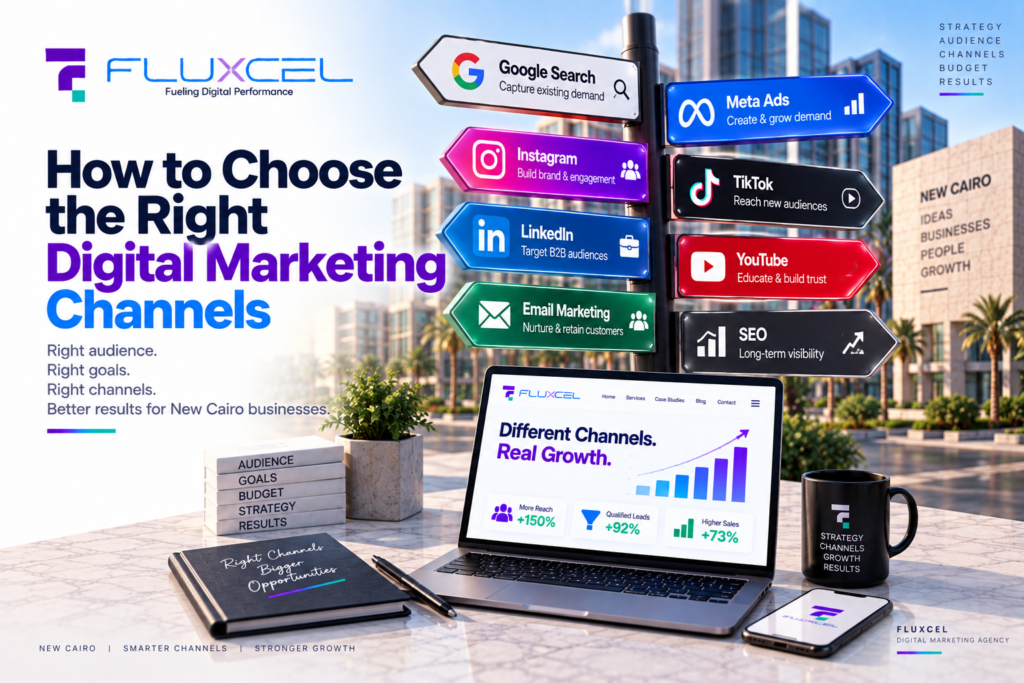
One of the biggest advantages of digital marketing is the number of ways businesses can reach customers.
It’s also one of the biggest challenges.
Should you invest more in Google Ads or Meta Ads? Does your business need TikTok? Should you focus on SEO? Is LinkedIn worth the investment? What about email marketing, YouTube, or remarketing?
With so many options available, businesses can easily spread their budgets across too many platforms without understanding what each one is supposed to achieve.
The answer isn’t to use every channel.
It’s to choose the channels that make sense for your customers, business objectives, budget, and stage of growth.
For companies operating in New Cairo, this becomes particularly important as competition for digital attention continues to increase. A Digital marketing agency New Cairo businesses work with should help determine where marketing investment has the greatest potential instead of recommending platforms simply because they are popular.
Start With Your Customer, Not the Platform
Marketing decisions often begin with questions such as:
“Should we start TikTok?”
“Should we increase our Instagram budget?”
“Do we need Google Ads?”
A better first question is:
Where and how do our customers look for businesses like ours?
A customer searching Google for an emergency dental clinic behaves very differently from someone discovering a new fashion brand while scrolling through Instagram.
Likewise, a business owner researching software or professional services may be more receptive to LinkedIn or Google Search than entertainment-focused social content.
Understand Customer Behavior
Before selecting channels, consider:
- Where does your audience spend time online?
- What platforms do they use for research?
- Do they actively search for your service?
- How long does the buying decision take?
- Do customers need education before purchasing?
- Is the purchase emotional, practical, or both?
- Do customers compare several providers?
These answers help narrow down which channels deserve attention.
Define What You Want Marketing to Achieve
Different channels are better suited to different objectives.
A business trying to generate immediate leads may require a different channel mix from a new brand trying to build awareness.
Start with the business goal.
Common objectives include:
- Increasing brand awareness
- Generating qualified leads
- Driving online sales
- Increasing store visits
- Booking appointments
- Building an audience
- Entering a new market
- Increasing repeat purchases
Once the objective is clear, channel selection becomes more strategic.
Use Google Search to Capture Existing Demand
Google Search can be particularly powerful when customers already know what they need.
Someone searching for a product, service, clinic, restaurant, agency, or solution is actively expressing intent.
That makes search valuable for businesses where customers commonly research before making a decision.
When Google Ads Can Make Sense
Google Ads can work well when:
- People actively search for your service
- Search intent is commercially valuable
- You need visibility relatively quickly
- You have clear conversion actions
- You can measure leads or sales
However, strong search intent doesn’t guarantee strong performance.
Keywords, advertising copy, landing pages, offers, conversion tracking, and follow-up all influence results.
Build Long-Term Visibility With SEO
Google Ads can place your business in front of customers quickly, but you pay for traffic.
SEO takes a different approach.
By improving website structure and publishing useful, optimized content, businesses can build organic visibility for relevant searches over time.
Think of SEO as a Long-Term Asset
SEO may include:
- Service page optimization
- Local SEO
- Blog content
- Technical improvements
- Internal linking
- Keyword targeting
- Website experience improvements
Unlike a paid campaign, a well-performing organic page doesn’t immediately disappear when you stop spending on advertising.
That’s why SEO can become increasingly valuable as the business grows.
A Digital marketing agency New Cairo companies work with should ideally balance immediate acquisition opportunities with longer-term organic growth.
Use Meta to Create and Capture Demand
Instagram and Facebook allow businesses to reach people based on demographics, interests, behaviors, engagement, and other available audience signals.
Unlike Google Search, users aren’t necessarily looking for your product when they see your advertisement.
That means the creative has a bigger job to do.
It needs to capture attention and create interest.
Meta Can Support Different Funnel Stages
Businesses can use Meta for:
Awareness: Introduce the brand.
Engagement: Build familiarity through useful or entertaining content.
Lead Generation: Encourage inquiries.
Sales: Promote products to relevant audiences.
Remarketing: Reconnect with people who already interacted with the business.
Strong creative and offers are essential because your advertisement is competing with everything else in someone’s feed.
Consider LinkedIn for B2B Marketing
For B2B companies, LinkedIn can provide access to professional audiences based on factors such as job roles, industries, and companies.
It can be particularly useful when the decision-maker is specific.
For example, a business might need to reach marketing managers, HR professionals, architects, business owners, or procurement teams.
Don’t Use LinkedIn Like Instagram
Professional audiences often respond better to content that provides genuine business value.
Consider sharing:
- Industry insights
- Case studies
- Research
- Company expertise
- Business challenges
- Practical solutions
- Project results
The objective should be to build authority and relevance rather than simply maintaining another social media profile.
Use TikTok When the Format Fits Your Audience
TikTok can create significant reach, particularly when businesses have products, services, or stories that translate naturally into short-form video.
But joining TikTok simply because the platform is popular isn’t a strategy.
Your business needs to be capable of producing content that fits how people use the platform.
That may include demonstrations, educational videos, transformations, behind-the-scenes content, trends, storytelling, or quick tips.
If your audience isn’t there—or your team cannot consistently produce suitable creative—your budget may be more valuable elsewhere.
Use YouTube for Deeper Education
Some products and services need more explanation than a short social post can provide.
YouTube can be valuable for businesses that benefit from demonstrations, tutorials, interviews, project walkthroughs, educational videos, or detailed explanations.
Video can also support customers during the consideration stage.
Someone may discover your company through another channel and later watch a detailed video before deciding whether to contact you.
This makes YouTube useful not only for awareness but also for trust-building.
Don’t Ignore Email Marketing
Businesses often focus so heavily on acquiring new customers that they forget about people they already know.
Email marketing can help nurture leads and maintain relationships with existing customers.
It can be used for:
- Offers
- Product launches
- Educational content
- Lead nurturing
- Abandoned carts
- Customer retention
- Repeat purchases
- Company updates
Email is especially valuable because the audience has already chosen to interact with the business.
That makes it very different from reaching a completely cold audience through advertising.
Use Remarketing Across Your Channel Mix
Most customers won’t convert the first time they discover your business.
They may visit the website, watch a video, interact with social media, compare alternatives, and return later.
Remarketing helps keep your business visible throughout that process.
Instead of repeatedly showing the same message, adjust communication based on previous behavior.
Someone who watched an introductory video may need more education.
Someone who visited a service page may need a case study.
Someone who abandoned checkout may need a reminder.
Remarketing makes multiple channels work together as part of one journey.
Match Channels to Customer Intent
One of the easiest ways to choose marketing channels is to think about intent.
High Intent
Customers are actively searching for a solution.
Channels such as Google Search and SEO can be particularly valuable here.
Medium Intent
Customers understand their problem and are exploring alternatives.
Social media, remarketing, email, YouTube, and detailed content can help influence their decision.
Lower Intent
Customers may not currently be thinking about your category.
Social advertising, video, influencer activity, and awareness campaigns can introduce the brand and create demand.
This doesn’t mean one platform belongs exclusively to one stage.
The point is to understand the role each channel plays.
Don’t Spread a Small Budget Too Thin
Using more platforms doesn’t automatically create better results.
Imagine having a limited monthly advertising budget and splitting it across Google, Meta, TikTok, LinkedIn, YouTube, and several other channels.
Each platform may receive too little budget to generate meaningful data or results.
It may be better to focus on two strong channels, learn what works, and expand gradually.
Prioritize Before You Expand
Ask:
- Where is customer intent strongest?
- Where does our audience spend time?
- Which channels can we execute well?
- What can we realistically afford?
- Which channels can we measure properly?
Focus creates better opportunities for learning and optimization.
Measure Channels by Business Results
Different platforms report performance differently.
One may highlight engagement. Another focuses on clicks. Another reports video views.
These numbers can make direct comparisons difficult.
Bring everything back to the business objective.
For lead generation, consider:
Cost per qualified lead → Lead-to-sale rate → Customer acquisition cost
For e-commerce:
Cost per acquisition → Average order value → Revenue → ROAS
For awareness:
Reach → Engagement → Branded search → Website activity → Assisted conversions
A Digital marketing agency New Cairo brands trust should evaluate channels based on their role in the customer journey, not isolated platform metrics.
Give Channels Enough Time to Generate Useful Data
Businesses sometimes launch a channel, run it briefly, and decide it doesn’t work.
But marketing systems need enough data to evaluate properly.
Creative needs testing.
Audiences need refinement.
Landing pages may require improvements.
Tracking needs validation.
At the same time, patience should not become an excuse for poor performance.
Set clear expectations and review results regularly.
If a channel consistently fails to contribute to your objectives despite meaningful testing, reconsider its role.
Let Your Channel Mix Evolve
The right channel mix today may not be the right one next year.
Customer behavior changes.
Platforms change.
Advertising costs change.
New competitors enter the market.
Your business also evolves.
A company initially focused on lead generation might later invest more heavily in brand building, SEO, customer retention, or new geographic markets.
Review your channel strategy regularly instead of treating it as a permanent decision.
Choose Fewer Channels, but Use Them Better
Successful digital marketing isn’t about appearing everywhere.
It’s about being present in the places that matter to your customers and using each channel for a clear purpose.
Understand your audience. Define your objectives. Capture existing demand through search. Create demand through social media. Build long-term visibility with SEO. Nurture relationships through email. Use video where deeper education matters. And connect everything through remarketing and measurement.
The strongest channel strategy is not necessarily the one with the most platforms.
It’s the one where every platform has a reason to be there.
At Fluxcel Digital Marketing Agency, we help businesses choose and connect the right combination of SEO, paid advertising, social media, content, email, and conversion strategies based on their audience and objectives.