
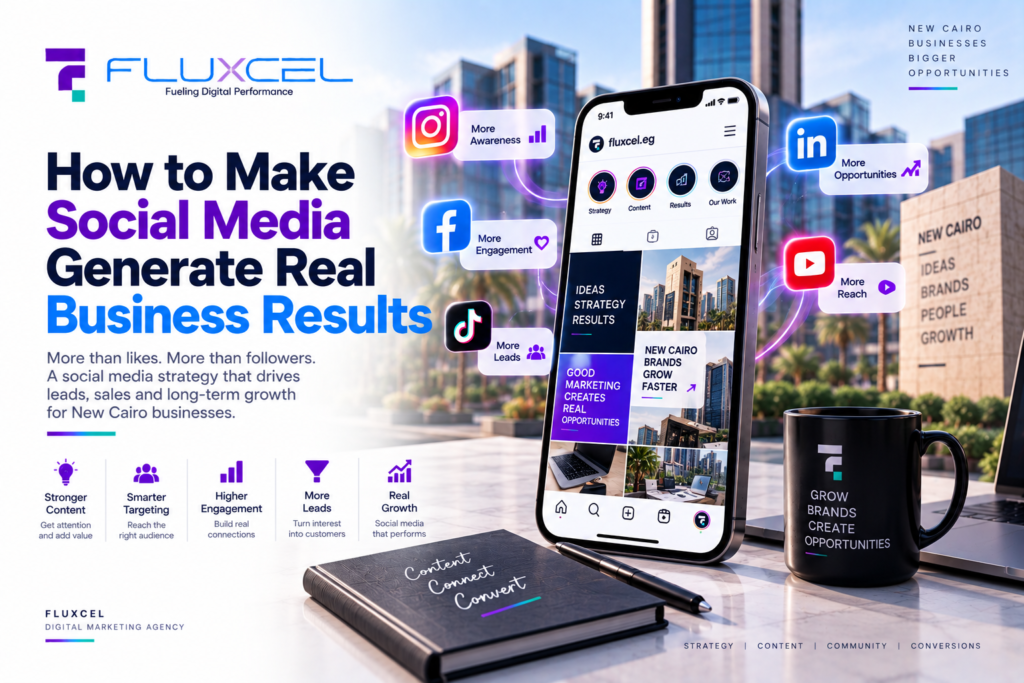
Social media is one of the first places businesses turn when they want to improve their digital presence.
Create an Instagram account. Start a Facebook page. Post several times a week. Produce Reels. Run some ads. Watch the follower count increase.
But after months of activity, many businesses face the same problem:
The page is active, but where are the business results?
Likes, views, comments, and followers can be useful signals, but they are not the final objective for most companies. Social media should help increase awareness, build trust, generate demand, attract qualified leads, support sales, and strengthen customer relationships.
For businesses in New Cairo, where customers are constantly discovering and comparing brands online, social media can play an important role in the buying journey.
The key is to stop treating it as a publishing schedule and start treating it as a business channel.
A Digital marketing agency New Cairo businesses work with should connect social media activity to clear objectives instead of measuring success only by engagement.
Start With a Business Objective
Before creating another content calendar, determine what you actually want social media to achieve.
Different businesses will have different priorities.
A restaurant may want more reservations and visits.
A real estate company may want qualified property inquiries.
A dental clinic might focus on appointment bookings.
An e-commerce brand may prioritize purchases.
A B2B company might use social media to build credibility and generate leads.
Without a clear objective, content easily becomes random.
Connect Content to the Goal
If your goal is lead generation, your content should create interest in your services and give people clear opportunities to inquire.
If your goal is brand awareness, your priority may be reach, memorable creative, educational content, and consistent positioning.
If your goal is sales, product-focused content, offers, social proof, retargeting, and conversion campaigns become more important.
Every post doesn’t need to generate a sale, but the overall content strategy should support the business objective.
Understand Why Your Audience Uses Social Media
People don’t usually open Instagram because they want to see advertisements.
They open it to discover, learn, communicate, follow interests, and be entertained.
Brands are competing with friends, creators, news, entertainment, and thousands of other pieces of content.
That means your content needs to earn attention.
Create Content for the Audience, Not the Company
Instead of asking:
“What do we want to post?”
Ask:
“What would our customers actually want to see?”
Think about their questions, frustrations, interests, buying concerns, and aspirations.
This shift can dramatically improve the relevance of your content.
Stop Making Every Post an Advertisement
Imagine following a brand that posts nothing except:
“Buy now.”
“Book today.”
“Limited offer.”
“Contact us.”
Eventually, the content becomes easy to ignore.
Promotional posts are necessary, but they should be supported by content that gives customers a reason to continue paying attention.
Create a Balanced Content Mix
Your social media strategy might include:
- Educational tips
- Customer questions and answers
- Product demonstrations
- Customer testimonials
- Case studies
- Behind-the-scenes content
- Industry insights
- Brand stories
- Offers
- Conversion-focused posts
Different content types perform different jobs.
Some attract attention. Others build credibility. Some create engagement, while others push customers toward conversion.
A Digital marketing agency New Cairo brands partner with should build a content system around these different roles.
Create Stronger Hooks
On social media, you often have only a few seconds to capture attention.
A beautiful design alone may not be enough.
The opening line, first frame, or first few seconds of a video need to give someone a reason to stop scrolling.
Instead of starting with your company name, begin with something relevant to the customer.
For example:
“Getting website traffic but no customers?”
“Your ads might not be the real problem.”
“Before increasing your marketing budget, check this.”
“Why are people clicking but not buying?”
These hooks immediately introduce a problem or question.
The rest of the content can then provide the answer.
Make Your Content Recognizable
Social media moves quickly.
A strong brand identity helps people recognize your content before they even read the account name.
Use consistent visual elements such as typography, colors, image style, layouts, and graphic treatments.
But consistency doesn’t mean every post should look identical.
The goal is to create a flexible visual system that still feels unmistakably connected to your brand.
Keep Your Tone Consistent Too
Brand recognition also comes from language.
Whether your brand is professional, energetic, educational, premium, friendly, or technical, maintain a recognizable tone across captions, videos, comments, and advertising.
Consistency builds familiarity.
And familiarity can contribute to trust.
Use Video to Explain, Not Just Entertain
Short-form video has become a major part of social media marketing.
But businesses sometimes chase trends without considering whether the content communicates anything useful about the brand.
Trends can help reach, but relevance matters more.
Use video to demonstrate products, answer questions, explain services, show processes, share customer stories, highlight projects, or simplify complex topics.
Get to the Point Quickly
Avoid long introductions.
If the first few seconds don’t give viewers a reason to continue, many will scroll away.
Start with the problem, result, question, or strongest visual.
Then deliver the value.
Turn Engagement Into a Customer Journey
Someone liking a post is not the end of the journey.
It can be the beginning.
Imagine someone watches your Reel, visits your profile, checks several posts, clicks your website, leaves, and then sees a retargeting advertisement a few days later.
That sequence can eventually produce a lead or sale.
Social media should therefore connect with your wider marketing ecosystem.
Create Clear Next Steps
Depending on the content, encourage users to:
- Visit your website
- Explore a service
- Send a message
- Save the post
- Read a guide
- Request a quote
- Book an appointment
- Shop online
Don’t force a sales CTA into every post.
Choose an action that makes sense for the customer’s current stage.
Combine Organic Social Media With Paid Advertising
Organic content and paid advertising work best when they support each other.
Organic content helps establish the brand, demonstrate expertise, communicate regularly, and build community.
Paid media allows businesses to reach larger or more targeted audiences.
Strong organic content can also reveal which messages resonate with customers.
Those insights can influence advertising creative.
Don’t Just Boost Everything
A post performing well organically does not automatically mean it should become an advertisement.
Paid campaigns need specific objectives.
Are you trying to generate awareness?
Website traffic?
Leads?
Sales?
Choose the campaign structure, creative, audience, and CTA based on that objective.
Use Social Proof to Reduce Customer Doubt
Customers naturally trust other customers.
Testimonials, reviews, before-and-after examples, case studies, user-generated content, and customer stories can make social media much more persuasive.
Instead of repeatedly telling people that your company provides great service, show evidence.
Social proof can be particularly valuable for customers who are already comparing several options.
It helps answer an important question:
“Can I trust this business?”
Respond to Your Audience
Social media is not supposed to be one-way communication.
Comments, direct messages, questions, and mentions provide opportunities to build relationships with potential customers.
Respond professionally and promptly.
A customer asking a question in the comments may be much closer to purchasing than someone who simply liked the post.
Your community management can influence how people perceive the entire brand.
Build Retargeting Audiences From Social Engagement
People who interact with your social media content have already shown some level of interest.
That makes them valuable audiences for future campaigns.
Depending on the platform and available tracking, businesses can build audiences around people who:
- Watched videos
- Engaged with posts
- Visited the profile
- Clicked through to the website
- Submitted a lead form
- Viewed products
Retargeting allows you to continue the conversation with more relevant messaging.
A Digital marketing agency New Cairo companies work with should consider how social engagement can contribute to the wider conversion funnel.
Don’t Judge Every Post by Likes
A post with fewer likes isn’t automatically unsuccessful.
For example, an educational post might generate saves and website clicks rather than comments.
A service post may reach fewer people but generate qualified inquiries.
A testimonial could influence customers without producing large engagement numbers.
Look at performance according to the purpose of the content.
Useful metrics might include:
- Reach
- Video watch time
- Saves
- Shares
- Profile visits
- Website clicks
- Messages
- Leads
- Purchases
- Cost per acquisition
The closer the metric is to your business objective, the more useful it becomes.
Learn From Your Best Content
Your social media analytics contain clues about what your audience actually wants.
Review your strongest posts.
What topics performed well?
Which hooks generated longer watch times?
Which formats produced more saves?
What content drove profile visits or website traffic?
Which posts generated inquiries?
Use these insights to improve future content.
You don’t need to reinvent the strategy every month.
Often, the better approach is to identify what works and build on it.
Turn Social Media Into a Growth Channel
Social media can generate far more than likes and followers.
It can introduce your business to new audiences, communicate your expertise, strengthen brand recognition, build trust, create demand, generate leads, and support sales.
But that requires a strategy.
Define the business objective. Understand your audience. Create content with different purposes. Build recognizable branding. Use stronger hooks. Connect organic content with paid advertising. Retarget engaged audiences. And measure performance beyond vanity metrics.
When social media becomes part of the wider customer journey, it becomes much more valuable to the business.
At Fluxcel Digital Marketing Agency, we help businesses connect social media strategy, content, creative, paid advertising, audience targeting, and conversion campaigns to measurable performance.