
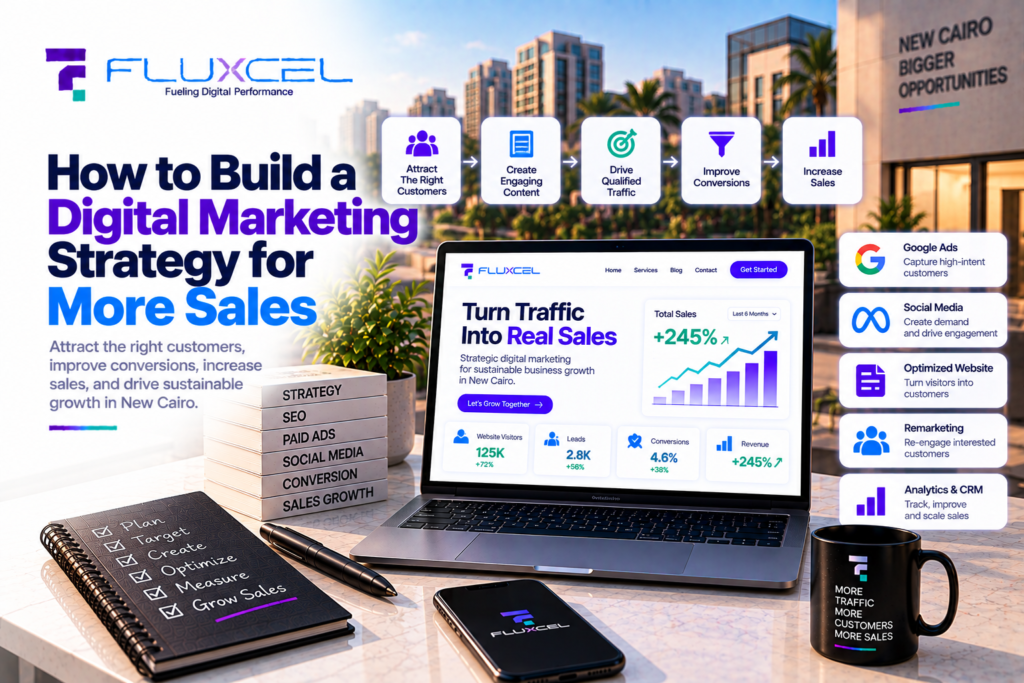
Getting more sales from digital marketing is not simply about increasing your advertising budget.
A business can generate thousands of website visits, receive strong social media engagement, and even collect hundreds of leads without seeing the sales growth it expected.
Why?
Because marketing activity and sales performance are not automatically the same thing.
To generate consistent revenue, every part of your digital strategy needs to work together—from targeting and messaging to website experience, lead nurturing, sales follow-up, and customer retention.
For businesses in New Cairo, this means moving beyond individual campaigns and creating a connected system designed around how customers actually make purchasing decisions.
A Digital marketing agency New Cairo businesses work with should not focus only on clicks, impressions, and leads. The strategy should connect those activities to real commercial outcomes.
Start With the Right Sales Goal
Before launching another campaign, define exactly what you want marketing to achieve.
“Get more sales” is a good direction, but it needs more detail.
For example, your goal could be to:
- Increase online purchases
- Generate more qualified sales inquiries
- Sell more of a specific product
- Increase appointment bookings
- Grow revenue from a particular service
- Increase repeat purchases
- Enter a new customer segment
The clearer the goal, the easier it becomes to build the right strategy around it.
Work Backward From the Sale
Instead of starting with the advertising platform, start with the final conversion.
Ask:
What needs to happen before someone becomes a customer?
For a service business, the journey might be:
Ad → Landing Page → Inquiry → Sales Call → Proposal → Customer
For an e-commerce business:
Ad → Product Page → Add to Cart → Checkout → Purchase
Understanding these steps helps identify where marketing needs to improve.
Understand Who Is Most Likely to Buy
More traffic does not necessarily mean more sales.
If your marketing attracts the wrong audience, increasing traffic may simply increase wasted budget.
Build a clear picture of your ideal customer.
Consider factors such as:
- Location
- Age or demographic profile
- Interests
- Business type
- Budget
- Customer needs
- Buying behavior
- Purchase motivation
But don’t stop with demographics.
The most important question is:
Why would this person buy from you?
Understanding motivation makes your marketing much stronger.
Focus on Customer Intent
Customers have different levels of readiness.
Someone watching an educational Reel may only be discovering a problem.
Someone searching Google for a specific service may already be comparing providers.
Your strategy should recognize this difference.
Low-Intent Customers
These customers may need:
- Educational content
- Videos
- Social media posts
- Brand awareness campaigns
- Guides
Medium-Intent Customers
They may respond to:
- Testimonials
- Case studies
- Comparisons
- Product demonstrations
- Detailed service information
High-Intent Customers
They may need:
- Pricing information
- Offers
- Product pages
- Landing pages
- Consultations
- Clear CTAs
Matching the message to customer intent can significantly improve marketing efficiency.
Build an Offer Customers Understand
Sometimes businesses have a traffic problem.
Other times, they have an offer problem.
If people are seeing your advertising but not taking action, ask whether the offer is clear enough.
Customers should understand:
What am I getting?
Why does it matter?
Why should I choose this company?
What should I do next?
Strong offers don’t always require discounts.
Value can come from convenience, expertise, quality, speed, service, customization, guarantees, or a better overall experience.
Use Google Search to Capture Existing Demand
Google Search can be particularly valuable because customers are actively looking for something.
Someone searching for a specific product or service may already have strong purchase intent.
This makes keyword selection extremely important.
Prioritize Commercial Intent
Compare:
“What is digital marketing?”
with:
“Digital marketing agency New Cairo.”
The first search is primarily informational.
The second suggests that the person may be looking for a provider.
Both can have value, but they serve different purposes.
A Digital marketing agency New Cairo companies work with should understand the difference between generating traffic and capturing purchasing intent.
Use Social Media to Create Demand
Search marketing captures demand that already exists.
Social media can help create demand before someone begins searching.
Platforms such as Instagram, Facebook, LinkedIn, and TikTok can introduce customers to:
- A problem
- A product
- A solution
- A brand
- An offer
This is especially useful for businesses selling products or services customers may not actively search for every day.
Lead With the Customer Problem
Instead of opening every advertisement with your company name, start with something the customer recognizes.
For example:
“Getting website traffic but still struggling to generate sales?”
The message immediately connects with a problem.
Then your business can introduce the solution.
Build Landing Pages Around One Objective
Sending every advertising campaign to your homepage can reduce conversions.
Your homepage usually has several purposes.
A campaign landing page should have one.
If you’re promoting a particular service, create a page specifically around that service.
The page should include:
- A strong headline
- Clear benefits
- Relevant information
- Trust signals
- Customer proof
- A clear offer
- One primary CTA
The visitor should immediately understand why they landed there.
Improve the Mobile Buying Experience
A significant part of the customer journey can happen on smartphones.
If your website is difficult to use on mobile, potential customers may leave before completing the action.
Test the complete journey yourself.
Check:
- Page speed
- Navigation
- Product pages
- Forms
- Buttons
- WhatsApp links
- Checkout
- Payment options
Small technical problems can become significant sales barriers.
Reduce Friction Before Conversion
Every unnecessary step gives customers another opportunity to leave.
Imagine a potential customer is ready to contact your business but encounters a form with fifteen required fields.
Or they are ready to purchase but discover unexpected delivery fees during checkout.
Friction can appear in many forms.
Common Conversion Barriers
These include:
- Complicated forms
- Slow websites
- Unclear pricing
- Weak CTAs
- Confusing navigation
- Limited payment options
- Poor mobile experience
- Missing product information
Removing friction can increase sales without generating any additional traffic.
Build Trust Before Asking Customers to Buy
Customers may like your product and still hesitate because they are unsure about your company.
This is particularly important when they discover the business through advertising.
Use trust signals throughout the journey.
These might include:
- Customer reviews
- Testimonials
- Case studies
- Certifications
- Client logos
- Real project examples
- Clear policies
- Contact information
Trust should appear close to important conversion points.
Use Content to Support Sales
Content marketing isn’t only for generating awareness.
It can help customers make decisions.
Create content that answers questions customers ask before purchasing.
For example:
- Which option is right for me?
- How does the service work?
- What does it include?
- What are the differences between products?
- What results can I expect?
- Why should I choose this solution?
Good content reduces uncertainty.
And reducing uncertainty can make purchasing decisions easier.
Use Remarketing to Recover Lost Opportunities
Most visitors won’t purchase during their first interaction.
That doesn’t mean they are not interested.
They may need more information, more time, or another reason to return.
Remarketing allows you to reconnect with people who have already shown interest.
Change the Message
Don’t simply show the exact same advertisement again.
A website visitor could see:
Customer testimonial
Then:
Product benefit
Then:
FAQ
Then:
Offer
Then:
Direct CTA
Each message can address a different part of the decision.
Follow Up With Leads Properly
Generating leads is only useful if someone converts them into customers.
This is where marketing and sales need to work together.
When a lead arrives, define:
- Who contacts them
- How quickly they respond
- Which channel they use
- How many follow-ups happen
- When the lead becomes qualified
- When the lead is considered lost
Poor follow-up can make a successful marketing campaign appear unsuccessful.
Use CRM Data to Improve Marketing
Your CRM can provide valuable information about what happens after someone becomes a lead.
Instead of measuring:
Campaign → Lead
measure:
Campaign → Lead → Qualified Lead → Opportunity → Customer → Revenue
This changes marketing decisions.
One campaign may generate cheap leads that rarely convert.
Another may generate more expensive leads that become high-value customers.
Without sales data, you may invest more budget in the wrong campaign.
Increase Sales From Existing Customers
More sales do not always require more new customers.
Existing customers can also contribute to growth.
Depending on your business, use:
- Email marketing
- Remarketing
- Loyalty programs
- Reorder reminders
- Product recommendations
- Upselling
- Cross-selling
Someone who already trusts your business may be more receptive to another relevant offer.
This is why acquisition and retention should be connected.
Use Automation to Improve Follow-Up
Marketing automation can help prevent potential customers from disappearing after the first interaction.
For example:
Lead submitted → Confirmation → Sales notification → Follow-up email → Reminder
For e-commerce:
Product viewed → Cart created → Checkout abandoned → Reminder → Product recommendation
Automation helps businesses communicate consistently at scale.
However, automation should support personal communication rather than completely replace it.
Test Your Offers and Messaging
Sometimes businesses immediately change targeting when a campaign underperforms.
But the audience may not be the problem.
Test different elements independently.
These can include:
- Headlines
- Offers
- Creative
- CTAs
- Landing pages
- Product positioning
- Lead forms
- Advertising copy
Testing helps identify what actually influences customer behavior.
Track Revenue, Not Just Leads
Lead volume is useful.
Sales are more useful.
Revenue provides even more context.
Suppose Campaign A generates 200 leads and Campaign B generates 100.
Campaign A looks stronger.
But if Campaign B generates twice as much revenue, your interpretation changes completely.
A Digital marketing agency New Cairo businesses trust should connect marketing performance with sales data whenever possible.
Understand Which Channels Assist the Sale
Customers often interact with several channels before purchasing.
A customer might:
See an Instagram Reel → Visit Your Website → Leave → Search on Google → Read Reviews → See a Remarketing Ad → Purchase
It would be misleading to assume only the final advertisement mattered.
Look at the complete customer journey when evaluating performance.
Different channels may contribute at different stages.
Improve What Happens After the First Sale
The sale should not be the end of the marketing journey.
A strong post-purchase experience can lead to:
- Repeat purchases
- Better reviews
- Referrals
- Higher lifetime value
- Stronger customer loyalty
Send useful follow-up communication.
Ask for feedback.
Recommend relevant products or services.
Give customers reasons to remain connected to your brand.
Build a Sales System, Not Just More Campaigns
Digital marketing generates stronger sales when all the pieces work together.
Understand your ideal customer. Target based on intent. Create stronger offers. Capture demand through search. Build awareness through social media. Improve landing pages. Reduce conversion friction. Build trust. Retarget interested visitors. Strengthen sales follow-up. Use CRM data. Retain existing customers. And continuously test what works.
The objective is not simply to generate more marketing activity.
It is to create a connected system that moves customers from attention to interest, interest to action, and action to long-term value.
At Fluxcel Digital Marketing Agency, we help businesses connect strategy, SEO, paid advertising, social media, content, landing pages, CRM, conversion optimization, and customer retention to drive measurable growth.