
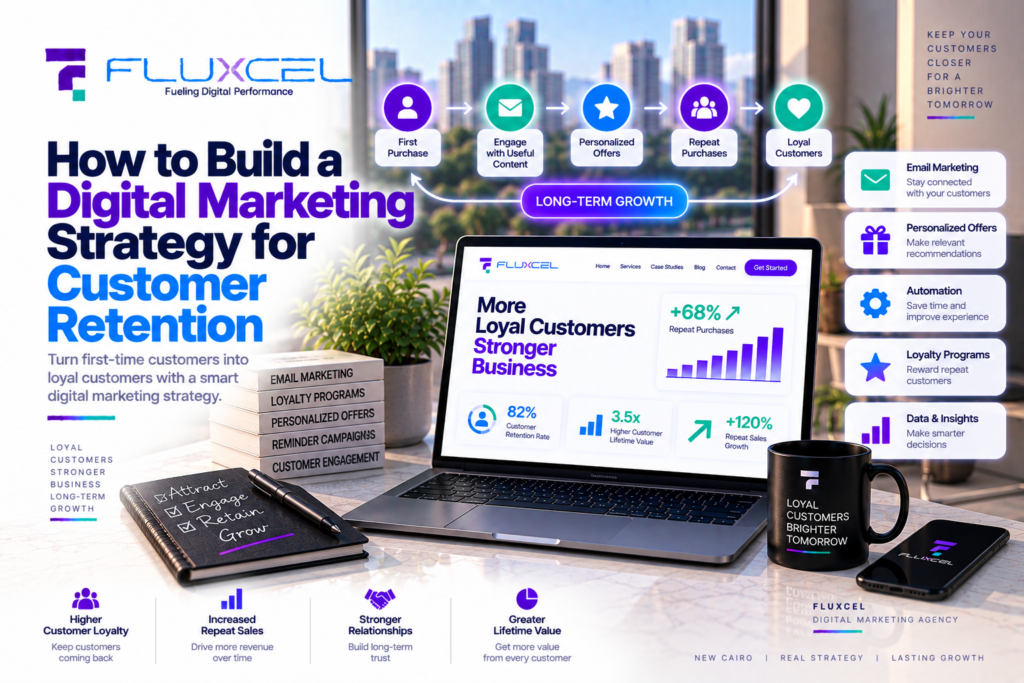
Getting a new customer feels like a win.
But what happens after the first purchase?
Many businesses invest heavily in attracting new customers through Google Ads, Meta campaigns, SEO, social media, and promotions—then reduce their marketing attention as soon as the sale is complete.
That creates a costly cycle.
Find a customer → Make a sale → Start looking for another customer.
A stronger strategy looks beyond the first transaction.
Existing customers already know your business. They have experienced your product or service and, if that experience was positive, they may be easier to engage again than someone discovering your brand for the first time.
Customer retention is therefore not only a customer-service responsibility. It should be part of your digital marketing strategy.
For businesses in New Cairo, where customers have access to more choices and can switch between brands quickly, maintaining strong relationships can become an important competitive advantage.
A Digital marketing agency New Cairo businesses work with should think about the complete customer lifecycle—from first discovery to repeat purchase, loyalty, and advocacy.
What Is Customer Retention?
Customer retention is your ability to keep customers engaged with your business after their initial purchase.
Depending on the company, this could mean encouraging customers to:
- Purchase again
- Renew a subscription
- Book another appointment
- Upgrade a service
- Purchase complementary products
- Recommend the business
- Remain active over a longer period
The objective is not to continuously pressure customers into buying.
It is to create enough value and maintain a strong enough relationship that returning to your business becomes a natural choice.
Why Customer Retention Matters
New customer acquisition will always be important.
But if customers constantly leave after one transaction, your business needs to replace them continuously just to maintain the same level of revenue.
Retention changes the equation.
A returning customer may already understand your products, trust your team, and know what to expect.
This can create opportunities for:
Repeat purchases
Upselling
Cross-selling
Reviews
Referrals
Higher customer lifetime value
Instead of viewing every transaction independently, think about the total value of the customer relationship.
Start With the Customer Experience
Marketing cannot compensate for a poor customer experience forever.
If customers receive slow service, confusing communication, poor-quality products, or unreliable support, sending more emails will not create loyalty.
Retention starts with delivering what was promised.
Review the Post-Purchase Journey
Ask what happens immediately after someone becomes a customer.
Do they receive confirmation?
Do they know what happens next?
Can they easily contact you?
Do you provide useful information after the purchase?
Is support easy to access?
These details influence whether customers want to return.
Collect Customer Data Responsibly
To build better retention campaigns, you need to understand your customers.
Useful information might include:
- Previous purchases
- Service history
- Customer preferences
- Purchase frequency
- Average order value
- Engagement history
- Customer feedback
This information can help you communicate more relevantly.
For example, someone who purchased a specific product may benefit from information related to that product rather than receiving generic promotions every week.
Segment Your Existing Customers
One of the biggest mistakes in retention marketing is treating every customer exactly the same.
Your customer database may contain very different groups.
Useful Customer Segments Could Include
New customers
People who recently made their first purchase.
Repeat customers
People who have purchased multiple times.
High-value customers
Customers who generate greater revenue or purchase frequently.
Inactive customers
People who haven’t interacted with your business recently.
Product-specific customers
People interested in particular categories or services.
Each segment may require a different message.
A Digital marketing agency New Cairo companies partner with should use segmentation to make retention campaigns more relevant instead of sending identical communication to everyone.
Use Email Marketing to Maintain the Relationship
Email remains a useful retention channel because it gives businesses a direct way to communicate with customers.
But constantly sending promotions can quickly reduce engagement.
Create a healthier mix of communication.
Emails could include:
- Useful tips
- Product recommendations
- New services
- Customer updates
- Educational content
- Exclusive offers
- Reorder reminders
- Loyalty benefits
The objective is to give customers a reason to continue opening your messages.
Create Useful Post-Purchase Content
Marketing content shouldn’t stop once a customer buys.
Post-purchase content can improve the experience and demonstrate continued value.
For example, an e-commerce company could send:
How to use the product
Maintenance tips
Frequently asked questions
Related product recommendations
A service business might provide:
What happens next
How to prepare
Follow-up advice
Additional resources
Useful post-purchase content can reduce uncertainty and keep your brand relevant.
Personalize Communication
Customers are more likely to pay attention when communication feels relevant to their interests.
Personalization doesn’t necessarily mean creating a completely unique campaign for every individual.
It can be as simple as using customer behavior to determine which message they receive.
For example:
Purchased Product A → Related Product B
Booked Service A → Follow-Up Reminder
Inactive Customer → Re-Engagement Campaign
High-Value Customer → Exclusive Benefit
Relevance is more important than sending more messages.
Use Remarketing for Existing Customers
Remarketing is often used to target website visitors who did not convert.
But it can also support retention.
Existing customers can be shown campaigns for:
- New products
- Complementary products
- Renewals
- Upgrades
- Seasonal offers
- New services
However, make sure your audience exclusions are properly managed.
A customer who already purchased a product should not repeatedly receive advertisements telling them to make the exact same first purchase.
Encourage Repeat Purchases at the Right Time
Timing matters.
If your product is normally reordered every two months, sending a reminder after one week may be unnecessary.
If a service requires regular maintenance, communication can be timed around when customers are likely to need it again.
Use previous customer behavior to identify natural repurchase cycles.
Create Helpful Reminders
A reminder should feel useful rather than aggressive.
For example:
“Running low? It may be time to reorder.”
or
“It’s been six months since your last appointment.”
The message works because it connects with a real customer need.
Create a Loyalty Strategy
Customers appreciate feeling recognized.
A loyalty strategy can encourage people to continue choosing your business.
Depending on your model, this could include:
- Points
- Member benefits
- Exclusive access
- Special offers
- Early product launches
- Referral rewards
- VIP experiences
You don’t necessarily need a complicated points system.
Sometimes simple benefits for returning customers can be enough.
Reward Loyalty Without Training Customers to Wait for Discounts
Discounts can encourage repeat purchases, but relying on them too heavily can create problems.
Customers may begin waiting for the next promotion instead of buying normally.
Build loyalty around more than price.
Consider benefits such as:
- Better service
- Convenience
- Early access
- Exclusive content
- Personalization
- Priority booking
- Added value
The goal is to make customers want to return because of the overall experience.
Ask Customers for Feedback
Your existing customers can tell you where the experience needs improvement.
Use surveys, reviews, conversations, and customer service feedback to identify recurring issues.
Ask questions such as:
What did you like?
What could we improve?
Was anything confusing?
Would you purchase from us again?
Don’t collect feedback simply to create another report.
Use it to make changes.
Turn Happy Customers Into Reviews
Satisfied customers can help strengthen your digital reputation.
Ask for reviews at appropriate moments in the customer journey.
For example, after:
- Successful delivery
- Completed service
- Positive customer-support interaction
- Repeat purchase
- Successful project
Make the process simple.
A strong base of genuine reviews can help both customer retention and new customer acquisition.
Create a Referral Strategy
Happy customers can become one of your strongest marketing channels.
A recommendation from someone a potential customer already trusts can carry significant influence.
Encourage referrals naturally.
Depending on the business, you might use:
- Referral benefits
- Customer invitations
- Shareable offers
- Loyalty rewards
But referrals also happen without formal programs when customers genuinely value the experience.
The strongest referral strategy still begins with providing something worth recommending.
Use Social Media to Keep Customers Connected
Social media should not focus exclusively on acquiring new followers.
Existing customers are already part of your audience.
Give them reasons to stay engaged.
Share:
- New products
- Customer stories
- Educational tips
- Behind-the-scenes content
- Community updates
- Product ideas
- Events
- Company developments
Customers who continue interacting with your content are more likely to remember your brand when they need you again.
Re-Engage Inactive Customers
Some customers will gradually stop interacting.
That does not always mean they are lost.
Create re-engagement campaigns for people who haven’t purchased or interacted within a relevant period.
You might remind them about:
- New products
- Updated services
- New benefits
- Useful content
- Personalized recommendations
Avoid simply saying:
“We miss you!”
Give them a meaningful reason to return.
Use Automation to Scale Retention
As your customer base grows, manually following up with everyone becomes difficult.
Marketing automation can help.
You can create workflows triggered by customer behavior.
For example:
Purchase → Confirmation → Usage Guide → Review Request → Related Offer
or:
Appointment → Reminder → Service → Follow-Up → Future Appointment Reminder
Automation helps maintain consistency without requiring the marketing team to manually send every message.
But automated communication should still feel relevant and human.
Track Customer Lifetime Value
One of the most useful metrics for retention is customer lifetime value.
Instead of asking:
“How much did this customer spend today?”
ask:
“How much value could this relationship generate over time?”
A customer who makes several purchases may be significantly more valuable than someone who makes one larger purchase and never returns.
Understanding lifetime value can also help you make better acquisition decisions.
Measure Retention Performance
Retention should be measured just like acquisition.
Depending on your business, useful metrics can include:
- Repeat purchase rate
- Customer retention rate
- Purchase frequency
- Customer lifetime value
- Churn rate
- Email engagement
- Referral rate
- Average order value
- Revenue from existing customers
A Digital marketing agency New Cairo businesses trust should look beyond new leads and understand how marketing contributes to the value generated after acquisition.
Connect Acquisition and Retention
Acquisition and retention should not operate separately.
The campaigns that generate the largest number of new customers may not generate the most valuable long-term customers.
Track customer quality by acquisition source.
You may discover that customers from organic search return more frequently.
Perhaps one Meta campaign attracts stronger repeat buyers.
Maybe referrals produce customers with higher lifetime value.
These insights can change how you allocate acquisition budgets.
Keep Improving the Relationship
Customer retention is not one campaign.
It is an ongoing process.
Customer expectations change.
Competitors improve.
New products appear.
Your communication needs to evolve too.
Continue learning from customer behavior and feedback.
Test new approaches while keeping the experience consistent.
Turn First-Time Customers Into Long-Term Relationships
Sustainable growth is not only about constantly finding new people.
It is also about creating more value from the relationships your business has already built.
Deliver a strong customer experience. Segment your audience. Personalize communication. Use email and remarketing strategically. Create useful post-purchase content. Reward loyalty. Ask for feedback. Encourage reviews and referrals. Automate repetitive communication. And measure customer lifetime value.
When acquisition and retention work together, marketing becomes more efficient and the customer relationship becomes more valuable.
At Fluxcel Digital Marketing Agency, we help businesses connect customer acquisition, CRM, email marketing, remarketing, content, automation, analytics, and retention strategy to create sustainable growth.