
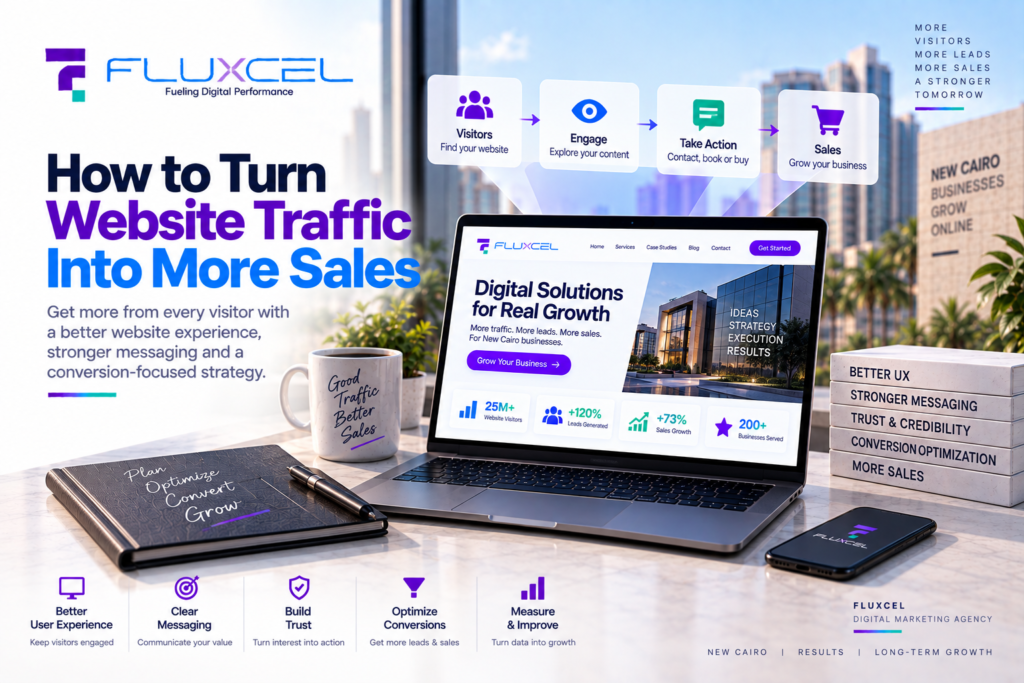
Getting people to visit your website is only half the job.
You can rank on Google, run successful Meta campaigns, invest in Google Ads, publish valuable content, and attract thousands of visitors every month.
But if those visitors leave without calling, submitting a form, booking an appointment, or purchasing something, traffic alone isn’t creating much business value.
The real question is not:
“How do we get more website visitors?”
It is:
“How do we get more value from the visitors we already have?”
For businesses in New Cairo, improving website conversion can be one of the most effective ways to grow without continuously increasing advertising budgets.
A Digital marketing agency New Cairo businesses work with should therefore focus on both sides of the equation: bringing the right people to the website and creating an experience that encourages them to take action.
Start With the Quality of Your Traffic
Before changing your website, make sure you’re attracting the right visitors.
Ten thousand irrelevant visitors will rarely outperform one thousand people with genuine interest in your products or services.
Traffic quality depends heavily on where visitors come from.
Someone searching Google for a specific service in New Cairo may have strong purchasing intent.
Someone who clicks a broad social media advertisement may still be discovering the category.
Both audiences can be valuable, but they require different approaches.
Understand Where Your Best Customers Come From
Look at traffic sources such as:
- Organic search
- Google Ads
- Meta Ads
- Social media
- Email marketing
- Referral websites
- Direct traffic
Then go deeper.
Which sources generate inquiries?
Which generate purchases?
Which produce qualified leads?
Which generate customers with higher value?
The goal is not simply to identify your largest traffic source. It is to identify your most valuable traffic sources.
Make Your Value Clear Immediately
When someone arrives on your website, they should quickly understand three things:
What do you offer?
Who is it for?
Why should they care?
If visitors need to scroll through several sections just to understand what your company does, the website is creating unnecessary friction.
Avoid Generic Headlines
Consider a headline such as:
“Welcome to Our Website.”
It communicates almost nothing.
A stronger headline focuses on the customer and the value being offered.
Your main message should clearly communicate what problem you solve or what outcome you help customers achieve.
Clarity usually matters more than clever wording.
Match Landing Pages With Your Campaigns
Imagine clicking an advertisement for a specific service and landing on a homepage that promotes ten different services.
Now the visitor needs to find the original offer again.
Some will.
Others will leave.
Campaigns perform better when the landing experience continues the same conversation.
Maintain Message Consistency
The journey should feel connected:
Ad → Landing Page → Offer → CTA
If your ad promotes one specific service, the landing page should focus on that service.
If your campaign targets a particular audience, the page should speak directly to that audience.
The more relevant the experience feels, the easier it becomes for customers to continue.
Improve Your Website Speed
A slow website can damage the customer experience before visitors even see your offer.
People have become accustomed to fast digital experiences.
If pages take too long to load, especially on mobile devices, potential customers may leave and choose another option.
Website speed can be affected by:
- Large images
- Unnecessary scripts
- Too many plugins
- Poor hosting
- Heavy animations
- Unoptimized video
- Technical issues
Improving performance doesn’t necessarily require removing everything visually interesting.
It means finding the right balance between design and usability.
Design for Mobile First
A website might look excellent on a large desktop monitor and still perform poorly on a smartphone.
Buttons may be too small.
Text might be difficult to read.
Forms may be frustrating.
Pop-ups might cover important information.
Images may load slowly.
Navigation could become confusing.
Test your customer journey on a real phone.
Complete the Journey Yourself
Open one of your advertisements.
Click through to the website.
Try to understand the service.
Fill out the form.
Use WhatsApp.
Try calling.
Complete checkout if you’re an e-commerce business.
You may discover problems that are difficult to notice from an analytics dashboard.
Use Clear Calls-to-Action
Visitors should always understand what they can do next.
A website without clear CTAs can generate interest without generating action.
Depending on the business, your primary CTA could be:
- Request a Quote
- Book an Appointment
- Talk to Our Team
- Send Us a Message
- Start Your Order
- Schedule a Consultation
- Shop Now
Avoid having too many competing primary actions in the same section.
Give customers direction.
A Digital marketing agency New Cairo companies work with should consider CTA strategy as part of conversion optimization rather than treating it as a minor design detail.
Build Trust Before Asking for the Sale
Customers don’t evaluate your offer in isolation.
They also evaluate whether they trust the business behind it.
This becomes especially important for higher-value purchases and professional services.
Before contacting you, potential customers may look for evidence that other people have already had a positive experience.
Add Strong Trust Signals
Depending on your business, these might include:
- Customer reviews
- Testimonials
- Case studies
- Previous projects
- Certifications
- Client logos
- Guarantees
- Team experience
- Clear contact information
- Business location details
The key is authenticity.
Specific evidence is usually stronger than vague claims such as “We are the best.”
Answer Customer Objections on the Page
A visitor may like your service but still have questions preventing them from taking action.
How much does it cost?
How long does it take?
What happens after I submit the form?
Is this suitable for my business?
Can I cancel?
Do you work in my location?
These questions create hesitation.
Your website should answer important objections before customers need to ask.
Use FAQs Strategically
An FAQ section shouldn’t exist simply because every website has one.
Use it to address genuine barriers to conversion.
Speak with your sales team.
Ask them which questions prospects repeatedly ask before buying.
Those questions are excellent candidates for your website.
Simplify Your Forms
Every additional form field requires more effort from the customer.
Sometimes that information is necessary.
Often, it isn’t.
If someone is requesting an initial consultation, you may only need:
Name
Phone or Email
Service of Interest
Message
Long forms can still make sense when qualification is important, particularly for high-value B2B services.
The goal is not to make every form extremely short.
It is to remove questions that provide no immediate value.
Use Stronger Product and Service Pages
Your service pages shouldn’t read like digital brochures.
They should help customers make decisions.
A strong service page should explain:
- The customer’s problem
- Your solution
- Key benefits
- How the process works
- Why customers should trust you
- Common questions
- The next step
For e-commerce websites, product pages should provide enough information to reduce uncertainty around features, specifications, delivery, returns, sizing, usage, and other important purchase factors.
Use Content to Support Conversion
Blogs and educational content are often associated with SEO and awareness.
But content can also help convert visitors.
Suppose someone lands on your service page but isn’t ready to contact you.
A relevant article can answer their questions and keep them engaged with your business.
Internal links can connect:
Blog → Service Page → Case Study → Contact Page
This allows visitors to explore according to their level of readiness.
Use Remarketing for Visitors Who Leave
Most website visitors will not convert during their first session.
That doesn’t mean the opportunity is lost.
Remarketing allows you to reconnect with people who already know something about your business.
But avoid simply showing them the same advertisement repeatedly.
Use Different Messages
Someone who visited your website might respond to:
- A customer testimonial
- A case study
- A specific benefit
- A product reminder
- An FAQ
- A stronger offer
- A direct CTA
Remarketing should move the conversation forward.
Track Micro-Conversions
Purchases and lead submissions are important, but smaller actions can also reveal customer intent.
These might include:
- Clicking a phone number
- Opening WhatsApp
- Viewing a pricing page
- Watching a product video
- Downloading a brochure
- Adding a product to cart
- Starting checkout
- Visiting several service pages
These behaviors help you understand how people move through the website before converting.
Find Where Visitors Are Dropping Out
Conversion optimization becomes easier when you identify where customers leave the journey.
For example:
High ad CTR + low landing-page engagement
The advertisement may be working, but the page may not match expectations.
High product views + low add-to-cart rate
The product presentation, pricing, or value proposition may need improvement.
High add-to-cart + low purchases
The checkout experience, delivery costs, payment options, or trust could be creating friction.
Instead of saying “the website isn’t converting,” identify where it stops converting.
Test Before Making Major Assumptions
Sometimes small changes produce meaningful improvements.
Test elements such as:
- Headlines
- CTAs
- Page structure
- Images
- Offers
- Form length
- Trust signals
- Product descriptions
- Landing-page copy
Avoid changing everything simultaneously.
When you test one meaningful variable at a time, it becomes easier to understand what actually influenced performance.
Measure Revenue, Not Just Conversion Rate
Conversion rate is important, but context matters.
Suppose Landing Page A converts 8% of visitors while Landing Page B converts only 5%.
Page A appears better.
But what if Page B generates customers who spend three times more?
Marketing performance needs to connect with business results.
A Digital marketing agency New Cairo businesses trust should look beyond website metrics and understand which experiences generate qualified customers and revenue.
Get More From the Traffic You Already Have
Businesses often respond to slow growth by trying to generate more traffic.
Sometimes that’s necessary.
But before increasing advertising spend, look at what happens after people arrive.
Improve your messaging. Make the website faster. Strengthen mobile usability. Add trust signals. Simplify forms. Create clearer CTAs. Answer customer objections. Improve landing pages. Retarget interested visitors. And continuously test the customer journey.
Even a small improvement in conversion rate can become significant when applied across thousands of website visitors.
At Fluxcel Digital Marketing Agency, we help businesses connect traffic acquisition, SEO, paid advertising, website experience, analytics, and conversion optimization to turn digital attention into measurable business results.