
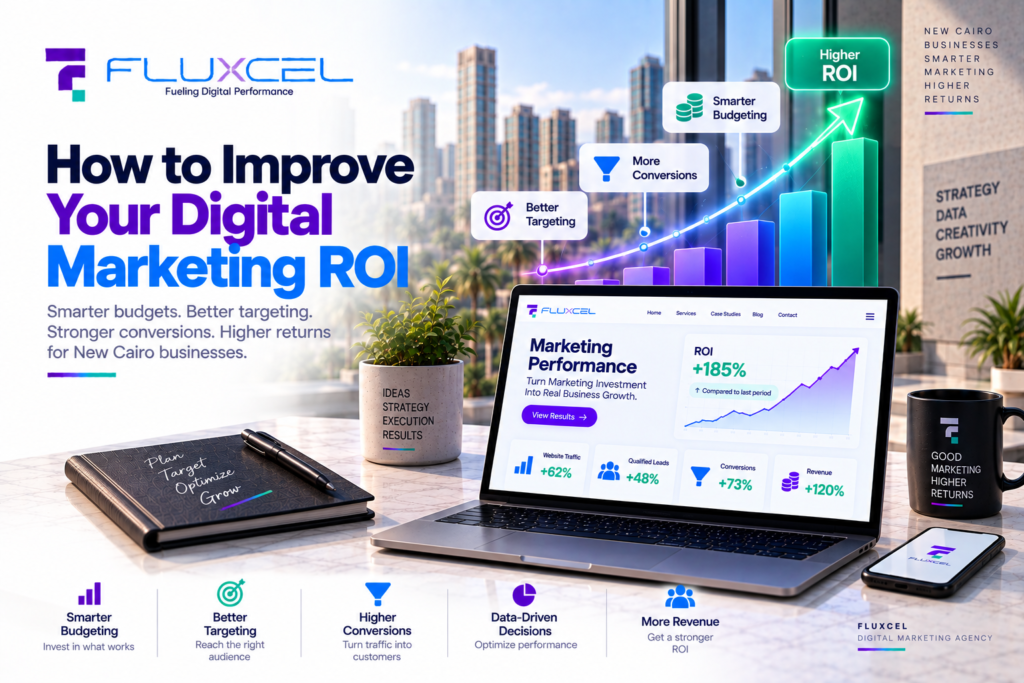
Spending more on digital marketing does not automatically create more growth.
A business can increase its advertising budget, publish more content, launch campaigns across multiple platforms, and still struggle to see a meaningful return.
The real question is not:
“How much are we spending on marketing?”
It is:
“What are we getting back from every pound we invest?”
That is where digital marketing ROI becomes important.
For businesses in New Cairo, improving ROI means understanding which marketing activities actually contribute to leads, customers, revenue, and long-term growth—and which ones are consuming budget without creating enough value.
A Digital marketing agency New Cairo businesses work with should therefore focus not only on generating activity, but on making marketing investment more efficient and measurable.
What Does Digital Marketing ROI Really Mean?
Digital marketing ROI measures the value generated from your marketing compared with what you invest.
At a basic level, businesses want to understand whether marketing is generating more value than it costs.
But ROI should not be viewed through advertising spend alone.
Your total marketing investment can include:
- Advertising budgets
- Content production
- Agency or team costs
- Marketing technology
- Website development
- Creative production
- Email and CRM tools
- SEO investment
Understanding the complete investment gives you a clearer picture of performance.
Start With Clear Business Goals
You cannot accurately measure ROI if you haven’t defined what marketing is expected to achieve.
Different businesses have different goals.
An e-commerce brand may prioritize revenue.
A dental clinic may focus on booked appointments.
A real estate company may care about qualified inquiries.
A B2B business might prioritize sales meetings and closed deals.
Connect Marketing to a Commercial Outcome
Instead of setting a broad objective such as:
“Increase social media performance.”
Define something closer to the business result:
“Generate more qualified leads at a sustainable acquisition cost.”
This gives your marketing team something meaningful to optimize.
Track the Entire Customer Journey
One of the biggest mistakes businesses make is evaluating campaigns only through advertising-platform metrics.
Clicks, impressions, engagement, and cost per lead provide useful information.
But they don’t tell you whether the business made money.
Consider the full journey:
Impression → Click → Lead → Qualified Lead → Customer → Revenue
Each stage provides different information.
Don’t Stop at Lead Generation
Imagine two campaigns.
Campaign A generates 100 leads at 150 EGP each.
Campaign B generates 60 leads at 220 EGP each.
Based purely on cost per lead, Campaign A appears stronger.
But suppose Campaign A generates five customers while Campaign B generates fifteen.
Campaign B may be producing significantly greater business value despite its higher lead cost.
This is why lead quality matters.
Know Your Customer Acquisition Cost
Customer acquisition cost, or CAC, helps businesses understand how much they are spending to acquire a new customer.
It provides much more commercial context than cost per click or cost per lead.
To understand CAC properly, include the relevant costs involved in generating new customers.
Then compare the number with the value those customers generate.
Cheap Customers Are Not Always Better Customers
One channel might acquire customers cheaply but attract mostly low-value, one-time buyers.
Another could have a higher acquisition cost but attract customers who purchase repeatedly or choose higher-value services.
That is why CAC should be considered alongside customer value.
Understand Customer Lifetime Value
Customer lifetime value helps estimate how much revenue or profit a customer can generate throughout their relationship with the business.
This becomes especially important for companies with:
- Repeat purchases
- Subscriptions
- Recurring services
- Long-term contracts
- Upselling opportunities
- Cross-selling opportunities
A customer who spends 1,000 EGP today may eventually be worth much more.
Looking only at the first transaction can lead to poor marketing decisions.
A Digital marketing agency New Cairo companies work with should consider both acquisition cost and long-term customer value when evaluating growth opportunities.
Stop Optimizing for Vanity Metrics
Large numbers can look impressive in reports.
One million impressions.
Thousands of likes.
Hundreds of thousands of video views.
But none of these metrics automatically mean the campaign generated meaningful business results.
Vanity metrics are not necessarily useless.
Reach can indicate awareness.
Engagement can indicate interest.
Video views can show content consumption.
The problem occurs when these metrics become the final definition of success.
Move Closer to Revenue
Whenever possible, connect reporting to:
- Qualified leads
- Appointments
- Sales opportunities
- Purchases
- Customer acquisition cost
- Revenue
- Repeat customers
- Customer lifetime value
The closer your metrics are to the business outcome, the more useful they become.
Improve Targeting Before Increasing Budget
Poor targeting can quickly reduce ROI.
If campaigns reach large numbers of people who are unlikely to become customers, the business pays for attention that has little commercial value.
Review who your best customers actually are.
Look at:
- Location
- Demographics
- Interests
- Search behavior
- Purchase history
- Customer value
- Lead quality
Then use those insights to refine your marketing.
Let Your Message Qualify the Audience Too
Targeting does not happen only inside advertising platforms.
Your creative can also help attract the right customers.
Specific messaging around the service, location, price range, customer problem, or use case can naturally filter the audience.
Sometimes a campaign with fewer clicks can produce better ROI because those clicks come from more relevant people.
Improve Conversion Rates
Generating more traffic is one way to increase sales.
Getting more value from existing traffic can often be more efficient.
Suppose your website receives 10,000 visitors and converts 1% into customers.
That’s 100 customers.
If you improve the conversion rate to 1.5%, the same traffic could potentially generate 150 customers.
No additional traffic was required.
Look for Conversion Barriers
Review areas such as:
- Website speed
- Mobile experience
- Landing-page messaging
- Calls-to-action
- Lead forms
- Checkout process
- Trust signals
- Product information
- Pricing clarity
Small improvements can have a significant impact when applied across large volumes of traffic.
Build Better Landing Pages
Sending paid traffic to a generic homepage can reduce campaign efficiency.
Landing pages should reflect the advertisement that brought the visitor there.
If an advertisement promotes one particular service, create a page around that service.
Keep the journey consistent:
Ad Message → Landing Page → Offer → CTA
Customers should immediately understand that they arrived in the right place.
This improves relevance and reduces unnecessary friction.
Invest More in What Already Works
Businesses sometimes divide marketing budgets evenly because it feels balanced.
But equal spending does not necessarily produce equal results.
If one campaign consistently generates profitable customers and another struggles, your budget allocation should reflect that information.
Follow Performance, Not Habit
Ask:
Which campaigns generate the highest-quality customers?
Which channels produce profitable sales?
Which services have the strongest margins?
Which audiences convert most effectively?
Shift investment toward proven opportunities while keeping enough budget available for testing.
Don’t Depend on Paid Advertising Alone
Paid media can generate fast results, but relying entirely on advertising can make growth increasingly expensive.
SEO, organic content, email marketing, referrals, and customer retention can help create additional sources of demand.
For example, a useful SEO article may continue generating traffic long after it is published.
An email database gives your business a way to communicate with customers without paying for every individual impression.
Diversifying your marketing can improve long-term efficiency.
Increase ROI Through Customer Retention
Acquiring a new customer is only one opportunity.
The same customer may purchase again, upgrade, refer someone, or use another service.
Retention strategies can include:
- Email marketing
- Loyalty programs
- Personalized offers
- Customer support
- Remarketing
- Product recommendations
- Follow-up campaigns
- Referral programs
Improving customer value can increase marketing ROI even if acquisition costs remain unchanged.
Use Remarketing More Strategically
A visitor who has already interacted with your business is different from someone who has never heard of you.
Remarketing allows businesses to reconnect with people who:
- Visited the website
- Viewed products
- Watched videos
- Engaged with social media
- Added items to cart
- Submitted previous inquiries
Instead of showing everyone the same message, adjust your creative based on their previous behavior.
The closer someone is to conversion, the more specific your message can become.
Improve Sales Follow-Up
Sometimes marketing is performing better than the final numbers suggest.
The problem happens after the lead arrives.
If leads are contacted slowly, handled inconsistently, or never followed up properly, valuable marketing opportunities are lost.
Marketing and sales should share information.
Sales should tell marketing which leads were qualified, which converted, and why others were lost.
Marketing can then use this feedback to improve targeting and campaigns.
A Digital marketing agency New Cairo businesses partner with should consider what happens after the lead—not just what happens before it.
Test Instead of Guessing
Digital marketing ROI improves when decisions are based on evidence.
Test different:
- Headlines
- Creative concepts
- Offers
- Audiences
- Landing pages
- CTAs
- Keywords
- Lead forms
Not every test will improve results.
But even unsuccessful tests provide information that can guide the next decision.
Over time, these improvements can compound.
Review Marketing Performance as a System
Individual campaign metrics do not always tell the full story.
A social media campaign may create awareness that later leads to branded Google searches.
An SEO article may introduce someone to your company months before they submit an inquiry.
A remarketing campaign may convert a customer originally acquired through another channel.
Look at how channels support one another.
This provides a more realistic view of marketing performance than judging every platform in isolation.
Make Every Marketing Pound Work Harder
Improving digital marketing ROI does not always mean cutting budgets.
It means investing more intelligently.
Track the full customer journey. Measure acquisition costs. Understand customer value. Improve targeting. Strengthen conversion rates. Build better landing pages. Retain customers. Connect marketing with sales. Test continuously. And move budgets toward the activities creating genuine business value.
When marketing decisions are connected to commercial outcomes, growth becomes easier to understand and optimize.
At Fluxcel Digital Marketing Agency, we help businesses connect advertising, SEO, content, analytics, conversion optimization, and customer data to improve marketing efficiency and create measurable growth.