
Digital marketing becomes expensive when there is no clear plan behind it.
A business may invest in social media, Google Ads, Meta campaigns, SEO, content creation, email marketing, and website development—but still struggle to understand whether these activities are moving the company forward.
The problem is not always the channels themselves.
Often, the problem is that every activity is happening independently.
A successful digital marketing plan brings everything together. It defines where the business wants to go, who it needs to reach, what it should communicate, which channels deserve investment, and how performance will be measured.
For businesses in New Cairo, having that structure is especially important. Competition is growing across industries, and customers can compare brands, prices, reviews, and alternatives within minutes.
A Digital marketing agency New Cairo businesses work with should therefore build marketing around a clear plan—not a collection of disconnected campaigns.
Start With the Business Objective
Before discussing platforms, content calendars, or advertising budgets, define what the business actually wants to achieve.
“Grow online” is not specific enough.
Your objective could be:
- Generate more qualified leads
- Increase online sales
- Launch a new product
- Increase appointment bookings
- Enter a new market
- Improve customer retention
- Build brand awareness
- Increase store visits
- Reduce customer acquisition costs
Different objectives require different strategies.
A business trying to generate immediate leads may prioritize Google Search and conversion-focused landing pages.
A new consumer brand may initially need stronger awareness through social media, video, creators, and paid campaigns.
Start with the destination before choosing the route.
Turn Business Goals Into Marketing KPIs
Once the objective is clear, decide how success will be measured.
Suppose your goal is to increase qualified leads.
You might track:
Website traffic → Leads → Qualified leads → Meetings → Customers
For an e-commerce business, the journey could look like:
Product views → Add to cart → Checkout → Purchase → Repeat purchase
Focus on Metrics That Support Decisions
Useful KPIs may include:
- Cost per lead
- Cost per qualified lead
- Conversion rate
- Customer acquisition cost
- Return on ad spend
- Revenue
- Average order value
- Repeat purchase rate
- Customer lifetime value
Reach, impressions, clicks, and engagement still matter, but they need to be viewed in the context of the wider business objective.
Define Your Ideal Customer
Marketing becomes much easier when you know exactly who you are trying to reach.
Don’t stop at basic information such as age and location.
Try to understand the customer’s situation.
What do they need?
What frustrates them?
What influences their purchasing decision?
What questions do they ask?
What prevents them from buying?
Which competitors are they considering?
Understand the Customer’s Motivation
Two people can purchase the same product for completely different reasons.
One customer might prioritize price.
Another might care about convenience.
Someone else may be looking for premium quality or specialist expertise.
Understanding these motivations allows you to create messages that feel relevant rather than generic.
Research the Competitive Landscape
You don’t need to copy competitors, but you should understand what customers are seeing when they compare your business with others.
Review how competitors position themselves online.
Look at:
- Their websites
- Search visibility
- Social media presence
- Advertising messages
- Offers
- Reviews
- Content
- Customer experience
Then identify opportunities.
Look for Gaps, Not Just Competitors
Perhaps everyone in your category communicates in exactly the same way.
That can create an opportunity to differentiate.
Maybe competitors have strong social media but weak websites.
Perhaps they rank well organically but their content lacks depth.
Maybe their advertising focuses heavily on price while your business can compete through service, expertise, or customer experience.
Competitive research should help you find your own position.
Define Your Value Proposition
Before asking customers to choose your company, be clear about why they should.
Your value proposition should communicate the benefit customers receive and what makes your approach worth considering.
Avoid generic claims such as:
“Best quality.”
“Professional services.”
“Your trusted partner.”
Instead, communicate something specific and meaningful.
Make the Customer the Focus
Your marketing should not simply explain what your company does.
It should explain what customers gain.
If you offer faster service, explain the time they save.
If your product is more durable, explain why that matters.
If you have specialist expertise, explain how it reduces risk or improves the result.
Strong positioning gives every campaign a clearer direction.
Choose the Right Marketing Channels
A good digital marketing plan does not require your business to use every available platform.
Choose channels according to audience behavior, customer intent, business goals, and available budget.
Google Search
Useful for capturing people actively searching for a solution.
SEO
Helps build long-term organic visibility around relevant customer searches.
Meta
Can support awareness, demand generation, lead generation, sales, and remarketing.
Can be valuable for B2B companies targeting specific professional audiences.
TikTok and Short-Form Video
Useful when the audience and product naturally fit visual, educational, entertaining, or demonstration-based content.
Email Marketing
Supports lead nurturing, customer retention, offers, and repeat business.
A Digital marketing agency New Cairo companies partner with should recommend channels because they serve a strategic purpose—not because every competitor is using them.
Decide How Your Channels Will Work Together
Choosing channels is only the beginning.
Now determine how they connect.
For example, someone could:
See a Meta Ad → Visit Your Website → Leave → Search Your Brand on Google → Read a Blog → See a Remarketing Ad → Submit an Inquiry
That’s one customer journey involving several channels.
Your plan should account for these interactions.
Social media can create awareness.
SEO can answer questions.
Search ads can capture demand.
Remarketing can bring visitors back.
Email can nurture leads.
Your website can convert interest into action.
The strongest strategies make these channels support each other.
Build Your Content Strategy
Content should be planned around customer needs and business objectives rather than simply filling empty spaces in a monthly calendar.
Create several clear content pillars.
For example:
Educational Content
Answer questions and provide useful information.
Expertise Content
Show your knowledge, processes, and experience.
Trust Content
Use testimonials, reviews, results, and case studies.
Product or Service Content
Explain what you offer and why it matters.
Brand Content
Show the personality, values, and people behind the business.
Conversion Content
Introduce offers and encourage customers to take action.
This mix gives customers different reasons to engage with your business.
Create a Clear Customer Journey
Your marketing plan should consider what happens from the first interaction to the final conversion.
Think in stages:
Awareness → Interest → Consideration → Conversion → Retention
Then determine what customers need at each stage.
At the awareness stage, they may need a reason to notice you.
During consideration, they need information and evidence.
At conversion, they need a clear offer and an easy next step.
After becoming customers, they need a reason to return.
Planning around this journey makes your marketing more connected.
Build Landing Pages Around Campaign Goals
Don’t assume your homepage is the best destination for every campaign.
A dedicated landing page can create a much more focused experience.
If you’re advertising one particular service, create a page specifically around that service.
The page should include:
- A clear headline
- Customer-focused benefits
- Relevant information
- Trust signals
- Testimonials or evidence
- A strong CTA
- An easy contact process
The advertisement and landing page should feel like parts of the same conversation.
Set a Realistic Marketing Budget
A marketing plan needs financial structure.
Instead of dividing the budget equally between every channel, allocate spending according to objectives and opportunities.
You might separate the budget into areas such as:
- Customer acquisition
- Brand awareness
- Content production
- SEO
- Remarketing
- Testing
The exact percentages will depend on the business.
What’s important is knowing why money is being allocated to each activity.
Leave Room for Testing
Not every marketing idea will work.
That’s normal.
A good plan should include room for experimentation.
Test:
- Creative concepts
- Audiences
- Offers
- Headlines
- Landing pages
- CTAs
- Content formats
- Keywords
Treat testing as a structured part of the strategy rather than something you only do when performance declines.
Every test should produce information that improves the next decision.
Create a Strong Measurement System
Marketing cannot be optimized properly if tracking is incomplete.
Make sure important actions are measured.
Depending on your business, these may include:
- Calls
- Form submissions
- WhatsApp inquiries
- Appointments
- Purchases
- Revenue
- Email signups
Tracking should connect marketing activity with meaningful customer actions.
A Digital marketing agency New Cairo businesses trust should be able to explain not only how many clicks a campaign generated, but what happened after those clicks.
Review Performance Regularly
A digital marketing plan should provide direction without becoming rigid.
Review performance regularly and ask:
What’s working?
What’s underperforming?
Which channels generate the strongest customers?
Where are we losing potential customers?
Which campaigns deserve more budget?
What should we test next?
These reviews help the strategy evolve based on real customer behavior.
Don’t Change Strategy Based on One Bad Week
Digital marketing naturally fluctuates.
A few slow days do not necessarily mean the entire strategy is wrong.
Look for meaningful patterns over an appropriate period.
At the same time, don’t ignore persistent problems.
If a campaign consistently produces poor-quality leads or a landing page repeatedly fails to convert, investigate the cause.
The objective is to balance patience with continuous optimization.
Build a Plan That Can Grow With the Business
Your marketing strategy should evolve as the company grows.
A new business might initially focus heavily on awareness and customer acquisition.
As it develops, priorities may expand toward SEO, customer retention, automation, brand building, and new markets.
Your plan should be structured enough to provide direction but flexible enough to adapt.
Turn Marketing Activity Into a Growth Plan
Digital marketing works best when every activity has a reason behind it.
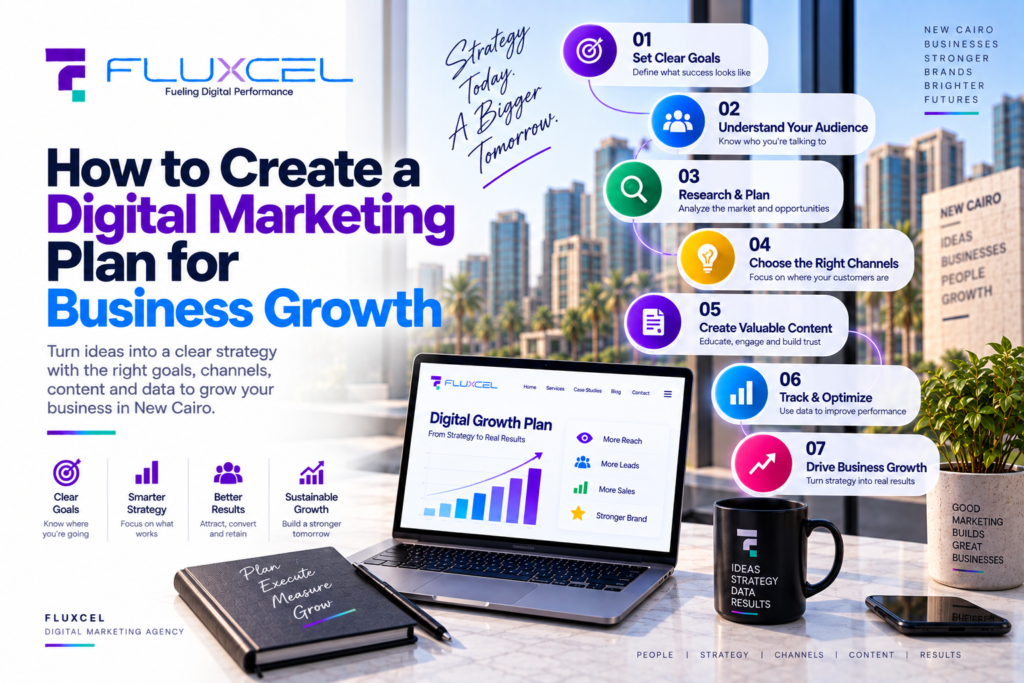
Start with business objectives. Understand your customers. Research the market. Define your positioning. Choose the right channels. Create useful content. Build a connected customer journey. Set measurable KPIs. Test continuously and use performance data to improve.
The goal isn’t simply to do more marketing.
It’s to build a system where your website, advertising, SEO, content, social media, and customer data work toward the same business objectives.
At Fluxcel Digital Marketing Agency, we help businesses turn individual marketing activities into connected strategies built around customers, performance, and measurable growth.