
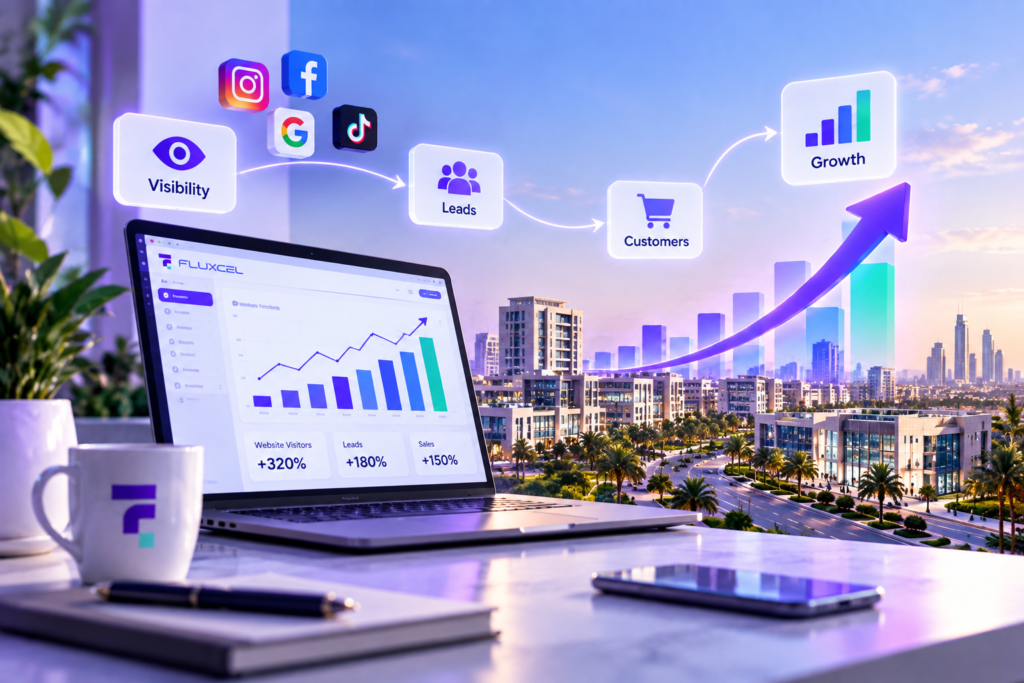
Getting noticed online feels like progress. Your Instagram reach is increasing, website traffic is growing, and more people are seeing your ads.
But there is one question that matters more than all of those numbers:
Is that attention actually helping your business grow?
Many businesses invest heavily in digital marketing but struggle to connect visibility with real results. They generate impressions, followers, clicks, and engagement without seeing the same improvement in inquiries, bookings, or sales.
The problem is rarely visibility itself. It is what happens after someone discovers the brand.
For businesses in an increasingly competitive market like New Cairo, the goal should not simply be to become more visible. A strong Digital marketing agency New Cairo strategy should create a clear path from awareness to interest, trust, conversion, and eventually customer loyalty.
Here is how businesses can make that happen.
Visibility Is Only the Beginning
Digital visibility is important because customers cannot choose a business they do not know exists.
Search engines, social media, paid advertising, online directories, and content marketing can all introduce your brand to potential customers.
However, visibility represents the beginning of the customer journey rather than the final objective.
Imagine two businesses.
The first reaches 500,000 people every month but has an unclear offer, a confusing website, weak calls-to-action, and slow customer service.
The second reaches 100,000 highly relevant people with a clear message, strong website experience, convincing social proof, and simple conversion process.
The second business may generate significantly more revenue despite having a smaller audience.
That is why businesses need to look beyond reach.
Attract the Right Audience, Not Just a Bigger One
More website visitors do not automatically mean more customers.
If most visitors have little interest in what you sell, increasing traffic simply increases the number of irrelevant visits.
Effective digital marketing starts with identifying who you actually want to reach.
Build a Clear Picture of Your Customer
Before launching campaigns, businesses should understand their ideal customers beyond basic demographics.
Ask questions such as:
- What problem are they trying to solve?
- What motivates them to start searching?
- What matters most when comparing providers?
- What questions do they ask before buying?
- What concerns could prevent them from converting?
- Which digital platforms influence their decisions?
This information helps shape targeting, content, advertising, and website messaging.
For example, a premium interior design company in New Cairo should not necessarily optimize campaigns for the cheapest possible lead. It needs prospects who match its positioning, project type, and budget.
Lead quality matters as much as lead quantity.
Give People a Reason to Remember Your Brand
Getting attention is becoming increasingly difficult.
Potential customers scroll through hundreds of posts, ads, videos, emails, and search results every week.
If your brand looks and sounds exactly like every competitor, being visible may not be enough.
Strong positioning answers a simple question:
Why should someone choose you?
Your answer might involve expertise, service quality, convenience, specialization, customer experience, product quality, innovation, or another genuine advantage.
The important part is communicating that difference consistently.
Your website, social media content, advertising, and sales communication should feel like parts of the same brand.
Create Content for Different Stages of the Customer Journey
Not everyone who discovers your business is ready to buy immediately.
Someone may encounter your brand for the first time today and become a customer several weeks later.
That means your content should support different levels of customer intent.
Awareness Content
This content introduces your business and attracts attention.
Examples include:
- Educational social media posts
- Short videos
- Industry insights
- Blog articles
- Helpful tips
- Problem-focused content
The objective is to become relevant to people who may eventually need your product or service.
Consideration Content
Once customers recognize their problem, they often begin comparing solutions.
This is where content should build confidence.
Useful formats include:
- Case studies
- Customer reviews
- Before-and-after examples
- Service explanations
- FAQs
- Product demonstrations
- Comparisons
Instead of repeatedly telling customers that your business is good, show them why they should believe it.
Conversion Content
When customers are ready to act, make the next step obvious.
Conversion-focused content may encourage users to:
- Request a quotation
- Book an appointment
- Purchase a product
- Call your business
- Send a WhatsApp message
- Schedule a consultation
Each step should require as little unnecessary effort as possible.
Turn Your Website Into a Conversion Tool
A website should do more than provide information about your company.
It should help visitors make decisions.
When someone reaches your website, they are usually trying to understand three things quickly:
Am I in the right place? Can this company solve my problem? What should I do next?
If those answers are difficult to find, visitors may leave.
Improve the First Impression
Your homepage and landing pages should immediately communicate what you offer and why it matters.
Avoid vague headlines that sound impressive but explain very little.
Clarity usually performs better than complexity.
Make Calls-to-Action Easy to Find
Do not make visitors search for the next step.
Use clear CTAs such as:
Book an Appointment
Request a Quote
Shop Now
Talk to Our Team
Schedule a Consultation
The appropriate CTA depends on the business and where the customer is in the buying journey.
Connect Paid Advertising With Strong Landing Pages
One of the easiest ways to waste an advertising budget is to focus entirely on the ad.
An excellent Meta or Google campaign can still underperform if it sends visitors to a weak page.
The advertisement creates the expectation. The landing page needs to continue the conversation.
If an ad promotes a specific service, users should arrive on a page dedicated to that service rather than a generic homepage.
The messaging should remain consistent from the advertisement to the landing page.
This improves the overall experience and makes conversion more likely.
A Digital marketing agency New Cairo businesses work with should therefore evaluate the entire customer journey rather than optimizing advertising platforms in isolation.
Use Retargeting to Reconnect With Interested Customers
Most people will not convert during their first interaction with a business.
They might visit your website, watch a video, view a product, or interact with your Instagram account and then leave.
That does not necessarily mean they are not interested.
They may simply need more time.
Retargeting campaigns allow businesses to reconnect with people who have already shown interest.
For example, an e-commerce brand could show product ads to previous website visitors, while a service business could promote customer testimonials or consultation offers to users who visited key service pages.
Instead of constantly paying to introduce the brand to completely new audiences, retargeting helps businesses continue conversations they have already started.
Measure What Happens After the Click
Marketing reports often focus heavily on surface-level metrics.
Reach increased.
Followers grew.
Clicks became cheaper.
Engagement improved.
Those numbers can provide useful context, but they do not tell the complete story.
Businesses should connect marketing activity with outcomes that matter commercially.
Depending on the business model, that could include:
- Qualified leads
- Cost per lead
- Appointment bookings
- Conversion rate
- Online purchases
- Customer acquisition cost
- Revenue
- Return on ad spend
This changes the conversation from “How many people saw our campaign?” to “What did the campaign contribute to the business?”
Improve the Follow-Up Process
Sometimes marketing is generating opportunities, but the business is losing them afterward.
A potential customer submits a form and receives no response until the following day.
Someone sends a message and gets a generic answer.
A qualified lead asks for pricing but receives no follow-up.
Marketing cannot compensate indefinitely for a weak sales process.
Businesses should create a clear system for managing new inquiries.
That can include faster response times, CRM systems, email automation, WhatsApp follow-ups, lead qualification, and structured sales processes.
The journey should continue smoothly after the customer clicks Submit.
Keep Testing Instead of Guessing
Successful digital strategies are rarely perfect from day one.
They improve through testing.
Businesses can experiment with different:
- Advertising creatives
- Headlines
- Offers
- Landing pages
- Audience segments
- Content formats
- Calls-to-action
The objective is not to change everything constantly. It is to make informed improvements based on real customer behavior.
Over time, small improvements across multiple stages of the customer journey can create a significant difference in overall performance.
Build a Marketing System That Supports Growth
Visibility matters, but attention alone does not grow a business.
Real growth happens when the right audience discovers your brand, understands its value, develops trust, and has a clear reason to take the next step.
That requires more than isolated social media posts or advertising campaigns.
It requires a connected strategy.
For businesses searching for a Digital marketing agency New Cairo, the focus should be on building an ecosystem where content, paid advertising, SEO, website experience, conversion optimization, and data work together.
At Fluxcel Digital Marketing Agency, we focus on turning digital activity into a structured growth journey—from the first impression to the final conversion.