
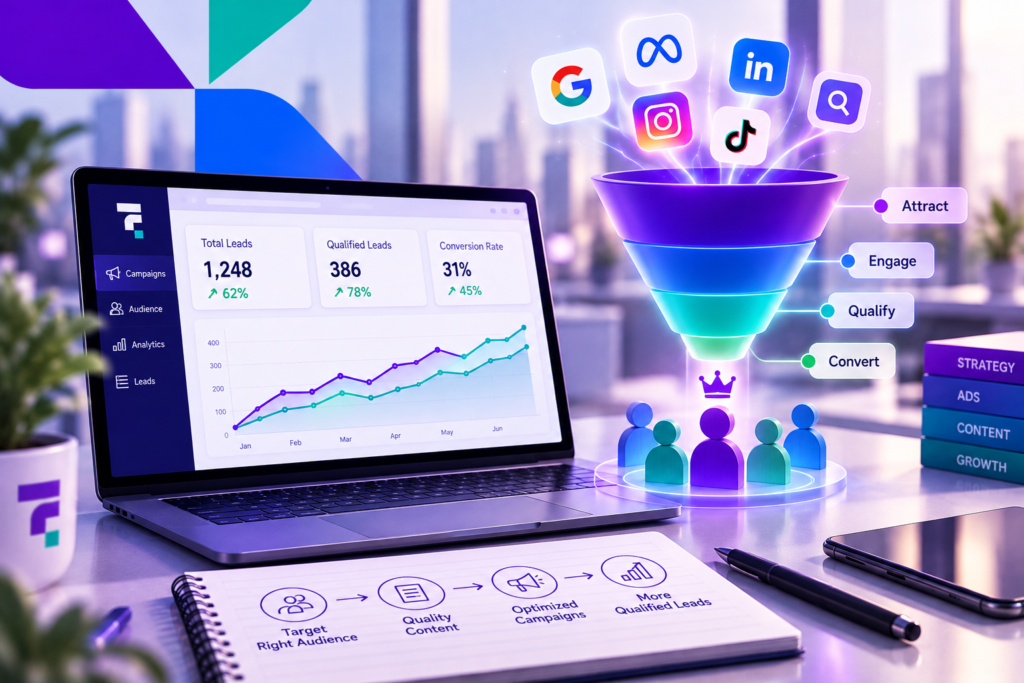
Every business wants more leads. More inquiries, more phone calls, more WhatsApp messages, and more people showing interest in its products or services.
But here’s something many businesses discover after spending thousands on advertising: more leads don’t always mean more sales.
You might receive 200 inquiries from a marketing campaign, only to discover that most people aren’t interested in buying, can’t afford your services, or aren’t even part of your target audience.
Meanwhile, another campaign generating just 40 inquiries might produce more paying customers.
That’s the difference between generating leads and attracting qualified leads.
For businesses operating in competitive markets like New Cairo, understanding this difference can significantly improve marketing efficiency.
Working with a digital marketing agency New Cairo businesses can rely on helps connect audience targeting, messaging, and campaign performance with actual sales opportunities.
So, how can your business attract people who are genuinely interested in what you offer?
1. Understand What Makes a Lead High Quality
Before launching another advertising campaign, it’s important to define what a qualified lead actually means for your business.
A lead is someone who expresses interest in your product or service. However, that interest doesn’t automatically mean they’re ready or able to purchase.
What Separates Qualified Leads From General Inquiries?
High-quality leads typically demonstrate several characteristics:
They have a genuine need for your product or service.
Their budget is reasonably aligned with your offering.
They fall within your target market or service area.
They have the authority or ability to make a purchasing decision.
Their expected purchasing timeline fits your sales process.
Consider a company offering premium office spaces in New Cairo.
An inquiry from someone looking for an affordable shared desk might not match its offering.
However, an established company searching for a private office in a specific business district could represent a stronger opportunity.
Both people are technically leads, but their potential value is different.
Understanding these distinctions helps businesses avoid spending time and money pursuing inquiries that are unlikely to convert.
2. Build Your Marketing Around the Right Audience
One of the biggest reasons campaigns generate poor-quality leads is overly broad targeting.
Businesses sometimes assume that reaching more people automatically increases their chances of finding customers.
In reality, attracting the wrong audience can consume your advertising budget without producing meaningful results.
Define Your Ideal Customer Profile
Start by examining your existing customers.
Look for common characteristics among people who purchase regularly, generate strong revenue, or are particularly satisfied with your services.
Ask questions such as:
Which customers benefit most from our offering?
What problems motivate them to contact us?
What is their typical budget?
Where are they located?
How do they usually discover our business?
For B2B companies, you might also consider industry, company size, and decision-maker responsibilities.
Segment Your Audience
Instead of communicating with everyone using the same message, divide your audience into meaningful groups.
For example, a marketing agency might target newly established businesses needing brand awareness, growing companies looking for more qualified leads, and established brands seeking better advertising efficiency.
Each group has different challenges and expectations.
Your campaigns should reflect those differences.
3. Use Search Intent to Reach Potential Customers
One of the most effective ways to improve lead quality is to understand what people are searching for and why.
Someone searching for “what is digital marketing” is probably looking for information.
Someone searching for “digital marketing services in New Cairo” may be actively evaluating agencies.
Both searches have value, but they represent different levels of commercial intent.
Focus on Keywords That Match Your Services
A strong SEO strategy combines informational content with service-focused pages.
Informational articles help potential customers understand their challenges.
Service pages explain how your business can solve those challenges.
Location-based keywords help businesses connect with relevant local audiences.
For example, targeting digital marketing agency New Cairo can help an agency align its website content with searches from businesses looking for marketing services in that area.
However, keywords alone aren’t enough.
Your website must also provide clear, relevant information that matches what visitors expect to find.
Avoid Chasing Traffic Without Purpose
A blog attracting thousands of visitors might contribute little to lead generation if its audience has no interest in your services.
That doesn’t make informational content useless.
It means businesses should understand the role each page plays in their marketing strategy.
Some content introduces your brand. Other pages help visitors compare options or take action.
Both can contribute to growth when connected to a clear customer journey.
4. Create Advertising Messages That Filter the Right Audience
Advertising isn’t only about attracting attention.
It’s also about helping people understand whether your offering is right for them.
A vague advertisement might generate curiosity and clicks from a broad audience, while a more specific message can attract fewer but more relevant inquiries.
Be Clear About What You’re Offering
Imagine a company promoting premium interior design services.
An advertisement saying “Transform Your Home Today” could appeal to almost anyone.
A more specific message such as “Complete Interior Design Solutions for New Cairo Homes” provides clearer information about the service and intended audience.
When appropriate, advertisements can also mention service categories, starting prices, or other important qualifications.
This allows potential customers to evaluate whether the offering matches their needs before contacting the business.
Match Your Message to Customer Problems
Strong advertising addresses a real concern.
Rather than simply promoting a service, explain what problem it helps solve.
For example:
“Getting Plenty of Leads but Not Enough Sales? Discover What’s Holding Your Campaigns Back.”
This message speaks directly to businesses experiencing a specific marketing challenge.
Relevant messaging helps attract people who recognize the problem and want to explore a solution.
5. Improve Lead Quality Through Better Landing Pages
Even well-targeted advertising campaigns can generate disappointing results when visitors arrive on ineffective landing pages.
A landing page should do more than encourage someone to complete a form.
It should help visitors understand the service and determine whether it’s suitable for them.
Include Information That Supports Better Decisions
An effective landing page typically communicates:
The service or product being offered.
Who the offering is designed for.
The main benefits customers can expect.
Relevant proof of experience or credibility.
What happens after submitting an inquiry.
For services with different packages or eligibility requirements, providing additional details can reduce misunderstandings.
Ask the Right Questions
Lead forms should be simple, but they can also collect information that helps identify customer needs.
For example, a B2B service provider might ask about company type, required service, or estimated project timeline.
Avoid requesting unnecessary personal information.
The goal is to collect enough context to support a productive conversation without making the inquiry process difficult.
6. Combine SEO and Paid Advertising for Stronger Results
SEO and paid advertising are often treated as separate activities.
However, they can work together to attract customers at different stages of the buying journey.
Use SEO to Build Long-Term Visibility
SEO helps your business become discoverable through relevant searches.
Useful articles, optimized service pages, and local search improvements can support organic traffic over time.
Although SEO usually requires patience, it can become an important source of qualified inquiries.
Use Paid Advertising for Targeted Reach
Google Ads can help businesses appear for selected search terms, while Meta Ads can reach audiences based on available targeting signals and campaign objectives.
Paid campaigns also provide opportunities to test messages, offers, and landing pages.
Insights from advertising performance can inform SEO content, while successful organic content can inspire new advertising concepts.
A digital marketing agency New Cairo companies partner with can coordinate these activities to create a more consistent lead generation strategy.
7. Qualify Leads Before Passing Them to Sales
Not every inquiry needs the same level of attention.
Some prospects are ready to make a decision, while others are still researching their options.
Treating both groups identically can create unnecessary pressure on your sales team.
Introduce a Simple Lead Qualification Process
You can evaluate inquiries based on factors such as:
Service relevance.
Budget compatibility.
Purchasing timeline.
Decision-making authority.
Level of demonstrated interest.
For example, a prospect requesting a detailed quotation for a project starting next month may deserve faster sales attention than someone casually exploring future possibilities.
This doesn’t mean ignoring early-stage prospects.
They may benefit from educational content, follow-up emails, or helpful information until they’re ready to move forward.
Keep Marketing and Sales Connected
Marketing teams should understand what happens after a lead is generated.
If the sales team repeatedly reports that inquiries are irrelevant, that feedback should influence audience targeting and campaign messaging.
Likewise, if certain campaigns consistently produce paying customers, marketing teams should investigate what makes those leads different.
Regular communication between both teams helps improve lead quality over time.
8. Measure Lead Quality Instead of Just Lead Volume
Cost per lead is useful, but it doesn’t tell the full story.
A campaign producing cheap inquiries can become expensive if almost none of those inquiries turn into customers.
Track the Metrics That Matter
Consider monitoring:
Cost per lead (CPL): Advertising cost divided by the number of leads generated.
Lead-to-customer conversion rate: The percentage of leads that become customers.
Cost per acquisition (CPA): The cost of acquiring a paying customer.
Qualified lead rate: The percentage of inquiries meeting your qualification criteria.
Revenue generated: Sales associated with leads from each campaign.
For example, consider two campaigns with the same EGP 10,000 budget.
Metric | Campaign A | Campaign B |
|---|---|---|
Leads generated | 200 | 80 |
Cost per lead | EGP 50 | EGP 125 |
Paying customers | 4 | 10 |
Cost per customer | EGP 2,500 | EGP 1,000 |
Although Campaign B generates fewer leads at a higher cost per lead, it acquires more customers at a lower cost per customer.
This illustrates why businesses should evaluate advertising performance using actual sales outcomes whenever reliable data is available.
9. Keep Improving Your Lead Generation Strategy
Attracting qualified leads isn’t a one-time achievement.
Audience behavior changes, competitors adjust their offers, and advertising platforms evolve.
Regular optimization helps businesses maintain campaign relevance.
What Should You Review?
Evaluate campaign performance using both marketing data and sales feedback.
Look for opportunities to improve:
Audience targeting and exclusions.
Keyword selection and search terms.
Advertising messages and creative assets.
Landing page relevance.
Lead qualification questions.
Follow-up processes.
Rather than making changes based on assumptions, use measurable results to guide decisions.
Sometimes, improving lead quality means accepting a higher cost per inquiry in exchange for a better chance of generating revenue.
The objective is to build a reliable pipeline of potential customers, not simply produce impressive numbers in an advertising dashboard.
Build a Lead Generation Strategy That Supports Real Growth
Generating leads is important, but attracting the right leads is what creates stronger business opportunities.
When your targeting, messaging, landing pages, and sales processes work together, your marketing becomes more focused and efficient.
Instead of measuring success by the number of inquiries alone, you can start evaluating how effectively those inquiries contribute to actual business growth.
At Fluxcel, we help businesses develop performance-focused marketing strategies designed to attract relevant audiences and improve lead generation results.
As a digital marketing agency New Cairo businesses can work with for SEO, paid advertising, and marketing optimization, we focus on connecting marketing activities with meaningful business objectives.