
One of the easiest ways to waste a marketing budget is trying to be everywhere.
Google Ads. Instagram. Facebook. TikTok. LinkedIn. YouTube. SEO. Email marketing. Influencers. Display advertising.
Every channel offers opportunities, and every platform has success stories. That can make businesses feel like they need to use all of them at once.
They don’t.
The best digital marketing strategy isn’t the one with the most channels. It’s the one that uses the right channels for the right customers at the right stage of their journey.
For businesses looking for a Digital marketing agency New Cairo, choosing where to invest should start with customer behavior and business objectives—not simply with whichever platform is currently getting the most attention.
Start With the Goal, Not the Platform
Businesses often approach marketing backwards.
They decide:
“We need to be on TikTok.”
Or:
“Let’s start Google Ads.”
Then they try to figure out what those platforms should achieve.
A stronger approach begins with the business objective.
Are you trying to:
- Generate qualified leads?
- Increase e-commerce sales?
- Build brand awareness?
- Launch a new product?
- Increase appointments?
- Reach business decision-makers?
- Enter a new geographic market?
- Increase repeat purchases?
Once the goal is clear, it becomes easier to identify which channels are suited to achieving it.
A platform isn’t good or bad by itself.
Its value depends on what you’re asking it to do.
Understand Where Your Customers Spend Their Time
Your business doesn’t need to be everywhere.
It needs to be where your customers are.
A B2B company trying to reach senior executives may prioritize very different channels from a fashion e-commerce brand targeting younger consumers.
Start by studying your audience.
Ask:
- Which platforms do they use?
- Where do they search for information?
- How do they discover new brands?
- What influences their purchasing decisions?
- Do they actively search for your service?
- How long does the buying decision usually take?
Customer behavior should guide channel selection.
Don’t choose a platform simply because it has millions of users.
Choose it because enough of the right users are there.
Understand the Difference Between Demand Capture and Demand Creation
This distinction can completely change how you think about digital channels.
Demand Capture
Some channels are particularly useful when customers already know what they need.
Google Search is a good example.
Someone searching:
“Digital marketing agency New Cairo”
is demonstrating a different level of intent from someone casually scrolling through Instagram.
Search marketing can capture that existing demand.
Demand Creation
Other channels are useful for introducing a brand, product, service, or problem before the customer actively searches for it.
Social media advertising can be powerful here.
A potential customer may not have been looking for your company at that exact moment, but the right creative can generate interest.
Strong strategies often use both.
One builds future demand.
The other captures people when they’re ready to act.
When SEO Makes Sense
SEO is particularly valuable for businesses whose customers use Google to research problems, services, products, or providers.
It can help build sustainable organic visibility over time.
SEO can work well when:
- Customers actively search for your services
- Your website contains valuable information
- You want long-term organic traffic
- Local search matters
- Customers research before purchasing
- You can consistently develop useful content
However, SEO is rarely an instant solution.
Building meaningful visibility can take time, particularly in competitive industries.
The advantage is that strong organic rankings can continue attracting potential customers without paying for every click.
When Google Ads Makes Sense
Google Ads can be powerful when customers already have clear intent.
If someone searches specifically for the service you offer, paid search can put your business directly in front of them.
It is often useful for:
- Lead generation
- Local services
- High-intent searches
- E-commerce
- Time-sensitive campaigns
- Competitive search terms
But success requires more than selecting keywords and adding a budget.
Businesses need to consider:
- Search intent
- Negative keywords
- Ad messaging
- Geographic targeting
- Landing pages
- Conversion tracking
- Lead quality
A campaign generating lots of clicks isn’t necessarily successful if those clicks rarely become customers.
When Meta Ads Make Sense
Facebook and Instagram advertising can help businesses reach customers based on interests, behavior, engagement, and other available targeting signals.
Meta can support several objectives, including:
- Brand awareness
- E-commerce sales
- Lead generation
- Retargeting
- Product launches
- Content distribution
Creative plays a major role.
Unlike Google Search, people aren’t necessarily looking for your product while scrolling through Instagram.
Your advertisement has to earn their attention.
Strong visuals, relevant hooks, clear benefits, and compelling offers become particularly important.
When Organic Social Media Makes Sense
Organic social media is valuable for much more than posting announcements.
It can help customers understand the personality, expertise, products, and credibility of a brand.
It’s particularly useful for:
- Building community
- Establishing familiarity
- Demonstrating expertise
- Showing products visually
- Sharing customer experiences
- Supporting brand credibility
Organic social media may not always produce immediate sales, especially for businesses with longer buying cycles.
Its value often appears across multiple customer touchpoints.
A person might discover your company through Google and then check Instagram before contacting you.
Your social presence becomes part of their evaluation process.
When LinkedIn Makes Sense
LinkedIn can be particularly useful for B2B companies and businesses targeting professionals or organizational decision-makers.
Potential applications include:
- B2B lead generation
- Thought leadership
- Employer branding
- Professional services
- Corporate partnerships
- Industry networking
The content usually needs to reflect the environment.
Content designed for Instagram shouldn’t automatically be copied and pasted to LinkedIn without considering the audience and context.
When YouTube Makes Sense
YouTube combines elements of search, social media, and long-form content.
It can be valuable when customers need to understand something before making a decision.
Businesses can use YouTube for:
- Educational content
- Product demonstrations
- Tutorials
- Customer stories
- Expert insights
- Brand storytelling
Video content can also be repurposed across other platforms, making production more efficient.
The challenge is creating content useful enough for people to choose to watch.
Don’t Ignore Email Marketing
Email is sometimes overlooked because it isn’t a new or trendy channel.
But it has one major advantage:
You’re communicating with people who have already given you permission to contact them.
Depending on the business, email can support:
- Lead nurturing
- Customer retention
- Product launches
- Promotions
- Educational content
- Abandoned cart recovery
- Repeat purchases
- Customer reactivation
Instead of constantly paying to reach completely new people, email helps businesses get more value from relationships they have already created.
Match the Channel to the Customer Journey
The same customer may interact with several channels before purchasing.
For example:
They discover your brand through Instagram.
Later, they search your company on Google.
They visit your website.
They read a blog article.
They leave.
A retargeting advertisement reminds them about your service.
They return and submit an inquiry.
Which channel generated the lead?
In reality, several contributed.
This is why a Digital marketing agency New Cairo strategy shouldn’t judge every channel in complete isolation.
Different channels can perform different roles.
Don’t Spread Small Budgets Too Thin
Imagine having a limited monthly marketing budget and dividing it equally between eight channels.
Each platform receives too little investment to generate meaningful data or consistent results.
Instead, prioritize.
Choose a small number of channels with the strongest connection to your goals and audience.
Build enough activity to understand performance.
Then expand strategically.
This usually produces more useful information than maintaining a weak presence everywhere.
Evaluate Channels Using the Right Metrics
You shouldn’t judge every channel using the same KPI.
For an awareness campaign, relevant metrics might include:
- Reach
- Frequency
- Video views
- Brand engagement
For a traffic campaign:
- Website visits
- Cost per click
- Engaged sessions
For lead generation:
- Qualified leads
- Cost per qualified lead
- Conversion rate
For e-commerce:
- Purchases
- Cost per acquisition
- Average order value
- Return on ad spend
Measurement should reflect what the channel is actually supposed to accomplish.
Look at Customer Quality, Not Just Acquisition Cost
The cheapest channel isn’t automatically the best channel.
Imagine one platform generates leads for EGP 150 each while another generates leads for EGP 300.
The first appears better.
But what if 5% of those leads become customers while 25% of the more expensive leads convert?
The second channel may be significantly more valuable.
Connect marketing data with sales results whenever possible.
This helps you understand where your best customers come from—not simply your cheapest leads.
Test Channels Before Making Big Commitments
You don’t always know which channel will work best before testing.
Customer behavior can surprise you.
Start with a clear hypothesis.
Define:
- The audience
- The objective
- The offer
- The creative
- The budget
- The measurement criteria
Run the test long enough to collect meaningful information.
Then decide whether to optimize, scale, or move the budget elsewhere.
Testing turns channel selection from opinion into evidence.
Build a Channel Mix That Works Together
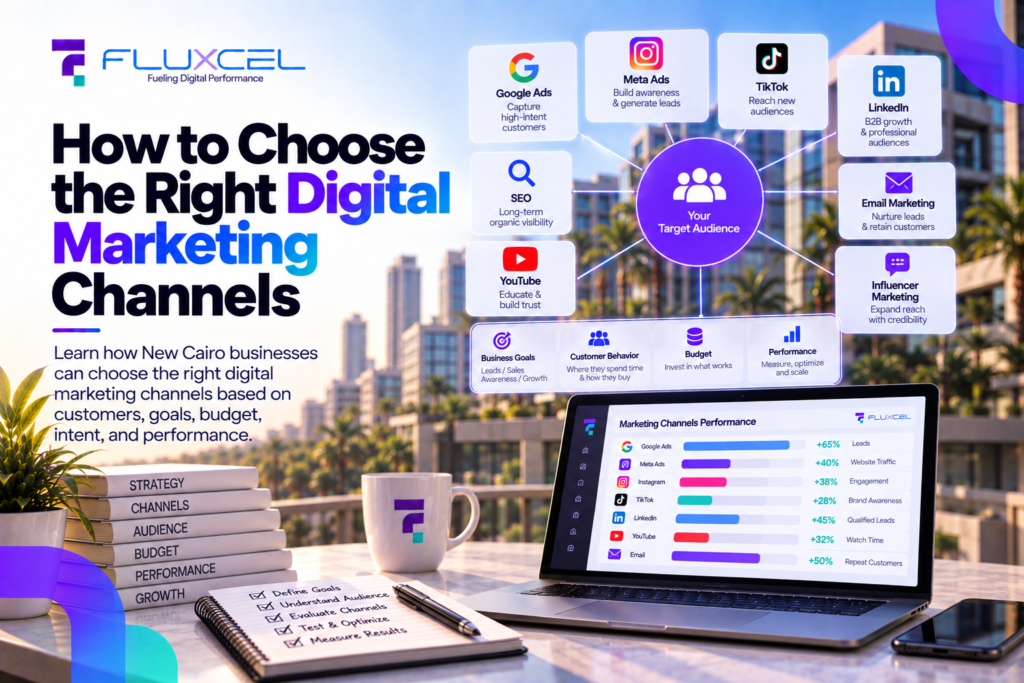
The strongest digital strategies often use a combination of channels.
For example:
SEO builds long-term visibility.
Google Ads captures immediate search demand.
Social media develops awareness and trust.
Meta Ads expands reach and supports retargeting.
Email nurtures leads and existing customers.
These channels don’t need to compete with one another.
They can support different stages of the same customer journey.
Choose Channels Based on Your Business, Not Trends
There will always be another platform, format, or marketing trend getting attention.
That doesn’t mean your business needs it.
The right channel mix depends on your customers, goals, budget, buying cycle, competition, content capabilities, and existing performance data.
For businesses searching for a Digital marketing agency New Cairo, channel selection should be a strategic decision rather than a checklist of platforms.
At Fluxcel, we help businesses identify where their customers are, how they make decisions, and which digital channels can play the strongest role in reaching measurable business goals.