
Not every person who sees your brand online is ready to buy.
Some are discovering your business for the first time. Others are researching a problem, comparing different companies, checking prices, reading reviews, or looking for one final reason to make a decision.
Yet many businesses market to all of these people in exactly the same way.
They show the same advertisement, send visitors to the same page, use the same call-to-action, and expect everyone to convert.
That approach ignores one of the most important parts of digital marketing: customer intent.
Understanding what someone is trying to accomplish at a particular moment can help businesses create more relevant content, stronger advertising campaigns, and better customer journeys.
For companies operating in New Cairo, where customers can compare multiple brands within minutes, understanding intent can be the difference between simply getting attention and actually generating business.
A Digital marketing agency New Cairo businesses work with should therefore build strategies around what customers need at each stage—not just which platforms they use.
What Is Customer Intent?
Customer intent describes what someone is trying to achieve when they interact with your business or search online.
Consider these three searches:
“What is SEO?”
“SEO vs Google Ads for small businesses”
“Digital marketing agency New Cairo”
All three people are interested in digital marketing, but their intentions are very different.
The first person is probably looking for information.
The second is comparing options.
The third may already be searching for a company to work with.
Treating them as the same audience would miss important differences in their readiness to take action.
Understand the Different Levels of Intent
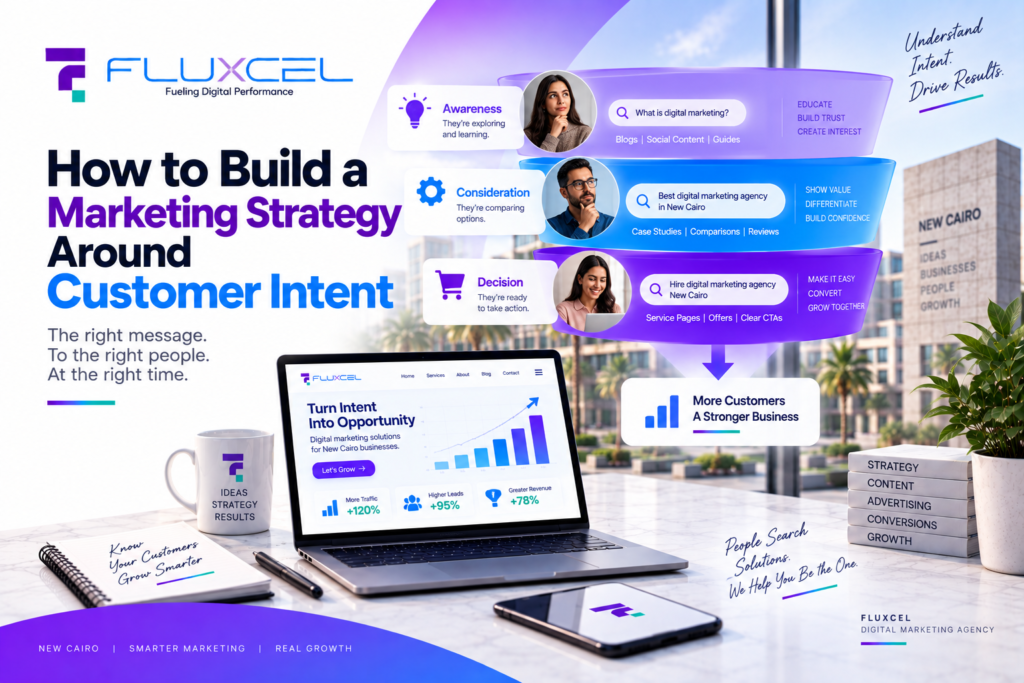
Customer intent can be simplified into several stages.
Informational Intent
At this stage, someone wants to learn something.
They may be researching a problem without knowing exactly what solution they need.
Typical searches might include:
- How does digital marketing work?
- How can I generate more leads?
- Why isn’t my website getting traffic?
- How can I improve online sales?
Educational blogs, guides, videos, FAQs, and social content work particularly well here.
The goal isn’t necessarily to push for an immediate sale.
It’s to become a useful source of information and introduce the customer to your brand.
Commercial Intent
Now the customer understands the problem and is researching possible solutions.
They might compare services, read reviews, explore case studies, or investigate pricing.
Content for this stage could include:
- Service comparisons
- Case studies
- Testimonials
- Product demonstrations
- Pricing information
- Detailed service pages
The objective is to show why your solution deserves consideration.
Transactional Intent
This customer is much closer to taking action.
They might search for a provider, request a quote, book an appointment, or look for a particular product.
At this stage, customers need clarity rather than more general education.
Strong landing pages, clear offers, visible CTAs, easy forms, and simple booking or checkout experiences become extremely important.
Map Content to the Customer Journey
One content format cannot do everything.
An educational blog might be excellent for attracting someone early in the journey but weak at converting a customer who is ready to request a quote.
Likewise, an aggressive sales advertisement may not work well for someone who has only just discovered that they have a problem.
Create content that supports different stages.
Awareness Content
Help customers understand a problem or opportunity.
Examples include educational videos, blogs, tips, guides, and social posts.
Consideration Content
Help potential customers evaluate solutions.
Use case studies, FAQs, testimonials, comparisons, demonstrations, and detailed service information.
Decision Content
Make taking action easy.
Use landing pages, consultations, offers, product pages, booking pages, and clear calls-to-action.
This creates a smoother journey from discovery to conversion.
Use Search Intent to Improve SEO
SEO becomes much more effective when keyword decisions are based on intent rather than search volume alone.
A keyword with 10,000 searches per month might look attractive.
But if those searches are mostly informational and your objective is immediate lead generation, a smaller keyword with strong commercial intent could be more valuable.
Match the Page to the Search
Different searches should lead to different types of pages.
An informational query might lead to a blog.
A service-related query should usually lead to a relevant service page.
A local high-intent search should lead to a page that clearly explains the service, location, benefits, trust signals, and next step.
A Digital marketing agency New Cairo brands work with should consider why someone is searching—not simply how often a keyword is searched.
Make Paid Ads Match Customer Intent
Advertising platforms provide powerful targeting capabilities, but targeting alone does not create relevance.
The message must also match what the customer wants.
Someone actively searching Google for a service is demonstrating stronger immediate intent than someone casually scrolling through social media.
Both audiences can be valuable, but they shouldn’t necessarily receive the same message.
Google Ads Can Capture Existing Demand
Search campaigns can reach people actively looking for specific products, services, or solutions.
The advertisement should closely match the search.
If someone searches for a specific service in New Cairo, avoid sending them to a generic homepage.
Take them directly to the most relevant page.
Social Ads Can Build and Develop Demand
Meta, Instagram, LinkedIn, and similar platforms can introduce customers to solutions they weren’t actively searching for.
Here, the creative needs to generate interest.
Lead with a customer problem, useful insight, strong benefit, or relevant opportunity rather than assuming the audience already knows what they need.
Use Retargeting Based on Behavior
Not every website visitor should receive the same retargeting advertisement.
Behavior provides clues about intent.
Someone who read one blog article may still be researching.
Someone who visited your pricing page three times is showing a very different level of interest.
Someone who added a product to their cart but didn’t purchase may be even closer to conversion.
Change the Message as Intent Increases
For early-stage visitors, you might promote educational content.
For people exploring service pages, show testimonials or case studies.
For high-intent visitors, use a stronger CTA or relevant offer.
This makes retargeting feel like the next stage of the conversation instead of repeating the same message.
Build Landing Pages for Specific Intent
Generic landing pages often try to speak to everyone.
As a result, they connect strongly with no one.
A better landing page is designed around one audience, one problem, and one primary action.
The headline should immediately confirm that the visitor is in the right place.
Then explain:
- The problem you solve
- The value of your solution
- Key benefits
- Why customers should trust you
- What they should do next
Remove information that distracts from the main objective.
Match Your CTA to Readiness
Not everyone is ready for Buy Now.
Calls-to-action should reflect customer intent.
Someone at an early stage might respond better to:
Explore Our Services
or:
Read the Full Guide
A customer comparing options may be ready for:
View Our Work
or:
See How It Works
A high-intent customer could be ready for:
Request a Quote
Book Your Consultation
Get Started
Matching the CTA to readiness can make the customer journey feel more natural.
Use First-Party Data to Understand Intent
Your existing data can reveal a lot about customer behavior.
Look at which pages people visit before converting.
Review which blog topics lead to service-page visits.
Identify which search terms produce qualified leads.
Look at which emails generate clicks and which products customers repeatedly view.
This information can help you understand the behaviors associated with stronger buying intent.
Focus on Patterns
One action doesn’t always mean much.
Someone visiting a pricing page once could simply be curious.
But a visitor who returns several times, reads a case study, checks pricing, and visits the contact page is showing a much stronger pattern.
Marketing becomes more effective when these signals are considered together.
Don’t Push Customers Too Quickly
One of the easiest ways to waste marketing opportunities is asking for too much too soon.
Someone who has never heard of your company may not be ready to book a sales call after seeing one Instagram post.
Give customers enough information to become comfortable with the decision.
Build familiarity.
Answer questions.
Demonstrate expertise.
Show evidence.
Then make the next step easy when they are ready.
Good marketing doesn’t just push customers toward a sale. It removes the barriers preventing them from reaching one.
Measure Performance by Intent
Different campaigns should not always be judged by the same metric.
An awareness campaign might be evaluated using reach, video engagement, branded search growth, or website visits.
A lead generation campaign should be measured through qualified leads and cost per acquisition.
A remarketing campaign might focus on conversion rate and revenue.
Understanding the role of each campaign prevents businesses from expecting every marketing activity to produce immediate sales.
A Digital marketing agency New Cairo companies partner with should connect these stages while still measuring each one according to its purpose.
Build Marketing Around What Customers Actually Want
Effective digital marketing is not about showing the same message to as many people as possible.
It’s about understanding what people need at different moments and giving them the right message, content, and next step.
Use search intent to guide SEO. Match advertising to customer awareness. Create content for different buying stages. Build landing pages around specific needs. Adjust retargeting based on behavior. And make your CTAs reflect how ready someone is to act.
When marketing follows customer intent, the journey becomes more relevant—and relevant marketing has a much better chance of turning attention into business.
At Fluxcel Digital Marketing Agency, we help businesses connect audience insights, SEO, content, advertising, customer journeys, and conversion strategy to create marketing built around real customer behavior.