
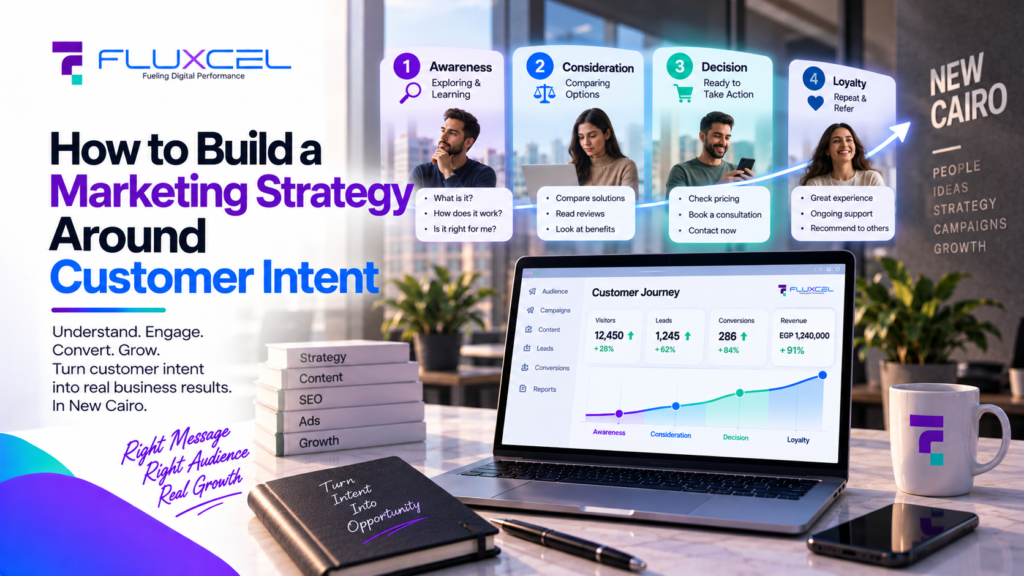
Not every potential customer is ready to buy.
Some people are discovering a problem for the first time. Others are researching possible solutions. Some are comparing businesses, prices, and reviews. And a smaller group is ready to call, book, request a quote, or make a purchase right now.
Yet many businesses market to all of these people in exactly the same way.
They show the same advertisement, use the same message, send everyone to the same landing page, and expect the same response.
That’s where marketing becomes inefficient.
Understanding customer intent allows businesses to match their marketing with what people actually want at each stage of their journey. A professional Digtial marketing agency new cairo can use these signals to create more relevant campaigns, improve lead quality, and move potential customers naturally toward a purchase.
What Is Customer Intent?
Customer intent describes what someone is trying to accomplish when they interact with your business.
Consider two Google searches:
“What is Invisalign?”
and
“Invisalign clinic New Cairo.”
Both searches relate to the same service, but they show very different levels of intent.
The first person is probably researching.
The second may already be looking for a provider.
Showing both people exactly the same marketing message misses an opportunity.
Understanding intent helps you determine what information, offer, or CTA is most appropriate at that moment.
Understand the Main Levels of Customer Intent
Customer journeys aren’t always perfectly linear, but it can help to divide intent into a few broad stages.
Informational Intent
These customers are looking for answers.
They may not even know exactly what solution they need yet.
Searches might include:
- How does this work?
- What causes this problem?
- What are the benefits?
- How much should I expect to pay?
- What are my options?
- What should I look for?
At this stage, aggressively pushing a sale may be premature.
Educational blogs, guides, videos, FAQs, and social content can be much more effective.
The objective is to become a useful source of information while introducing your brand.
Consideration Intent
Now the customer understands the problem and is evaluating solutions.
They might compare different services, brands, products, or providers.
At this stage, customers often want to know:
Why should I choose you?
Useful content includes:
- Service comparisons
- Customer reviews
- Testimonials
- Case studies
- Product demonstrations
- Before-and-after examples
- Detailed service pages
- FAQs about the buying process
This is where trust becomes extremely important.
Transactional Intent
These customers are closer to taking action.
They may search for prices, availability, appointments, quotations, offers, or specific providers.
Marketing should make conversion easy.
Use clear CTAs such as:
- Book Now
- Request a Quote
- Shop Now
- Schedule a Consultation
- Call Today
- Get Started
- Send Us a WhatsApp Message
Don’t overwhelm high-intent customers with unnecessary information or complicated processes.
Help them take the next step.
Use Search Behavior to Understand What Customers Want
Search engines provide some of the clearest signals of customer intent.
Someone searching for “best running shoes for beginners” is probably researching.
Someone searching for a particular shoe model with “buy online Egypt” has much stronger purchase intent.
This distinction should influence your SEO and Google Ads strategies.
Build Content Around Different Search Intent
Your website shouldn’t consist only of service or product pages.
Create content for multiple stages of the customer journey.
For example:
Educational Blog → Comparison Page → Service Page → Contact Page
A customer could discover your business through an informational article and return later when they’re ready to purchase.
A Digtial marketing agency new cairo can map keywords to different customer intentions rather than treating every keyword as an immediate sales opportunity.
Match Advertising With Audience Intent
Paid advertising becomes much stronger when messaging reflects how familiar someone already is with your business.
Imagine showing the same “Who We Are” advertisement to someone who has visited your website five times.
That person probably doesn’t need another introduction.
They need a reason to act.
Create Different Messages for Different Audiences
For completely new audiences, introduce the problem and your value.
For engaged audiences, provide education and proof.
For website visitors, address objections or highlight benefits.
For people who viewed specific products, remind them about those products.
For previous customers, introduce relevant additional services or offers.
This makes advertising feel more relevant and prevents businesses from repeating the same message throughout the entire customer journey.
Create Content That Matches Real Customer Questions
One of the easiest ways to understand intent is to listen to customers.
What do people ask your sales team?
What questions appear in WhatsApp conversations?
What concerns do customers raise before purchasing?
Why do people decide not to buy?
These conversations contain valuable marketing insights.
Turn Questions Into Content
If customers constantly ask about pricing, create content explaining what affects pricing.
If they worry about quality, show how your product or service is delivered.
If they don’t understand the difference between two options, create a comparison.
If they need reassurance, publish customer experiences or case studies.
Instead of guessing what content people want, use the questions they’re already asking.
Improve Landing Pages Based on Intent
Not every visitor should necessarily land on your homepage.
Someone clicking a campaign for a specific service should see information about that service.
Someone responding to a promotional offer should immediately see the offer.
Someone searching for pricing should be able to understand the value and cost structure without navigating through several unrelated pages.
Maintain Message Consistency
Your customer should feel like they’re continuing the same conversation.
Search/Ad → Landing Page → CTA
If the message changes dramatically between these stages, conversion can suffer.
A strong landing page should answer the question or need that brought the visitor there in the first place.
Use Retargeting to Respond to Customer Behavior
Retargeting becomes much more powerful when it’s based on behavior rather than simply targeting “all website visitors.”
A person who read one blog is different from someone who visited your pricing page three times.
Their intent signals aren’t equal.
Build More Relevant Retargeting
You could create different messages for:
- Blog readers
- Service-page visitors
- Product viewers
- Video viewers
- Social media engagers
- Cart abandoners
- Previous leads
- Existing customers
Someone who abandoned checkout might need a reminder.
Someone who watched an educational video might benefit from a case study.
Someone who repeatedly visited a service page might be ready for a consultation offer.
Use behavior to determine the next message.
Score Leads Based on Intent
Not every lead deserves exactly the same follow-up priority.
Some prospects are simply exploring. Others need your service immediately.
Lead scoring can help sales teams understand which opportunities require the fastest attention.
Useful Intent Signals Could Include
- Requesting pricing
- Booking a consultation
- Visiting key pages repeatedly
- Selecting a specific service
- Providing budget information
- Downloading a resource
- Opening multiple emails
- Returning to the website
- Requesting a quotation
The stronger the buying signals, the more valuable fast and personalized follow-up becomes.
Don’t Confuse Engagement With Intent
A post receiving thousands of likes doesn’t necessarily mean thousands of people want to purchase.
Similarly, someone may watch an entire video because it’s entertaining without having any interest in becoming a customer.
Engagement is useful, but it needs context.
A smaller audience with strong purchasing intent can sometimes be far more valuable than a massive audience with little commercial interest.
A Digtial marketing agency new cairo should therefore evaluate campaigns using metrics connected to the objective.
For awareness, reach and engagement may matter.
For lead generation, qualified leads become more important.
For sales campaigns, revenue and customer acquisition cost should receive greater attention.
Use Intent Data to Spend Marketing Budgets Smarter
Customer intent can also help businesses decide where their budgets should go.
High-intent audiences may justify more aggressive advertising because they’re closer to conversion.
Lower-intent audiences can still be valuable, but they may need education and nurturing before they’re ready.
Instead of expecting every campaign to immediately generate sales, assign each campaign a role.
For example:
Awareness campaigns introduce the brand.
Content campaigns educate customers.
Retargeting campaigns build consideration.
Conversion campaigns capture demand.
Together, these campaigns create a more complete customer journey.
Keep Learning From Customer Behavior
Customer intent isn’t something you define once.
People change.
Markets change.
Competitors introduce new offers.
Customer expectations evolve.
Use search data, website analytics, advertising performance, CRM information, customer feedback, and sales conversations to continuously improve your understanding.
Look for patterns.
Which questions appear before customers convert?
Which pages do successful customers visit?
Which advertising messages attract the best leads?
Which objections cause deals to be lost?
Every answer can improve your marketing strategy.
Build Marketing Around What Customers Actually Want
Great digital marketing doesn’t begin with asking:
“What do we want to promote?”
It begins with:
“What does the customer need right now?”
Understanding customer intent allows businesses to deliver the right message at the right stage instead of pushing the same sales message to everyone.
Create educational content for people researching.
Build trust for customers comparing options.
Remove friction for people ready to purchase.
Retarget audiences based on their behavior.
Prioritize leads showing stronger buying signals.
Then use performance data to continuously improve the journey.
Working with a Digtial marketing agency new cairo can help connect SEO, paid advertising, content, analytics, website experience, and sales around actual customer behavior.
At Fluxcel Digital Marketing Agency, we focus on understanding not only who your audience is, but what they’re looking for and when they’re ready to act.