
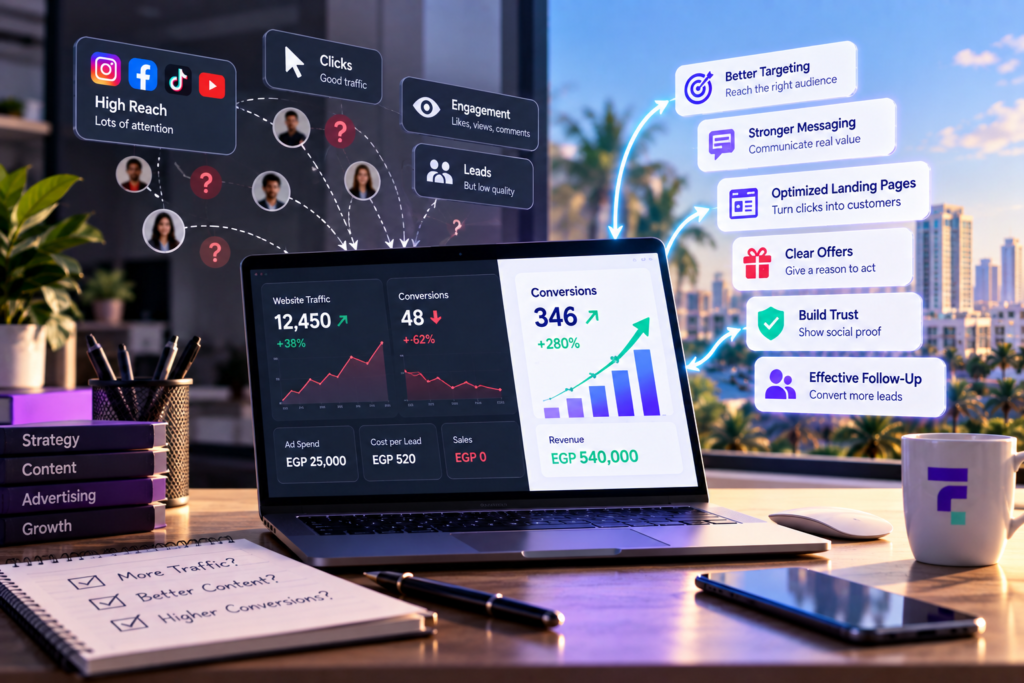
Your ads are running. Your social media accounts are active. Website traffic looks healthy. People are liking, clicking, watching, and sometimes even sending messages.
But sales are not growing at the same rate.
It is one of the most frustrating situations for a business investing in digital marketing.
When this happens, the natural reaction is often to blame the advertising platform, increase the budget, change the creative, or launch another campaign.
Sometimes those changes help. But often, the real problem is deeper.
Digital marketing conversion depends on the entire customer journey. Your targeting, message, offer, website, credibility, follow-up, and customer experience all influence whether attention eventually becomes revenue.
For businesses looking for a Digital marketing agency New Cairo, understanding where that journey is breaking can be more valuable than simply generating more traffic.
You Are Getting Attention From the Wrong Audience
High reach can look impressive in a marketing report.
But reaching thousands of people who are unlikely to become customers creates very little business value.
Imagine a premium service business running broad campaigns focused on generating the cheapest possible clicks. The campaign may produce excellent traffic numbers while attracting people who are not suitable for the service.
The problem is not necessarily the ad.
It is the audience.
Look Beyond Demographics
Strong targeting goes beyond age, gender, and location.
Think about:
- Customer needs
- Purchase intent
- Interests
- Online behavior
- Budget expectations
- Previous interactions with your brand
- Stage in the buying journey
The closer your marketing gets to genuine customer intent, the more valuable your traffic can become.
Your Message Is Too Generic
Take a quick look at advertisements in almost any competitive industry.
You will probably find phrases such as:
Best quality.
Professional service.
Affordable prices.
Customer satisfaction guaranteed.
There is nothing inherently wrong with these statements, but competitors can say exactly the same thing.
That creates a problem.
Customers do not have a clear reason to remember your brand.
Make Your Value Specific
Instead of relying on broad claims, communicate something meaningful.
Explain:
- What makes your process different
- Who your service is designed for
- What specific problem you solve
- What customers can expect
- Why your experience matters
- What makes your product or service valuable
Specific messaging makes it easier for the right customer to recognize that your business may be relevant to them.
Your Offer Is Not Strong Enough
Sometimes customers understand what you sell but still have no reason to act.
This is where the offer becomes important.
An offer is not simply a discount.
It is the combination of value, timing, reassurance, and the next step you give a potential customer.
Depending on the business, this might include:
- A consultation
- A personalized quotation
- A free assessment
- A trial
- A product bundle
- An exclusive package
- Free delivery
- A demonstration
Ask yourself:
Why should the customer respond to this campaign today?
If the answer is unclear, the offer may need work.
Your Advertising and Landing Page Do Not Match
A customer sees an interesting advertisement.
They click.
Then they arrive somewhere completely different from what they expected.
This happens surprisingly often.
An advertisement might promote one particular service but direct customers to a general homepage containing ten different services.
The customer now has to search for the information that convinced them to click in the first place.
Some will.
Many will not.
Maintain Message Continuity
If your ad promotes a specific service, the landing page should focus on that service.
If your ad presents an offer, that offer should immediately appear on the destination page.
If your campaign targets a specific customer problem, continue discussing that problem after the click.
Every stage should feel connected.
A Digital marketing agency New Cairo businesses work with should evaluate campaigns beyond the advertising dashboard and consider what users experience after clicking.
Your Website Creates Too Much Friction
Customers usually choose the easiest path.
If your website makes that path difficult, conversion rates can suffer.
Common problems include:
- Slow loading times
- Confusing navigation
- Too many form fields
- Poor mobile design
- Hidden contact information
- Unclear pricing or service details
- Broken buttons
- Complicated checkout processes
Each issue may appear small individually.
Together, they create friction.
Test Your Own Website Like a Customer
Open your website on your phone and try to complete your main conversion action.
Can you easily find the service?
Can you understand what is offered?
Can you contact the company?
How many steps are required?
Does anything feel frustrating?
Businesses often become so familiar with their own websites that they stop noticing these obstacles.
Customers Do Not Trust You Yet
People rarely buy simply because a business tells them it is excellent.
They look for evidence.
This becomes especially important when customers are considering an unfamiliar brand, expensive service, healthcare provider, online store, or long-term business relationship.
Trust can be built through:
- Genuine customer reviews
- Testimonials
- Case studies
- Previous projects
- Clear contact information
- Team expertise
- Certifications
- Helpful educational content
- Transparent policies
The goal is to reduce uncertainty.
Customers should feel that there is a real, credible business behind the website and advertising.
You Are Asking Customers to Buy Too Quickly
Not everyone who discovers your brand today is ready to purchase today.
Some products have short decision cycles.
Others require days, weeks, or even months.
A customer may first discover your company through Instagram, later read one of your blogs, search your brand on Google, check reviews, visit your website several times, and only then contact you.
If your marketing focuses only on immediate conversion, you may lose people who simply need more time.
Build a Nurturing Journey
Use different content to move customers gradually toward a decision.
This could include:
- Educational posts
- Email marketing
- Retargeting campaigns
- Testimonials
- FAQs
- Case studies
- Product demonstrations
- Helpful blog content
Your objective is to stay relevant while the customer is considering their options.
Your Call-to-Action Is Weak or Confusing
Customers should always know what to do next.
A vague CTA such as “Learn More” can work in certain situations, but sometimes a more specific action provides greater clarity.
Examples include:
Book Your Consultation
Request Your Quote
Shop the Collection
Schedule an Appointment
Talk to Our Team
The CTA should match the customer’s stage in the journey.
Someone reading an introductory educational article may not be ready to “Buy Now.”
Someone searching for an emergency service probably does not need another downloadable guide.
Context matters.
You Are Measuring the Wrong Success Metrics
Marketing dashboards provide dozens of metrics.
Not all of them deserve equal attention.
A campaign can achieve:
- High reach
- Low cost per click
- Strong video views
- Thousands of likes
…and still produce very little revenue.
These metrics are not useless, but they need context.
If your goal is customer acquisition, look deeper.
Track:
- Qualified leads
- Conversion rate
- Cost per qualified lead
- Cost per acquisition
- Sales
- Revenue
- Return on ad spend
This helps separate activity from actual performance.
Your Follow-Up Is Losing Potential Customers
Sometimes the digital marketing is working perfectly.
The campaign reaches the right person.
The offer attracts them.
The landing page convinces them.
They submit an inquiry.
Then nobody responds for eight hours.
That is where the conversion is lost.
Treat Lead Response as Part of Marketing
Create a clear follow-up process.
For example:
- Lead submits an inquiry.
- Confirmation is sent immediately.
- Sales receives a notification.
- Lead is contacted quickly.
- Follow-up is recorded in the CRM.
- Additional attempts happen when necessary.
The marketing journey does not end when someone completes a form.
It ends much later.
Your Marketing Channels Are Working Separately
Your social media team publishes content.
Your media buyer runs ads.
Someone else manages Google.
Another person handles the website.
Sales follows up with leads.
But nobody connects the information.
This creates disconnected marketing.
Instead, channels should learn from each other.
If Google Search reveals a frequently searched customer question, turn it into social content.
If sales hears the same objection every day, address it on your landing page.
If a blog generates high-quality organic traffic, consider using that topic in paid campaigns.
If one customer segment converts exceptionally well, use that information to improve targeting.
The strongest marketing systems create feedback loops.
Fix the Weakest Part Before Spending More
When campaigns underperform, increasing the budget can sometimes make the problem worse.
If your landing page converts poorly, more traffic means paying for more visitors to leave.
If your sales follow-up is weak, more leads create more missed opportunities.
If your message is unclear, increasing reach simply shows an unclear message to more people.
Before scaling, identify the bottleneck.
Is it:
- Traffic quality?
- Messaging?
- The offer?
- Landing page conversion?
- Trust?
- Checkout?
- Lead qualification?
- Sales follow-up?
Fixing one major bottleneck can sometimes create more growth than launching several new campaigns.
Conversion Is a System, Not a Single Metric
There is rarely one magical change that suddenly transforms digital marketing performance.
Conversions are usually influenced by several connected factors.
The right audience needs to see the right message.
The message needs a relevant offer.
The advertisement needs to lead to a convincing experience.
The website needs to build trust.
The CTA needs to be clear.
The business needs to follow up effectively.
And performance needs to be measured beyond clicks and impressions.
For businesses searching for a Digital marketing agency New Cairo, the objective should not simply be to generate more digital activity. It should be to understand how every part of the journey contributes to business growth.
At Fluxcel Digital Marketing Agency, we look beyond individual campaigns to connect strategy, creative, paid media, SEO, websites, analytics, and conversion into one stronger digital journey.