
Digital marketing becomes complicated when businesses try to do everything at once.
Post every day. Run Meta Ads. Start Google Ads. Improve SEO. Make Reels. Send emails. Try TikTok. Redesign the website.
Each activity can be valuable, but doing more does not necessarily mean getting better results.
What separates effective digital marketing from random activity is strategy.
A strong strategy gives every channel a purpose. It defines who you want to reach, what you want them to do, how you will reach them, and how success will be measured.
For a growing business working with a Digital marketing agency New Cairo, the goal should not be to appear everywhere. It should be to build the right combination of channels and activities around real business objectives.
Start With the Business Goal
Before choosing platforms or creating campaigns, define what marketing actually needs to achieve.
“Grow the business” is too broad.
A useful goal is more specific.
For example:
- Generate more qualified leads
- Increase online sales
- Drive appointment bookings
- Launch a new product
- Enter a new market
- Increase repeat purchases
- Build awareness in New Cairo
- Reduce customer acquisition costs
The goal determines the strategy.
An e-commerce brand trying to increase sales will need a very different approach from a B2B company looking for qualified decision-makers.
Without a clear objective, businesses often end up measuring whatever numbers are easiest to find rather than the numbers that actually matter.
Understand the Customer Behind the Data
Marketing platforms provide plenty of demographic information, but knowing that your audience is between 25 and 40 years old and lives in Cairo is rarely enough.
You need to understand the person behind those numbers.
Identify What Drives Their Decisions
Ask questions such as:
What problem is the customer trying to solve?
Understanding the problem helps you communicate value instead of simply describing your service.
What matters when they compare businesses?
It could be price, quality, convenience, expertise, location, speed, reputation, or customer service.
What makes them hesitate?
Price concerns, lack of trust, unclear information, or a complicated buying process can prevent conversions.
Where do they look for information?
Different audiences may rely on Google, Instagram, TikTok, LinkedIn, YouTube, reviews, or recommendations.
These insights help businesses create marketing that feels relevant instead of generic.
Choose Channels Based on Their Role
One of the biggest strategic mistakes is expecting every marketing channel to perform the same job.
They don’t.
Different platforms influence customers at different moments.
SEO Captures Existing Demand
Search engine optimization helps your business appear when people are actively researching topics, products, or services.
SEO can be particularly valuable for building long-term visibility around searches connected to customer needs.
Google Ads Targets High Intent
Search campaigns can put your business in front of people actively searching for what you provide.
For many service businesses, this makes Google Ads valuable for lead generation.
Social Media Builds Familiarity
Instagram, Facebook, TikTok, and other social platforms can help people discover your brand and understand its personality.
Social media is particularly useful for visual storytelling, education, engagement, and staying visible between purchasing decisions.
Paid Social Expands Reach
Meta and other paid social platforms allow businesses to reach specific audiences beyond their existing followers.
They can support awareness, lead generation, sales, and retargeting depending on campaign structure.
Email Supports Retention
Marketing should not stop when someone becomes a customer.
Email can help businesses maintain relationships, encourage repeat purchases, share useful information, and reconnect with previous customers.
A Digital marketing agency New Cairo businesses partner with should determine the role of each channel rather than simply using every available platform.
Build a Clear Marketing Funnel
Most customers don’t move directly from discovering a brand to purchasing.
There are usually several interactions in between.
A simple marketing funnel can be divided into three stages.
Awareness
At this stage, people may not know your company yet.
Your objective is to earn attention from the right audience.
Useful content might include:
- Educational videos
- Search-optimized articles
- Social media content
- Industry insights
- Problem-focused advertising
Consideration
Now the customer knows your brand but may still be evaluating alternatives.
This is where deeper information becomes important.
Use:
- Case studies
- Testimonials
- Product demonstrations
- Service explanations
- FAQs
- Comparisons
- Retargeting campaigns
Conversion
At this stage, remove unnecessary friction.
Give customers a clear next step such as:
- Buy now
- Book an appointment
- Request a quote
- Schedule a consultation
- Send a WhatsApp message
The easier the next action is to understand, the better.
Create Content Around Customer Questions
Businesses often struggle with content because they start by asking:
“What should we post today?”
A better question is:
“What does our customer need to know?”
Your customers are already giving you content ideas.
Look at questions received through sales calls, WhatsApp messages, comments, emails, and meetings.
If customers repeatedly ask the same question, there is probably an opportunity to create content around it.
Build Content With Different Purposes
Not every post needs to sell.
A balanced strategy should include content that:
- Educates potential customers
- Answers common questions
- Addresses objections
- Demonstrates expertise
- Shows products or services
- Builds credibility
- Shares customer experiences
- Encourages action
This approach creates a stronger content ecosystem instead of a feed filled with repetitive promotional posts.
Make Your Website Part of the Strategy
A surprising number of businesses spend heavily on advertising while ignoring the website customers reach after clicking.
That can create a major performance problem.
Your website is often where interest becomes action.
It should be:
- Fast
- Mobile-friendly
- Easy to navigate
- Clear about your services
- Consistent with your branding
- Built around customer needs
- Easy to contact or purchase from
Calls-to-action should also be obvious.
Don’t make customers search for a phone number, WhatsApp button, booking form, or checkout.
Every important page should guide visitors toward a logical next step.
Connect Your Channels Instead of Managing Them Separately
Digital marketing becomes much stronger when channels support one another.
Imagine a potential customer discovers your company through Instagram.
Later, they search your business name on Google.
They visit your website, read a useful article, and leave.
A few days later, they see a retargeting advertisement.
They return to the website and submit an inquiry.
Which channel generated that customer?
The answer isn’t always just one.
The customer journey was influenced by several touchpoints.
This is why marketing strategy should look at the entire ecosystem rather than evaluating every platform in isolation.
Set KPIs That Reflect Business Performance
Marketing metrics should help businesses understand whether their strategy is moving in the right direction.
Some useful KPIs include:
- Qualified leads
- Conversion rate
- Cost per lead
- Customer acquisition cost
- Revenue
- Return on ad spend
- Organic search traffic
- Lead-to-customer rate
- Repeat purchase rate
Awareness metrics such as reach, impressions, engagement, and video views still matter, but they should be interpreted according to the campaign objective.
A campaign designed for awareness should not be evaluated exactly like a campaign designed to generate immediate purchases.
Test Before You Scale
A strong strategy should never remain completely static.
Customer behavior changes.
Competitors change.
Platforms change.
Creative performance changes.
Instead of assuming what will work, test it.
You can experiment with:
- Ad creative
- Headlines
- Offers
- Landing pages
- Audiences
- Calls-to-action
- Content formats
Testing allows decisions to be based on evidence.
Once something consistently performs well, you have a stronger reason to increase investment.
Review the Strategy Regularly
Digital marketing is not something you build once and leave untouched.
Performance should be reviewed regularly to identify what needs to change.
Ask:
Which channels are generating the best customers?
Which campaigns are becoming more expensive?
What content is attracting meaningful engagement?
Where are customers dropping out?
What should receive more budget?
What should be reduced or stopped?
A professional Digital marketing agency New Cairo businesses work with should continuously connect these insights back to the overall strategy.
Build a Marketing System, Not a Collection of Tactics
The strongest digital strategies are not necessarily the ones using the most platforms.
They are the ones where every activity has a clear purpose.
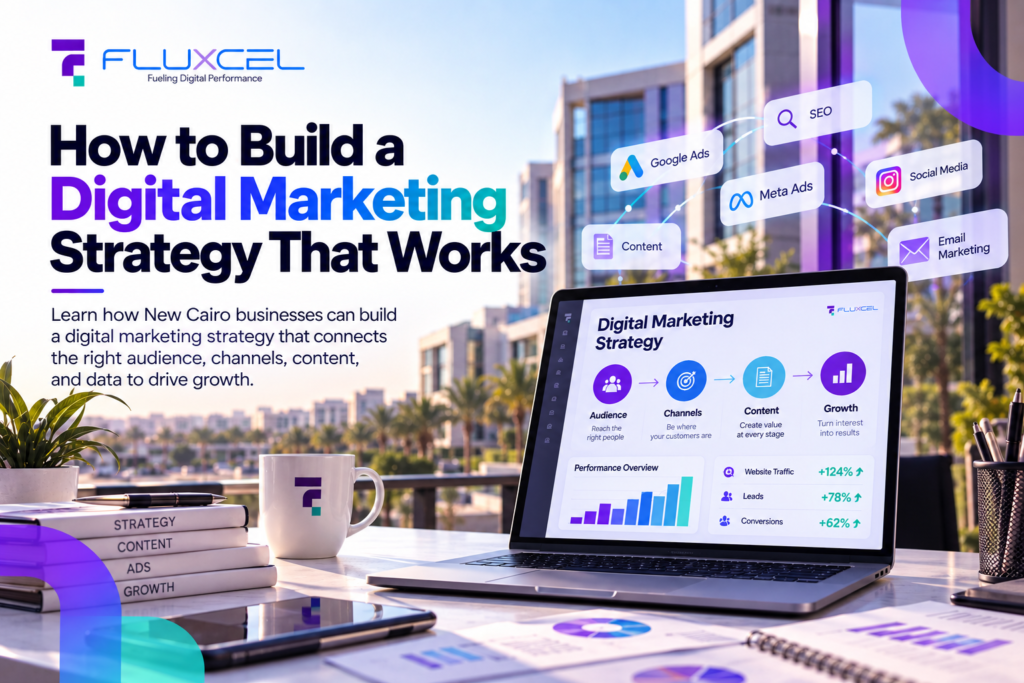
Your audience informs your messaging. Your goals determine your channels. Your content supports the customer journey. Your website turns interest into action. Your data shows where improvements are needed.
When these pieces work together, marketing becomes less about constantly searching for the next tactic and more about building a repeatable system for growth.
At Fluxcel, we help businesses develop digital strategies that connect branding, content, advertising, SEO, websites, and performance measurement around clear business objectives.