
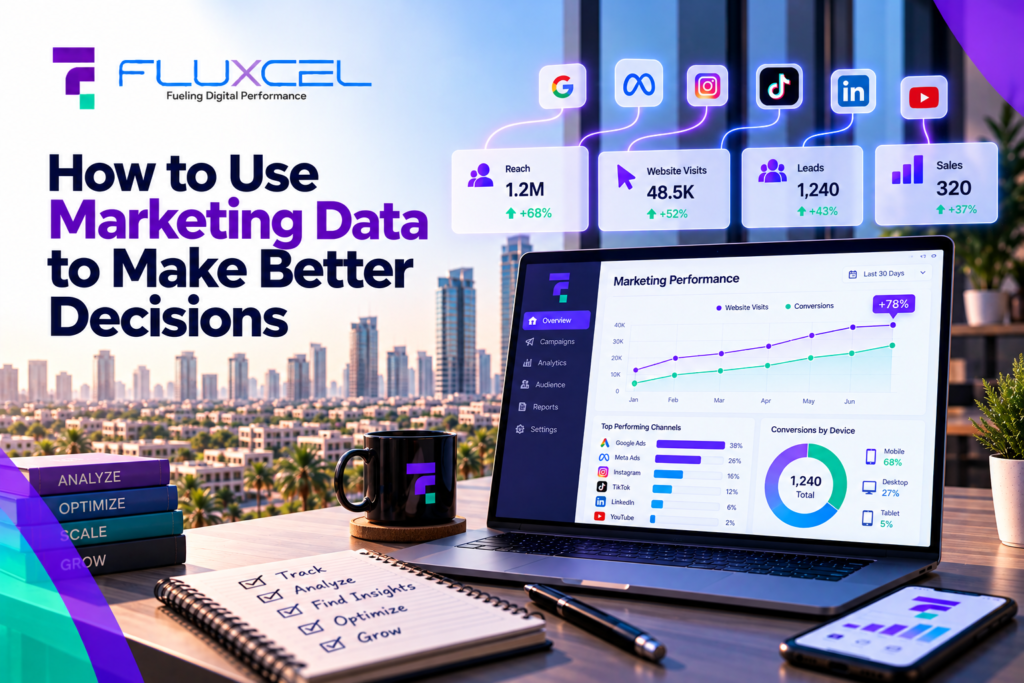
Running a digital marketing campaign is only half the job. Understanding what happens after launching it is where the real opportunities begin.
Every day, businesses collect valuable information through their websites, social media platforms, advertising campaigns, and customer interactions. They can see how many people clicked an advertisement, visited a website, submitted an inquiry, or completed a purchase.
But having access to data doesn’t automatically mean businesses know how to use it.
Many companies spend hours reviewing dashboards filled with numbers without understanding which metrics deserve attention or what actions they should take next.
For businesses operating in New Cairo, where competition continues to grow across industries, making informed marketing decisions can create a meaningful advantage.
Working with a Digital marketing agency New Cairo businesses can depend on helps turn marketing data into practical insights that improve campaign performance and support long-term growth.
The goal isn’t to collect more numbers. It’s to understand what those numbers mean and use them to make better decisions.
Why Marketing Data Matters More Than Ever
Digital marketing offers something traditional advertising has historically struggled to provide: detailed information about how audiences interact with campaigns.
Businesses can analyze customer behavior, evaluate advertising performance, and identify opportunities to improve results.
However, the value of marketing data depends on how accurately it is collected and interpreted.
From Guesswork to Informed Decisions
Imagine an e-commerce business running advertisements on Facebook, Instagram, and Google.
At the end of the month, the marketing team notices that Facebook generated the highest number of website visitors.
Without further analysis, they might decide to increase the Facebook advertising budget.
But when they examine sales data, they discover that Google attracted fewer visitors who generated more purchases and higher revenue.
This changes the decision.
Instead of investing based on traffic volume alone, the business can evaluate which channel contributes most effectively to its objectives.
Marketing data helps companies move beyond assumptions and focus on evidence.
Identify the Metrics That Actually Matter
One of the biggest challenges in digital marketing is deciding which numbers deserve attention.
Advertising platforms provide dozens of metrics, but not all of them are equally important.
The right metrics depend on the business model and marketing objectives.
Awareness Metrics
When the objective is increasing brand visibility, businesses may monitor:
Reach.
Impressions.
Video views and watch time.
Branded search activity.
Relevant audience growth.
These metrics help evaluate how widely a message is being distributed and whether audiences are becoming familiar with the brand.
Engagement Metrics
Engagement metrics help businesses understand how people interact with their content.
Examples include shares, comments, saves, clicks, and meaningful website interactions.
However, engagement should always be interpreted in context.
A post generating thousands of likes may not contribute directly to revenue, while a smaller campaign could attract highly relevant potential customers.
Conversion and Revenue Metrics
For businesses focused on generating sales, commercial performance becomes particularly important.
Useful metrics include:
Conversion rate.
Cost per acquisition.
Return on ad spend.
Average order value.
Revenue by marketing channel.
Customer lifetime value.
A professional Digital marketing agency New Cairo companies work with should prioritize metrics that connect marketing activity with actual business outcomes.
Use Google Analytics 4 to Understand Website Performance
Google Analytics 4, commonly known as GA4, helps businesses understand how visitors interact with their websites and applications.
When configured correctly, it can provide useful information about traffic sources, user engagement, and important customer actions.
Understand Where Your Visitors Come From
GA4 can help businesses analyze traffic from channels such as:
Organic search.
Paid search.
Paid social media.
Organic social media.
Email marketing.
Direct visits.
Referral websites.
Understanding these sources makes it easier to evaluate how different marketing channels contribute to website activity.
For example, a business may discover that organic search attracts visitors who spend more time exploring service pages, while paid campaigns generate more immediate inquiries.
These insights can help guide content development and advertising investment.
Track Important Website Events
Businesses should configure events that reflect meaningful customer actions.
Depending on the website, these might include purchases, completed contact forms, appointment requests, or other valuable interactions.
Accurate event tracking helps businesses evaluate performance beyond simple visitor counts.
Connect Google Ads and Meta Ads With Business Results
Advertising dashboards provide valuable campaign information, but platform reports shouldn’t always be treated as the complete picture.
Different platforms use different attribution methods and reporting windows.
This means reported conversions may not perfectly match sales records or website analytics.
Evaluate Campaigns Across Platforms
Consider a business spending EGP 100,000 across multiple advertising channels.
Example: Monthly advertising performance
Metric | Google Ads | Meta Ads |
|---|---|---|
Advertising spend | EGP 50,000 | EGP 50,000 |
Reported leads | 200 | 400 |
Cost per lead | EGP 250 | EGP 125 |
Confirmed customers | 40 | 25 |
Advertising cost per customer | EGP 1,250 | EGP 2,000 |
At first glance, Meta Ads appears more efficient because it generates twice as many leads at a lower cost.
However, Google Ads produces more confirmed customers at a lower advertising cost per customer.
This demonstrates why evaluating campaigns solely through cost per lead can be misleading.
The final decision should also consider customer value, profitability, and the reliability of attribution.
Understand Customer Behavior Through Data
Marketing performance isn’t determined entirely by advertising platforms.
Customer behavior after clicking an advertisement also influences results.
Businesses should understand what visitors do once they arrive on a website.
Identify Where Customers Lose Interest
Suppose a business notices that many visitors explore its product pages but relatively few begin checkout.
This could indicate several possible issues.
Product information might be incomplete.
Pricing expectations may not match the offer.
Delivery information could be unclear.
Or visitors may simply be researching rather than preparing to purchase.
Instead of immediately increasing advertising spending, the business should investigate these possibilities.
Combine Quantitative and Qualitative Insights
Analytics tools show what users do, but they don’t always explain why.
Customer feedback, usability testing, support inquiries, and appropriately configured session analysis tools can provide additional context.
For example, analytics might show that visitors frequently leave a particular page.
Customer feedback could reveal that the page doesn’t answer an important purchasing question.
Combining both types of information leads to better-informed decisions.
Build Marketing Dashboards That Support Decisions
Many businesses receive lengthy marketing reports filled with charts and numbers.
However, more information doesn’t necessarily produce better understanding.
A useful dashboard should highlight the metrics most relevant to the business.
What Should a Marketing Dashboard Include?
A practical performance dashboard might show:
Total marketing spending.
Revenue or qualified opportunities generated.
Customer acquisition cost.
Conversion rates by channel.
Campaign performance trends.
Progress toward monthly objectives.
The dashboard should also make it easy to compare performance across meaningful periods.
For example, comparing this month with the previous month can help identify changes.
However, businesses should consider seasonality, promotions, tracking changes, and differences in spending before drawing conclusions.
Turn Reports Into Action Plans
A good marketing report should answer three questions:
What happened?
Identify the most important performance changes.
Why might it have happened?
Investigate possible causes using available evidence.
What should happen next?
Recommend specific actions based on the findings.
This approach makes reporting more valuable than simply presenting numbers.
Use Data to Improve Advertising Budget Allocation
Marketing budgets shouldn’t be distributed based entirely on historical habits.
Businesses should regularly evaluate where spending produces the greatest value.
Identify High-Performing Campaigns
Start by comparing campaigns using relevant business metrics.
A campaign generating consistent profitable sales may deserve additional investment.
Another campaign attracting low-quality traffic might require changes to targeting, creative messaging, or landing pages.
However, businesses should avoid making major budget changes based on a single day of performance.
Digital advertising results naturally fluctuate.
Decisions should reflect meaningful trends and sufficient data.
Recognize Diminishing Returns
Increasing advertising spending doesn’t always produce proportional growth.
A campaign may perform efficiently at a moderate budget but become less profitable when spending increases significantly.
This can happen when the campaign begins reaching less relevant audiences or competition increases.
Monitoring marginal performance helps businesses understand when scaling remains financially attractive.
Use Customer Data Responsibly
Customer information can improve marketing relevance, but businesses must handle it carefully.
Data collection should have a clear purpose and comply with applicable privacy requirements.
Prioritize First-Party Data
First-party data is information collected directly through customer interactions with a business.
Examples include purchase histories, customer preferences, and information voluntarily submitted through website forms.
When collected and used appropriately, this information can support more relevant communication and better customer understanding.
Businesses should:
Explain how customer information is used.
Obtain appropriate consent where required.
Protect personal information.
Limit access to authorized employees.
Respect customer communication preferences.
Avoid collecting unnecessary information.
Responsible data practices support both customer trust and long-term marketing effectiveness.
Avoid Common Marketing Data Mistakes
Even businesses with sophisticated analytics systems can make poor decisions when interpreting information.
Focusing on One Metric
Evaluating performance through a single number can hide important problems.
For example, a lower cost per lead may look positive even when sales conversion rates decline.
Ignoring Tracking Problems
Missing events, duplicate conversions, and incorrect campaign tagging can distort performance reports.
Businesses should regularly review their tracking setup.
Confusing Correlation With Causation
Two metrics moving together doesn’t necessarily mean one caused the other.
An increase in website traffic during a sales promotion may reflect several factors, including seasonal demand or other marketing activities.
Making Decisions Too Quickly
Small datasets and short reporting periods can produce misleading conclusions.
Businesses should consider sample size, normal performance variation, and the commercial importance of proposed changes.
Reporting Without Taking Action
Collecting data has limited value if businesses never use it to improve their marketing activities.
Insights should lead to practical recommendations, testing, and follow-up evaluation.
Create a Culture of Continuous Marketing Improvement
Data-driven marketing isn’t about replacing creativity with spreadsheets.
It’s about helping creative and strategic decisions become more effective.
Marketing teams can use performance insights to understand which messages resonate, which audiences respond, and which channels contribute to business objectives.
Build a Simple Optimization Process
A practical approach follows four steps:
Analyze: Review performance and identify meaningful opportunities.
Prioritize: Select improvements based on expected impact and available resources.
Test: Implement changes using an appropriate testing method.
Evaluate: Measure results and decide whether to continue, adjust, or stop.
Repeating this process helps businesses improve their marketing strategies over time.
Rather than relying on assumptions, teams develop a clearer understanding of what works for their particular audience.
Turn Marketing Information Into Business Growth
Businesses don’t need more complicated dashboards to succeed.
They need reliable information, clear objectives, and the ability to turn insights into meaningful action.
By understanding customer behavior, measuring relevant performance indicators, and connecting advertising data with actual business results, companies can make more informed marketing decisions.
For businesses operating in New Cairo, this approach can help reduce unnecessary spending, identify growth opportunities, and improve marketing efficiency.
At Fluxcel, we believe successful digital marketing combines creative thinking with performance analysis.
Our approach focuses on connecting campaign management, analytics, customer insights, and strategic planning to help businesses make decisions based on measurable outcomes.
As a Digital marketing agency New Cairo businesses can partner with, Fluxcel helps brands develop marketing strategies informed by data and aligned with their commercial objectives.
Ready to understand what your marketing numbers are really telling you?
Connect with Fluxcel Digital Marketing Agency and discover how better performance analysis can help your business make smarter marketing decisions.