
You are running ads. Your social media is active. People are visiting your website. Your content is getting views.
But the sales are not following.
This is one of the most frustrating situations for any business because, from the outside, the marketing appears to be working. The numbers may show reach, traffic, engagement, clicks, and even inquiries, yet the actual business results remain disappointing.
The problem is often not one single campaign.
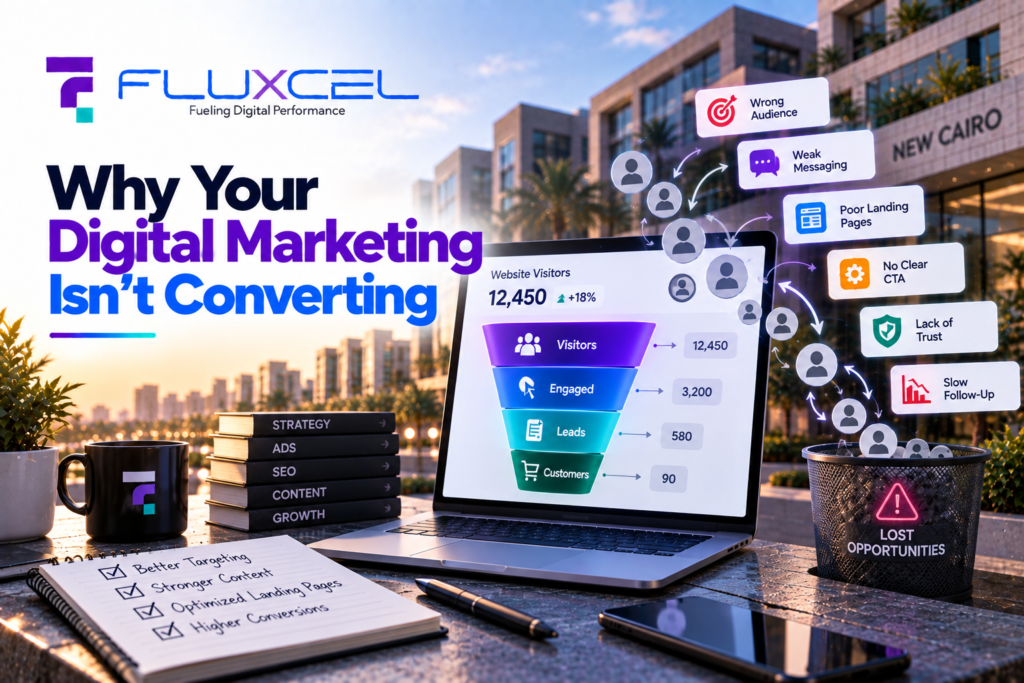
Conversion depends on an entire journey. The audience, message, creative, offer, website, follow-up process, and customer experience all influence whether someone eventually becomes a customer.
For businesses in an increasingly competitive market like New Cairo, identifying where this journey breaks down can unlock far more growth than simply increasing the advertising budget.
A Digital marketing agency New Cairo businesses work with should therefore ask a bigger question than “How do we get more traffic?”
The better question is: What is stopping the traffic we already have from converting?
You’re Reaching People, but Maybe the Wrong People
Large reach numbers can look impressive.
But 500,000 impressions from the wrong audience may be less valuable than 20,000 impressions from people genuinely interested in your product or service.
Poor audience quality is one of the first areas to investigate when campaigns generate activity but few customers.
Revisit Your Ideal Customer
Ask yourself:
- Who usually becomes a customer?
- Where are they located?
- What problem are they trying to solve?
- What is their typical budget?
- What influences their buying decision?
- How quickly do they make a decision?
- What prevents them from purchasing?
The answers should influence your targeting, content, creative, and offers.
Your marketing becomes stronger when it feels like it was created for a specific person rather than everyone.
Your Message Is Too Generic
Take a look at the advertisements in your industry.
You will probably see phrases such as:
“Best quality.”
“Professional service.”
“Contact us today.”
“Your trusted partner.”
There is nothing necessarily wrong with these statements, but they rarely give customers a compelling reason to choose one business over another.
Make the Value Obvious
A strong message should help answer:
What problem do you solve?
What makes your solution valuable?
Why should someone choose you?
Why should they take action now?
The more specific your message becomes, the easier it is for potential customers to understand whether your business is relevant to them.
Your Ad and Landing Page Don’t Match
Imagine clicking an advertisement promoting a specific service and landing on a homepage containing ten different services.
Now the visitor has to search for what attracted them in the first place.
Every extra step creates friction.
Maintain Message Consistency
If the advertisement promotes:
“Premium Offices for Rent in New Cairo”
the landing page should immediately continue that message.
It should show relevant offices, locations, benefits, pricing information where appropriate, and a clear way to inquire.
The visitor should feel that they arrived exactly where they expected.
This principle applies to almost every industry.
Better message matching can make the journey feel more natural and improve the likelihood of conversion.
Your Website Looks Good but Doesn’t Sell
A beautiful website and a high-converting website are not always the same thing.
Design matters, but visitors also need clarity.
Your website should guide people toward a decision.
Check the Basics
Ask whether visitors can quickly understand:
- What your company offers
- Who the service is for
- Why they should choose you
- How your process works
- What previous customers think
- How to contact you
- What action to take next
If these answers are difficult to find, potential customers may leave before reaching out.
Your Call-to-Action Is Too Weak
Sometimes customers are interested but do not know what to do next.
Your CTA should make the next step obvious.
Compare:
Learn More
with:
Book Your Free Consultation
The second CTA tells visitors exactly what will happen.
Other strong CTAs can include:
- Request a Quote
- Book an Appointment
- Send Us a WhatsApp Message
- View Available Units
- Shop the Collection
- Talk to Our Team
Choose wording that reflects the action you genuinely want the customer to take.
You’re Asking for Too Much Too Soon
Not every visitor is ready to buy immediately.
Imagine someone discovers your business for the first time through an Instagram Reel.
They click your profile, visit your website, and immediately encounter aggressive sales messaging.
They may simply not know you well enough yet.
Build the Relationship in Stages
Early-stage audiences may need:
- Educational content
- Helpful information
- Brand introduction
- Demonstrations
Middle-stage audiences may respond to:
- Case studies
- Testimonials
- Comparisons
- FAQs
- Detailed benefits
High-intent audiences can receive:
- Offers
- Consultations
- Product-focused campaigns
- Booking messages
- Direct sales CTAs
Marketing becomes more effective when the message matches the customer’s level of awareness.
Your Offer Isn’t Strong Enough
Sometimes targeting is good.
The creative is strong.
The website works.
But customers still do not convert.
The offer itself may be the problem.
Ask a simple question:
Why should someone act now instead of waiting or choosing a competitor?
A stronger offer does not always mean a discount.
You might improve perceived value through:
- Free consultation
- Added service
- Flexible payment
- Faster delivery
- Bundle options
- Free trial
- Better guarantee
- Exclusive availability
The best offer depends on what your customers value.
Customers Don’t Trust You Yet
Trust is especially important when customers are spending significant money or sharing personal information.
If your website or social channels provide little evidence that real customers choose your business, potential buyers may hesitate.
Add Credibility Where Decisions Happen
Trust signals can include:
- Google reviews
- Customer testimonials
- Case studies
- Previous clients
- Project portfolios
- Real product photos
- Certifications
- Team information
- Clear contact details
Do not hide all your proof on one testimonial page.
Place relevant trust signals close to important conversion points.
Your Website Is Too Slow
A customer clicking your advertisement expects the website to respond quickly.
A slow page creates friction before they have even seen your offer.
Large images, unnecessary scripts, excessive plugins, and poor hosting can all affect performance.
Mobile speed deserves particular attention because many users encounter your brand through their phones.
Before increasing your advertising budget, make sure the website receiving that traffic performs properly.
You’re Ignoring Mobile Users
Open your website on your own phone.
Not inside the website editor.
Not in a desktop preview.
Use it like a customer.
Can you easily navigate?
Can you read everything?
Are buttons easy to tap?
Does the menu work properly?
Can you complete the form quickly?
Can you purchase without unnecessary steps?
Small usability issues can create major conversion problems when most campaign traffic comes from mobile devices.
Your Lead Follow-Up Is Too Slow
Sometimes the marketing is converting perfectly.
The problem happens afterward.
A lead submits a form at 11:00 AM.
Nobody responds until the following afternoon.
Meanwhile, the customer contacts two competitors.
By the time your sales team calls, the opportunity may already be gone.
Create a Clear Response Process
Define:
- Who receives new inquiries
- How quickly they should respond
- How the first contact happens
- How many follow-ups are required
- How leads are qualified
- How outcomes are recorded
Fast, organized follow-up can improve the return from marketing without changing the advertising campaign at all.
You’re Optimizing for the Wrong Metric
Platforms make it easy to focus on metrics such as:
- Reach
- Impressions
- Likes
- Clicks
- Video views
- Cost per lead
These numbers provide useful information, but they do not necessarily indicate profitability.
A campaign generating cheap leads may produce poor-quality inquiries.
A campaign with a higher cost per lead may produce customers who spend significantly more.
This is why a Digital marketing agency New Cairo businesses partner with should connect advertising data with actual business results.
Track the Entire Conversion Journey
Instead of stopping at clicks or leads, follow what happens next.
A useful journey might look like:
Impression → Click → Website Visit → Lead → Qualified Lead → Sale → Repeat Customer
Once you can see this journey clearly, conversion problems become easier to identify.
Lots of clicks but few leads?
Look at the landing page.
Lots of leads but few qualified opportunities?
Review targeting and messaging.
Qualified leads but few sales?
Investigate the offer and sales process.
Customers purchasing once but never returning?
Look at retention and customer experience.
Data becomes much more useful when it helps diagnose a specific problem.
Don’t Increase the Budget Until You Fix the Funnel
When results slow down, one temptation is to spend more.
But increasing budget multiplies whatever system already exists.
If the funnel is efficient, scaling can create growth.
If the funnel is broken, scaling can create more waste.
Before increasing spend, review:
- Audience quality
- Creative performance
- Offer strength
- Landing page conversion
- Lead quality
- Sales follow-up
- Tracking accuracy
Fixing these areas can sometimes produce better results without increasing the overall media budget.
Conversion Is a System, Not a Single Metric
Businesses often search for one reason their marketing is not converting.
In reality, conversion is usually the result of several connected factors.
The right audience needs to see the right message.
The message needs to create enough interest to generate a click.
The landing page needs to build confidence.
The offer needs to provide value.
The CTA needs to be clear.
The sales team needs to follow up effectively.
And your tracking needs to show what happens throughout that journey.
When these elements work together, marketing becomes significantly easier to optimize and scale.
At Fluxcel Digital Marketing Agency, we look beyond individual campaigns to understand the complete digital customer journey and identify where businesses are losing opportunities.