
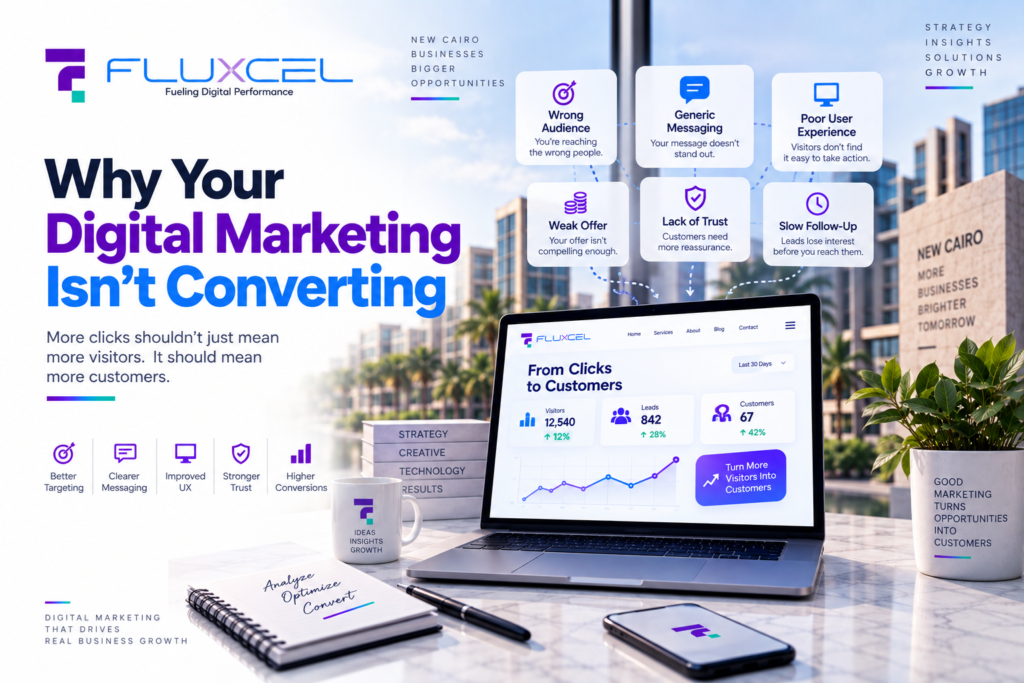
Your ads are running. People are visiting your website. Your social media accounts are active. Engagement looks reasonable, and your campaigns are generating clicks.
But the sales aren’t following.
It’s one of the most frustrating situations for any business investing in digital marketing. Everything appears active on the surface, yet leads, appointments, purchases, or revenue remain below expectations.
The problem isn’t necessarily your advertising budget.
Often, there is a disconnect somewhere between getting attention and getting action.
For businesses in New Cairo, fixing that gap is increasingly important. Customers have more options, more information, and less patience for confusing digital experiences.
A Digital marketing agency New Cairo businesses work with should look beyond impressions and clicks to understand why potential customers aren’t taking the next step.
You’re Attracting Traffic, but Not the Right Traffic
More website visitors might look like progress, but traffic has little value if those visitors are unlikely to become customers.
Imagine attracting 20,000 people to your website through a broad campaign. If most of them have little interest in your product, those impressive traffic numbers won’t translate into meaningful results.
This is where audience quality matters.
Look at Intent, Not Just Reach
Before launching a campaign, ask:
- Who are we trying to reach?
- What problem do they have?
- Are they actively searching for a solution?
- What would motivate them to take action?
- Can they realistically become customers?
Your targeting, keywords, content, and creative should all reflect those answers.
The objective isn’t simply to reach more people.
It’s to reach more of the right people.
Your Message Is Too Generic
“High quality.”
“Professional solutions.”
“Best service.”
“Customer satisfaction is our priority.”
These messages appear everywhere.
The problem isn’t that they’re necessarily wrong. The problem is that they give customers very little reason to choose one business over another.
Your marketing message needs to communicate a clear value proposition.
Answer the Customer’s Real Question
When someone discovers your business, they are subconsciously asking:
“Why should I choose you?”
Your marketing should answer that quickly.
Instead of focusing entirely on what your company does, explain the outcome customers receive.
Highlight specific advantages, expertise, convenience, service quality, technology, experience, speed, or other genuine differentiators.
Specific messages are usually more persuasive than broad claims.
Your Ad and Landing Page Don’t Match
Imagine seeing an advertisement promoting a specific offer.
You click it.
Instead of finding that offer, you’re taken to a generic homepage where you have to search for it yourself.
That small disconnect creates friction.
Customers expect continuity.
If an advertisement talks about one service, the landing page should immediately continue that conversation.
Maintain Message Consistency
Keep these elements aligned:
Ad → Headline → Offer → Landing Page → CTA
The customer should always feel like they’re moving naturally to the next step.
A Digital marketing agency New Cairo companies work with should evaluate the entire journey rather than treating the advertisement and website as separate assets.
Your Website Looks Good but Doesn’t Guide Visitors
A beautiful website is not automatically an effective website.
Strong visuals can create a positive first impression, but customers still need direction.
They need to understand what you offer, why it matters, and what they should do next.
If your website forces visitors to think too much, you may lose them.
Make the Next Step Obvious
Every important page should have a clear primary action.
Depending on your business, that might be:
- Book an Appointment
- Request a Quote
- Call Now
- Send a WhatsApp Message
- Shop Now
- Schedule a Consultation
Avoid hiding important actions at the bottom of long pages.
Customers shouldn’t need to search for a way to become customers.
Your Offer Isn’t Strong Enough
Sometimes targeting is right, the website is good, and the advertising looks professional—but the offer simply isn’t compelling.
An offer is more than a discount.
It is the combination of value, relevance, timing, and perceived risk.
Ask yourself:
Why should someone take action now instead of later?
Strengthen the Value of the Offer
Depending on the business, you might improve an offer through:
- A consultation
- A useful bonus
- Bundled value
- Flexible options
- A limited-time benefit
- Clearer pricing
- Easier booking
- Free delivery
- A guarantee
The right offer should make sense for your business and customer. Avoid creating promotions simply to generate clicks.
Customers Don’t Trust You Yet
A customer discovering your brand for the first time may not be ready to buy immediately.
Before taking action, they might search your company name, check your Instagram page, read Google reviews, browse your website, compare alternatives, and look at previous work.
Every one of those interactions affects trust.
Show Evidence, Not Just Claims
Instead of telling people you’re excellent, show them why they should believe it.
Use:
- Genuine reviews
- Testimonials
- Case studies
- Client results
- Previous projects
- Certifications
- Recognizable clients
- Team expertise
- Clear business information
Trust reduces the perceived risk of making a decision.
This becomes particularly important for expensive products, professional services, healthcare, B2B services, and other decisions where customers naturally spend more time researching.
Your CTA Is Too Weak
“Learn More” has its place, but it isn’t always the strongest CTA.
Your call-to-action should tell customers exactly what happens next.
Compare:
Learn More
with:
Book Your Free Consultation
The second option communicates a much clearer action.
Match the CTA to Customer Intent
Someone reading an educational article may not be ready to buy.
Someone viewing a pricing or service page might be much closer.
Use CTAs appropriate to each stage of the journey rather than asking every visitor to take the same action.
Your Mobile Experience Is Losing Customers
A campaign may perform well on desktop but fail when someone opens the website on their phone.
Slow pages, tiny buttons, broken layouts, intrusive pop-ups, difficult forms, and poorly optimized images can quickly frustrate mobile users.
Test the entire journey yourself.
Open the advertisement on your phone.
Click through.
Navigate the landing page.
Complete the form.
Try calling the business.
Try sending a message.
You may discover conversion problems that aren’t obvious from a desktop dashboard.
You’re Asking for Too Much Information
Long lead forms can create unnecessary resistance.
If someone wants an initial consultation, do you really need ten pieces of information before speaking to them?
Maybe not.
Start with what is genuinely necessary.
For many businesses, an initial form might only require:
- Name
- Phone or email
- Service of interest
- One qualification question
Additional information can be collected during the sales conversation.
Reducing unnecessary effort can improve conversion without increasing traffic or advertising spend.
Your Follow-Up Is Too Slow
Marketing doesn’t stop when a lead is generated.
If someone submits a form and your sales team responds two days later, the campaign may not be the problem.
The customer may already have spoken with three competitors.
Create a clear system for handling inquiries.
Decide who receives them, how quickly they should respond, what happens if the prospect doesn’t answer, and how follow-up is tracked.
A Digital marketing agency New Cairo brands partner with should consider what happens after conversion when evaluating overall campaign performance.
You’re Optimizing for the Wrong Metrics
High reach feels good.
Cheap clicks look good.
Low cost per lead looks even better.
But none of these numbers automatically mean the business is making money.
Consider the full funnel:
Reach → Clicks → Leads → Qualified Leads → Customers → Revenue
Suppose Campaign A generates leads for 100 EGP and Campaign B generates leads for 200 EGP.
Campaign A initially appears better.
But if Campaign B generates three times as many paying customers, its more expensive leads may actually be far more profitable.
Marketing performance needs business context.
You’re Not Testing Enough
Sometimes a campaign isn’t fundamentally broken.
It simply hasn’t been optimized yet.
Test different elements individually:
- Creative hooks
- Headlines
- Audience segments
- Offers
- Landing pages
- CTAs
- Lead forms
- Remarketing messages
Avoid changing everything simultaneously. If too many variables change at once, you won’t know what actually improved performance.
Digital marketing becomes stronger when testing creates learning.
Fix the Journey, Not Just the Advertisement
When digital marketing isn’t converting, increasing the budget isn’t always the solution.
Look at the complete customer experience.
Are you attracting the right audience? Is the message specific? Does the offer provide enough value? Does the landing page continue the conversation? Is the website easy to use? Does the brand feel trustworthy? Is the CTA clear? Does the sales team respond quickly?
Conversion problems are often caused by several small gaps rather than one major failure.
Fixing those gaps can help the same marketing budget generate significantly more value.
At Fluxcel Digital Marketing Agency, we connect strategy, content, SEO, paid advertising, website experience, and performance optimization to help businesses turn digital attention into measurable results.