
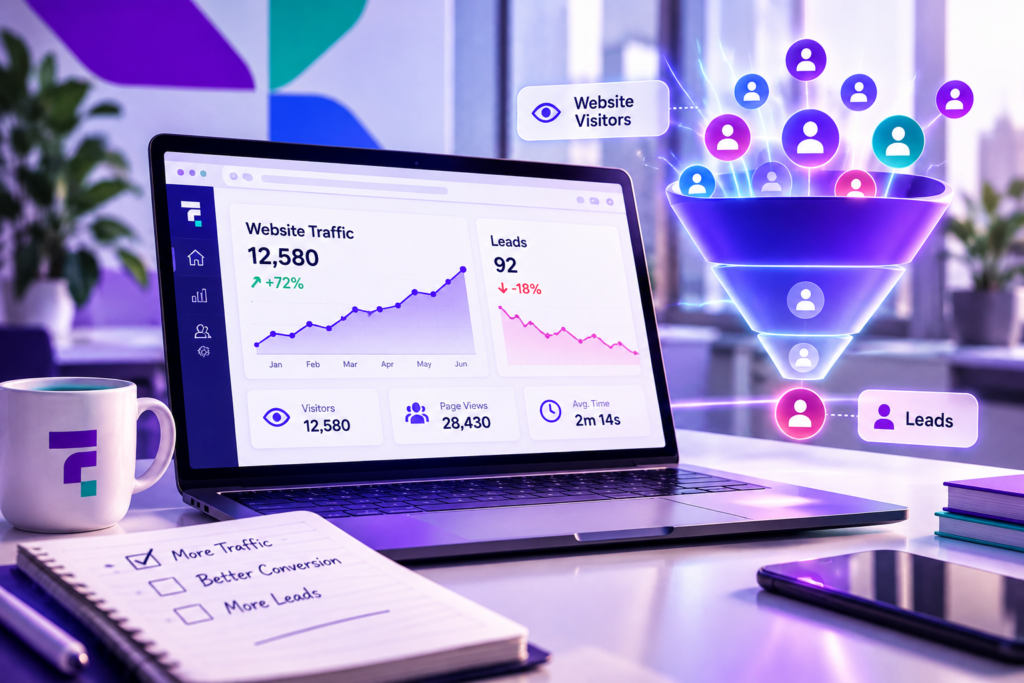
Getting people to visit your website is a good sign. It means your business is being discovered, your marketing campaigns are reaching an audience, and potential customers are showing interest in what you offer.
But what happens when those visitors leave without contacting you, requesting a quotation, or making a purchase?
It’s a frustrating situation for many businesses. You invest in SEO, Google Ads, and social media campaigns, watch your traffic numbers increase, and expect inquiries to follow. Instead, your website generates plenty of visits but very few actual opportunities.
The problem isn’t always your advertising budget or the quality of your products. Sometimes, it’s what happens after someone lands on your website.
Working with a digital marketing agency New Cairo businesses trust can help identify the barriers preventing visitors from becoming customers.
Let’s explore why websites struggle to generate leads and what you can do to turn more visitors into real business opportunities.
1. You’re Attracting Visitors Who Aren’t Ready to Buy
Not all website traffic has the same value.
Someone searching for general information about a product is at a different stage from someone actively looking for a company to purchase it from.
Both visitors might reach your website, but their likelihood of contacting you can be completely different.
Understand the Difference Between Traffic and Intent
Imagine you operate an interior design company in New Cairo.
A visitor searching for “modern living room ideas” might simply be looking for inspiration.
Meanwhile, someone searching for “interior design company in New Cairo” may be actively comparing service providers.
The first search can help build brand awareness, while the second may offer a stronger opportunity to generate an inquiry.
Neither audience is necessarily wrong. The important thing is understanding what each visitor needs.
How to Attract More Qualified Visitors
Focus on search terms and marketing messages that reflect different stages of the buying journey.
For example:
Informational keywords for educational articles.
Service-related keywords for your main website pages.
Location-specific keywords for local customers.
High-intent keywords for people comparing providers or requesting prices.
Review which traffic sources generate actual inquiries rather than judging success by visitor numbers alone.
A smaller audience with stronger purchasing intent can sometimes produce better results than a large volume of unrelated traffic.
2. Your Website Doesn’t Explain Your Value Clearly
When someone opens your website, they should quickly understand what your business offers and why it matters.
If visitors need to scroll through several sections to figure out what you do, you risk losing their attention.
Your Homepage Should Answer Three Questions
Within the first few seconds, visitors should be able to understand:
What does this company offer?
Why should I choose this company?
What should I do next?
Consider a business selling office spaces.
A headline such as “Creating Better Business Experiences” might sound professional, but it doesn’t clearly explain the service.
A more direct alternative would be:
“Premium Offices for Rent in New Cairo’s Leading Business Destinations.”
The second headline immediately communicates the offering and location.
Clear messaging doesn’t mean sacrificing creativity. It means making sure creativity supports understanding.
Focus on Benefits, Not Just Features
Businesses often describe their services using technical language that customers may not understand.
Instead of listing capabilities alone, explain how those capabilities solve problems.
For example, rather than simply mentioning “advanced marketing analytics,” explain that customers can better understand where their leads come from and which campaigns contribute to sales.
The easier your value is to understand, the easier it becomes for visitors to consider taking action.
3. Your Calls to Action Are Too Weak or Difficult to Find
A website might have excellent design, informative content, and competitive services but still fail to generate inquiries because visitors aren’t clearly guided toward the next step.
That’s where calls to action become important.
Make Your CTA Specific
Generic buttons such as “Learn More” or “Submit” don’t always communicate what visitors can expect.
Depending on your business, stronger alternatives might include:
Request a Free Consultation
Get a Customized Quotation
Book Your Appointment
Explore Available Properties
Speak With Our Team
The right CTA depends on the action you want customers to take.
Place CTAs Where They Matter
Don’t rely on one contact button hidden in your website’s navigation menu.
Relevant calls to action should appear naturally throughout important pages.
For example, a service page might include a consultation button near the top, another after explaining the benefits, and a final CTA after answering frequently asked questions.
Avoid overwhelming visitors with too many competing actions. Give each page a clear primary objective.
4. Your Website Creates Too Much Friction
Sometimes, visitors want to contact your business but give up because the process feels unnecessarily complicated.
Long forms, confusing navigation, slow-loading pages, and unclear instructions can all create friction.
Simplify Your Lead Generation Process
Review your contact forms from a customer’s perspective.
Do you really need someone to provide their full address, company size, detailed requirements, and several other fields before speaking with your team?
For an initial inquiry, basic information might be enough.
Depending on your business, this could include a name, phone number, email address, and short message.
You can collect additional details later during the qualification process.
Make Mobile Experience a Priority
Many customers discover businesses through mobile search and social media.
If your website looks attractive on a desktop but becomes difficult to navigate on a phone, you could be losing valuable opportunities.
Check whether:
Buttons are easy to tap.
Text is readable without zooming.
Forms work smoothly on mobile devices.
Important information appears without excessive scrolling.
Pages load efficiently on typical mobile connections.
A mobile-friendly website should make the customer’s journey feel simple, not like extra work.
5. Visitors Don’t Trust Your Business Enough Yet
Trust plays an important role in online decision-making.
A potential customer might appreciate your services but hesitate to share their information if your website doesn’t provide enough evidence of credibility.
This is particularly important for businesses offering high-value products or services that require a significant commitment.
Build Confidence Through Social Proof
Your website can demonstrate credibility using:
Genuine customer reviews.
Relevant testimonials.
Completed projects and case studies.
Real photographs of your team or workplace.
Clear company and contact information.
Accurate descriptions of your experience and capabilities.
For example, a real estate company could showcase completed transactions or property portfolios, while a marketing agency could explain how it approached a client’s business challenge.
The goal isn’t to make exaggerated promises.
It’s to give potential customers enough information to feel confident about starting a conversation.
Answer Questions Before Customers Ask
People often hesitate because they have unanswered questions.
Consider including a useful FAQ section covering pricing approaches, service processes, timelines, and what happens after an inquiry.
Removing uncertainty can make contacting your business feel like a smaller commitment.
6. Your Landing Pages Don’t Match Your Advertisements
Imagine clicking an advertisement promoting a specific service, only to arrive on a homepage displaying several unrelated offerings.
You would probably need to search for the information that originally interested you.
Some visitors will do that. Others will simply leave.
Maintain Message Consistency
Your advertisement and landing page should communicate the same offer.
For example, if a Google ad promotes dental implants, the destination should ideally be a relevant dental implant service page rather than a generic clinic homepage.
The landing page should reinforce the advertisement’s message through consistent headlines, relevant information, and a clear CTA.
Create Dedicated Pages for Important Campaigns
Businesses running multiple campaigns can benefit from creating dedicated landing pages for different audiences or services.
A digital marketing agency New Cairo companies partner with can help evaluate which campaigns need specialized landing pages and how those pages should support conversion goals.
This approach can improve relevance and make performance easier to measure.
7. You’re Not Measuring the Right Website Actions
Website traffic reports can show how many people visited your pages, but they don’t automatically explain why visitors failed to convert.
To make informed decisions, businesses need reliable conversion tracking.
Track Actions That Matter
Depending on your business, useful conversion events might include:
Completed contact forms.
Appointment booking confirmations.
Phone call inquiries.
WhatsApp contact clicks.
Quotation requests.
Completed purchases.
Tools such as Google Analytics 4 and Google Tag Manager can help businesses measure relevant interactions when configured correctly.
However, a click on a WhatsApp button doesn’t necessarily mean a conversation occurred, just as a form submission doesn’t automatically represent a qualified lead.
Understanding these differences is essential for accurate reporting.
Look for Patterns in Visitor Behavior
Review the pages where visitors commonly exit and compare how different traffic sources perform.
If one landing page attracts substantial traffic but rarely generates inquiries, investigate its messaging, design, loading speed, and CTA.
Avoid changing everything at once. Start with a specific problem, test a possible solution, and measure the outcome.
8. Your Follow-Up Process Is Losing Opportunities
Not every lead becomes a customer immediately.
Someone might request information while comparing multiple companies, reviewing budgets, or waiting for approval from a decision-maker.
If your business doesn’t follow up effectively, interested prospects can lose momentum.
Build a Reliable Lead Management Process
A simple follow-up system can make a meaningful difference.
Start by ensuring every inquiry reaches the right team member.
Then establish a process for responding, recording customer requirements, and following up when appropriate.
A CRM can help organize leads, track conversations, and reduce the risk of missed opportunities.
For example, a potential customer requesting a quotation might need clarification about available packages before making a decision.
A timely, relevant response can help move the conversation forward.
The objective isn’t to pressure customers. It’s to make sure interested people receive the information they need.
9. You’re Making Website Changes Without Testing
Businesses sometimes redesign entire websites because they aren’t generating enough leads.
But a complete redesign isn’t always necessary.
The issue might be a confusing headline, an overly complicated form, or a CTA that visitors rarely notice.
Start With Small, Measurable Improvements
Conversion rate optimization involves identifying opportunities to improve the percentage of visitors who complete meaningful actions.
You could test:
A clearer homepage headline.
A shorter inquiry form.
A more prominent consultation button.
A different landing page layout.
Stronger customer testimonials.
Consider a website receiving 5,000 visitors monthly.
At a 1% conversion rate, it generates 50 inquiries. Increasing that rate to 2% would produce 100 inquiries from the same traffic volume.
Illustrative monthly inquiry volume
Example assumes 5,000 visitors per month and the same traffic quality.
This example shows why improving conversions can be just as valuable as increasing website traffic.
Actual results will depend on your audience, offer, website experience, and sales process.
Turn More Website Visitors Into Business Opportunities
Increasing website traffic is only one part of digital marketing success.
If visitors don’t understand your services, trust your business, or know how to contact you, additional traffic may simply increase your marketing expenses without delivering the results you expect.
The solution is to create a website experience that connects customer expectations with clear information, useful content, and simple conversion opportunities.
From attracting relevant visitors to optimizing landing pages and tracking meaningful actions, every stage contributes to stronger lead generation.
At Fluxcel, we help businesses identify gaps in their digital performance and create practical strategies to improve marketing results.