
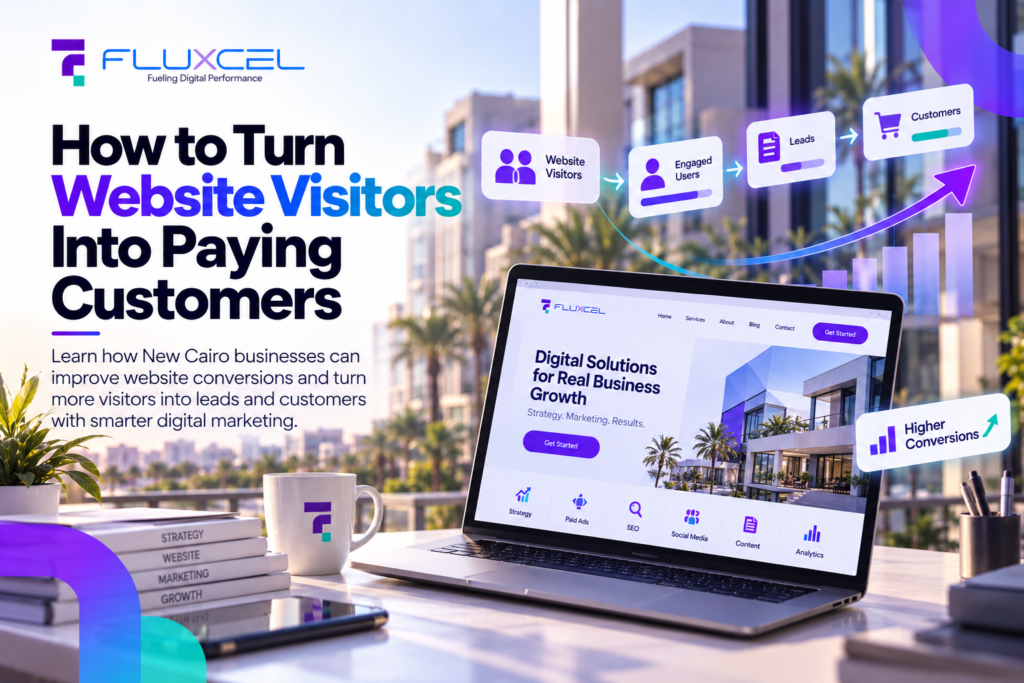
Getting people to visit your website is only half the job.
You can invest in Google Ads, SEO, social media, Meta campaigns, and content marketing to increase traffic. But if visitors arrive and leave without calling, submitting a form, booking, or purchasing, that traffic isn’t creating much value for the business.
For many businesses, the biggest opportunity isn’t simply attracting more visitors. It’s getting more value from the visitors they already have.
A strong Digital marketing agency New Cairo strategy should therefore look beyond traffic numbers and focus on what happens after someone lands on the website.
That means understanding customer intent, improving the user experience, building trust, removing unnecessary friction, and making the next step easy.
Why Website Traffic Doesn’t Always Convert
A website can receive thousands of visits without generating enough business.
There isn’t always one obvious reason.
Sometimes the wrong audience is being attracted. Sometimes the website loads slowly. Sometimes the offer isn’t clear. In other cases, visitors simply don’t see enough reason to trust the company.
Common conversion problems include:
- Unclear messaging
- Complicated navigation
- Slow loading times
- Weak calls-to-action
- Poor mobile experience
- Too many form fields
- Lack of social proof
- Confusing service information
- A disconnect between ads and landing pages
Before spending more money to increase traffic, businesses should understand what is stopping existing visitors from converting.
Make Your Value Clear Immediately
Visitors shouldn’t need several minutes to understand what your company does.
When someone lands on an important page, they should quickly understand three things:
What do you offer?
Why is it relevant to them?
What should they do next?
This sounds simple, but many websites make visitors work too hard to find the answers.
A clever headline might look good creatively, but clarity usually matters more when someone is deciding whether to continue exploring.
Focus on the Customer’s Problem
Instead of talking only about the company, communicate the value customers receive.
For example, a service page shouldn’t simply list features.
Explain how those features help the customer achieve something, solve a problem, save time, reduce difficulty, or improve an outcome.
People are usually more interested in what your service can do for them than in a long description of the company itself.
Create a Clear Path to Conversion
Every important page should have a purpose.
What do you want someone to do after reading it?
The answer could be:
- Request a quote
- Book an appointment
- Buy a product
- Call the business
- Send a WhatsApp message
- Schedule a consultation
- Complete a lead form
Once you know the desired action, design the page around it.
Calls-to-action should be easy to find and written clearly.
Generic buttons such as “Submit” can often be replaced with more specific language such as “Request Your Quote” or “Book Your Consultation.”
The customer should always know what happens next.
Build Landing Pages Around Customer Intent
Sending every advertising campaign to the homepage isn’t always the best approach.
Imagine someone searches specifically for one of your services.
They click your Google Ad and arrive on a homepage containing ten different services.
Now they need to find the information they originally searched for.
Every additional step creates an opportunity to lose that visitor.
A dedicated landing page can continue the conversation immediately.
If the advertisement is about a specific service, the landing page should focus on that service.
If the campaign promotes a specific offer, visitors should see that offer immediately.
This alignment between the ad, customer intent, and landing page can significantly improve the quality of the experience.
Make Trust Visible
Customers visiting your website for the first time don’t automatically trust your business.
They may be comparing you with several alternatives.
Your website needs to give them reasons to feel confident.
Use Real Social Proof
Depending on the business, trust signals can include:
- Customer reviews
- Testimonials
- Case studies
- Client logos
- Certifications
- Project examples
- Before-and-after results
- Business experience
- Awards or recognized partnerships
The key is relevance.
Don’t hide your strongest proof on a separate page that few people visit. Place it naturally near the services, products, or calls-to-action where customers are making decisions.
A Digital marketing agency New Cairo businesses work with should consider trust-building part of conversion strategy, not simply a branding exercise.
Improve the Mobile Experience
A website can look excellent on a large desktop screen and still perform poorly for customers using smartphones.
Mobile visitors often behave differently.
They may be browsing while moving, comparing businesses quickly, or looking for an immediate way to call or message.
Your mobile experience should therefore be simple and fast.
Check whether:
- Text is easy to read
- Buttons are large enough to tap
- Forms work properly
- Menus are easy to navigate
- Images load efficiently
- WhatsApp and phone buttons are accessible
- Important information appears early on the page
Test the website as a customer would rather than simply resizing a browser window.
Reduce Friction in Your Forms
Forms are one of the most important conversion points on many websites.
They’re also where businesses often ask for too much.
If someone simply wants to request a consultation, do you really need ten pieces of information before speaking with them?
Every unnecessary field adds friction.
Start by collecting the information genuinely required to continue the conversation.
For example:
- Name
- Phone number
- Service of interest
Additional information can often be collected later.
The easier the first step feels, the more comfortable potential customers may be taking it.
Match Traffic Quality With Conversion Strategy
Sometimes the website isn’t the main problem.
The traffic is.
A campaign can generate large numbers of inexpensive clicks while attracting people with little intention of buying.
This is why conversion optimization cannot be separated from audience targeting.
Look beyond cost per click and ask:
Which traffic sources generate qualified inquiries?
Which campaigns produce actual customers?
Which keywords attract people with stronger buying intent?
Which audiences spend meaningful time on the website?
This information helps businesses understand where marketing investment creates real value.
Use Content to Remove Customer Objections
Visitors don’t always leave because they dislike the offer.
Sometimes they simply don’t have enough information to make a decision.
Think about the questions your sales team hears regularly.
Customers may want to know:
- How does the service work?
- How long does it take?
- What is included?
- Who is it suitable for?
- What makes your company different?
- What happens after they contact you?
Addressing these questions directly on your website can make the decision easier.
FAQ sections, service explanations, videos, case studies, and blog content can all help customers move forward with greater confidence.
Retarget Visitors Who Aren’t Ready Yet
Not every visitor will convert during their first session.
Some are researching.
Others are comparing options.
Some may simply get distracted and leave.
Retargeting allows businesses to reconnect with people who have already demonstrated interest.
For example, someone who visited a specific service page could later see an advertisement related to that service.
An e-commerce visitor who viewed a product might see it again.
Someone who engaged with your content could receive a stronger conversion-focused message later.
Rather than treating every visit as a one-time opportunity, retargeting helps businesses continue the customer journey.
Track Conversions, Not Just Traffic
Traffic reports can look impressive.
“Website visitors increased by 40%.”
That’s useful information, but it doesn’t answer the most important question:
Did the additional traffic generate business?
Businesses should track actions connected to their goals.
These might include:
- Form submissions
- Phone calls
- WhatsApp clicks
- Purchases
- Bookings
- Quote requests
- Downloads
- Qualified leads
From there, you can calculate metrics such as conversion rate and cost per acquisition.
If 10,000 visitors generate 50 leads, increasing traffic isn’t the only option.
Improving the website so the same traffic generates 75 or 100 leads could create significant growth without doubling advertising spend.
Test Small Changes and Learn From the Results
Conversion optimization isn’t about redesigning your entire website every few months.
Often, smaller changes can reveal valuable insights.
Test different:
- Headlines
- Calls-to-action
- Page layouts
- Forms
- Offers
- Images
- Landing page copy
- Trust elements
The important part is measuring what happens.
Avoid changing everything simultaneously because you won’t know which adjustment influenced performance.
Make informed changes, monitor the results, and continue improving.
Turn Your Website Into a Growth Asset
A website shouldn’t simply act as an online company profile.
It should play an active role in customer acquisition.
That means attracting the right people, answering their questions, building confidence, and guiding them toward action.
For businesses searching for a Digital marketing agency New Cairo, website performance should be considered alongside SEO, paid advertising, social media, and content. Driving traffic without improving the conversion experience leaves a major part of the growth opportunity untouched.
At Fluxcel, we connect digital marketing with the complete customer journey—from attracting the right audience to improving the experience that turns interest into measurable business opportunities.