
Growth and scaling are not exactly the same thing.
A business can grow by spending more money, hiring more people, generating more leads, and increasing marketing activity. But if costs rise at almost the same rate as revenue, that growth becomes difficult to maintain.
Scaling is different.
It means building systems that allow the business to handle more customers and generate more revenue without increasing costs and complexity at the same pace.
Digital marketing can play an important role in making that possible.
But scaling does not mean doubling your advertising budget overnight. It requires understanding what already works, improving weak points, building repeatable processes, and then increasing investment with greater confidence.
For companies searching for a Digital marketing agency New Cairo, the objective should not simply be getting bigger numbers. It should be building a digital marketing system capable of supporting the next stage of the business.
Make Sure You Are Ready to Scale
Before trying to generate significantly more customers, ask whether the business is ready to handle them.
This is one of the most overlooked parts of scaling.
Imagine a campaign suddenly generates three times the normal number of leads.
Can the sales team respond quickly?
Can operations deliver the service?
Is inventory available?
Can customer support manage additional requests?
Does the website perform reliably under increased demand?
If the answer is no, marketing can expose operational problems rather than solve them.
Look for Signs of a Repeatable Model
A business may be ready to scale when it has:
- Consistent customer demand
- A clear target audience
- Proven products or services
- Reliable conversion tracking
- A functioning sales process
- Predictable acquisition channels
- Sufficient operational capacity
You do not need perfection.
You do need enough evidence to understand what you are scaling.
Identify Your Most Valuable Customer Segments
Not all customers create the same value for a business.
Some purchase once.
Others return repeatedly.
Some require extensive support.
Others are easy to serve and frequently recommend the company to others.
Before scaling customer acquisition, identify the audiences that create the strongest long-term value.
Ask Better Customer Questions
Instead of asking only:
“Who generates the most leads?”
Ask:
“Which audience generates the best customers?”
Look at factors such as:
- Average purchase value
- Repeat purchase behavior
- Profitability
- Sales conversion rate
- Customer retention
- Product or service preferences
This information can help you prioritize marketing toward customers who contribute more to sustainable growth.
Scale What Works Before Adding More Channels
Businesses sometimes treat scaling as an opportunity to expand everywhere.
They launch TikTok.
Then LinkedIn.
Then YouTube.
Then another Google campaign.
Then influencer marketing.
Suddenly, the marketing team is managing twice as many channels without necessarily generating twice the business.
A better approach is to scale proven channels first.
If Google Search consistently generates qualified leads, explore how much additional demand can be captured there.
If Meta campaigns generate profitable e-commerce purchases, test new audiences, creatives, and offers before abandoning the model.
If SEO is producing high-quality organic traffic, expand the content and keyword strategy.
Expansion should follow evidence.
Increase Advertising Budgets Carefully
A campaign performing well at EGP 10,000 per month will not necessarily perform equally well at EGP 100,000.
As budgets increase, platforms may need to reach broader audiences. Frequency can rise. Cost per acquisition can change.
Scaling therefore needs monitoring.
Increase Investment With Performance in Mind
When increasing budgets, watch metrics such as:
- Cost per acquisition
- Qualified lead volume
- Conversion rate
- Revenue
- Return on ad spend
- Customer acquisition cost
The goal is not simply to spend more.
The goal is to determine how far a profitable acquisition model can expand before efficiency begins to decline.
Build a Strong Creative Testing System
Advertising performance can decline when audiences repeatedly see the same creative.
What worked three months ago may gradually become less effective.
Businesses trying to scale need a consistent process for developing and testing new creative ideas.
That does not mean randomly producing more designs.
Test meaningful variables such as:
- Different customer problems
- Different hooks
- Product benefits
- Customer testimonials
- Educational angles
- Video versus static creative
- Different offers
- Different calls-to-action
Over time, you begin to understand which messages consistently resonate with your audience.
That knowledge becomes an advantage.
Build Landing Pages for Different Audiences
As your marketing grows, sending every visitor to the same page becomes increasingly limiting.
Different campaigns may target different needs.
A real estate business might have separate campaigns for investors and homebuyers.
A clinic might advertise several treatments.
A B2B company might serve multiple industries.
Each audience deserves messaging that reflects what they are actually looking for.
Personalize the Journey
Create dedicated landing experiences based on:
- Service
- Product category
- Customer type
- Campaign
- Location
- Customer intent
The closer the landing page matches the reason someone clicked, the easier it becomes for them to understand the offer and take action.
A Digital marketing agency New Cairo businesses choose for growth should consider this complete journey when scaling paid campaigns.
Strengthen SEO as You Scale Paid Advertising
Paid advertising can provide immediate traffic, but continuously increasing ad spend is not the only path to growth.
SEO can create another acquisition channel.
As your business grows, expand your website around relevant customer searches.
That might include:
- Service pages
- Product category pages
- Local pages
- Educational articles
- FAQs
- Industry-specific resources
- Case studies
Strong organic visibility can help capture customers who are already searching for what your business provides.
Over time, a diversified acquisition strategy can reduce the risk of depending entirely on one advertising platform.
Use Automation to Handle Repetitive Marketing Tasks
Scaling manually becomes difficult.
If every lead requires someone to copy information into a spreadsheet, send the same confirmation email, and manually remind the sales team, the process becomes increasingly inefficient as volume grows.
Automation can help manage repetitive tasks.
Businesses may automate:
- Lead capture
- CRM updates
- Email sequences
- Appointment reminders
- Sales notifications
- Abandoned cart messages
- Customer onboarding
- Reporting
Automation does not replace human communication where it matters.
It removes unnecessary repetitive work so teams can focus on higher-value interactions.
Connect Marketing With a CRM
At a small scale, leads can sometimes be managed through spreadsheets, WhatsApp conversations, or inboxes.
As volume grows, opportunities can easily disappear.
A CRM helps businesses organize the customer journey.
It can show:
- Where leads came from
- Who contacted them
- Their current sales stage
- Follow-up history
- Whether they converted
- Revenue associated with the customer
This also improves marketing decisions.
Instead of knowing which campaign generated the most forms, you can begin identifying which campaigns generated actual customers.
Focus on Customer Retention, Not Only Acquisition
Scaling does not always require finding more new customers.
Sometimes the biggest growth opportunity is already inside your existing customer base.
Acquiring a customer takes time and marketing investment. Once trust has been established, there may be opportunities to create additional value through:
- Repeat purchases
- Cross-selling
- Upselling
- Loyalty programs
- Email marketing
- Customer-exclusive offers
- Relevant product recommendations
Retention becomes particularly important for e-commerce, subscription businesses, and services customers need repeatedly.
Build Post-Purchase Marketing
Do not allow the customer journey to disappear immediately after a sale.
Continue communicating.
Send useful information.
Ask for feedback.
Recommend relevant services.
Share new products.
Encourage reviews.
Strong post-purchase experiences can turn customers into repeat buyers and advocates.
Know Your Customer Acquisition Cost
Scaling becomes risky when businesses do not understand how much it costs to acquire a customer.
Customer acquisition cost gives you a clearer picture of whether growth is financially sustainable.
For example, generating thousands of leads may sound impressive.
But if only a small percentage convert and the final acquisition cost exceeds what the customer is worth, scaling the campaign could simply scale the loss.
Compare acquisition cost with metrics such as:
- Average order value
- Gross margin
- Repeat purchases
- Customer lifetime value
The objective is sustainable economics, not impressive dashboards.
Create Reporting That Supports Decisions
As marketing becomes more complex, reporting becomes increasingly important.
But more data does not automatically mean better decisions.
A useful performance dashboard should help answer questions such as:
Which channels generate customers?
Which campaigns produce the strongest return?
Which audiences have the highest conversion rate?
Where are we losing potential customers?
Which products or services are growing fastest?
Where should we invest next?
Reports should make decision-making easier, not bury teams under unnecessary metrics.
Build a Brand While You Scale Performance
Performance marketing is powerful, but businesses should not forget the brand behind the campaigns.
As more people encounter your company, consistency becomes increasingly important.
Your visual identity, messaging, customer experience, website, advertising, and social media should reinforce one another.
A recognizable brand can make future marketing easier because customers already know who you are.
Performance generates action.
Brand builds memory and preference.
Sustainable growth benefits from both.
Scaling Requires a Connected Digital System
You cannot scale effectively by simply doing more of everything.
You need to know what deserves more investment.
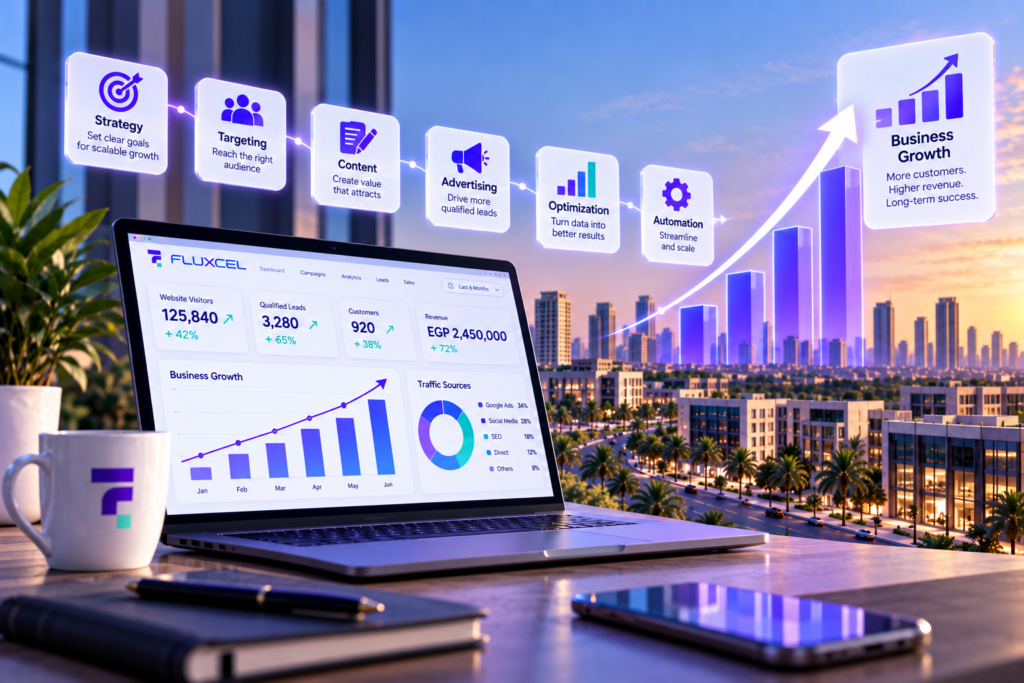
That means identifying your strongest customers, improving conversion rates, expanding proven channels, strengthening SEO, testing creative, automating repetitive processes, improving retention, and connecting marketing data with actual sales.
When these pieces work together, digital marketing becomes more than a collection of campaigns.
It becomes an infrastructure for growth.
For businesses searching for a Digital marketing agency New Cairo, the real opportunity is to build a system that can grow alongside the company rather than constantly starting again with every new campaign.
At Fluxcel Digital Marketing Agency, we connect strategy, paid media, SEO, content, websites, conversion, automation, and analytics to help businesses build digital marketing systems designed for sustainable growth.