
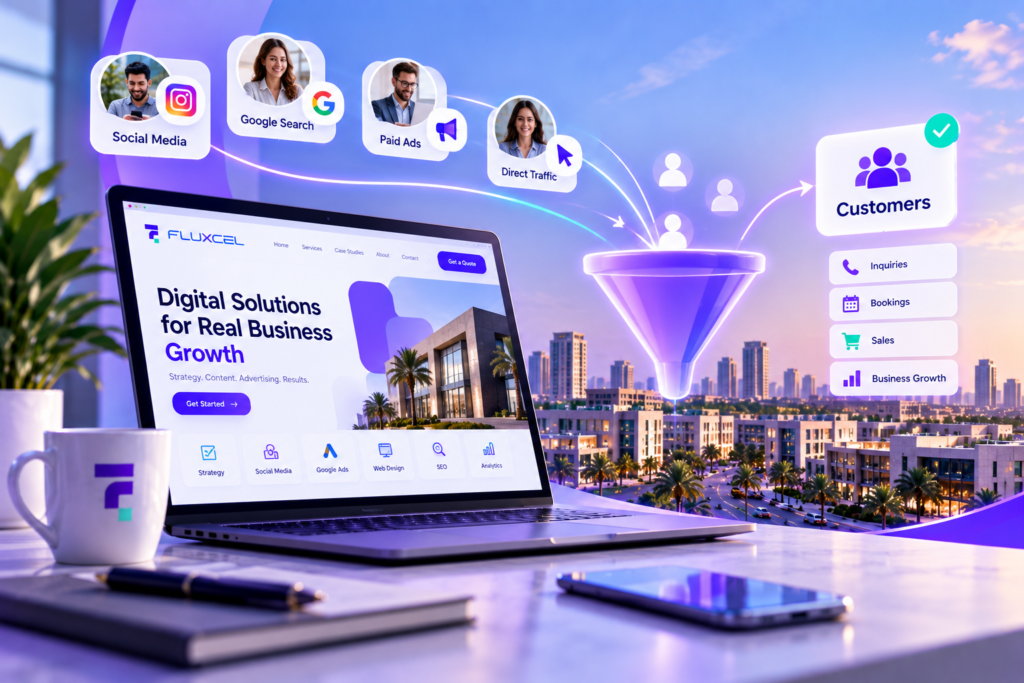
Getting people to your website is an achievement, but it is not the result.
Businesses invest in SEO, Google Ads, social media, Meta campaigns, and content marketing to increase website traffic. Then they open their analytics dashboard and see hundreds or even thousands of visitors.
But sales remain the same.
The problem is often not traffic. It is conversion.
If people are reaching your website but leaving without calling, purchasing, booking, or submitting an inquiry, increasing traffic alone may simply increase the number of people who leave.
For businesses working with a Digital marketing agency New Cairo, improving conversion should be just as important as generating traffic. The objective is not only to bring people through the digital door. It is to give the right visitors enough clarity, confidence, and motivation to take the next step.
Understand Why People Visit Your Website
Before changing your website, understand why people are arriving in the first place.
Not every visitor has the same intention.
Someone who discovers your brand through an Instagram Reel may simply be curious. A person searching Google for a specific service may already be comparing providers. A returning visitor who has viewed your pricing page three times could be much closer to making a decision.
These visitors should not all be treated the same way.
Think About Search and Customer Intent
Website visitors generally arrive at different stages of the buying journey.
They may be:
- Discovering a problem
- Researching possible solutions
- Comparing different companies
- Looking for prices
- Checking reviews
- Evaluating your credibility
- Ready to contact or purchase
Your website needs content that supports each stage.
A visitor who is researching needs useful information. Someone comparing companies needs reasons to trust you. A visitor who is ready to buy needs a simple conversion process.
Make Your Value Clear Immediately
Visitors should not have to investigate your website to understand what your business does.
Within the first few seconds, your main page should answer three basic questions:
What do you offer?
Who is it for?
Why should I care?
Many websites make the mistake of leading with clever but vague statements.
A headline such as “Creating Excellence for Tomorrow” might sound impressive, but it tells a potential customer very little.
Clear communication is usually stronger.
If you are a dental clinic, tell visitors which dental services you provide and where you are located.
If you are an e-commerce business, make your products and benefits immediately visible.
If you are a B2B company, explain the problem you solve.
Customers should not need to decode your marketing.
Design Around the Customer, Not the Company
Businesses naturally want to talk about themselves.
“Our company was founded…”
“We are passionate about…”
“We provide…”
There is nothing wrong with introducing your business, but customers usually arrive with a different priority:
What can you do for me?
Good website copy connects your capabilities with customer needs.
Instead of simply listing features, explain their value.
For example:
Feature: Same-day appointment availability.
Customer value: Get the care you need without waiting weeks for an appointment.
The second version answers the question customers are actually asking.
Create Clear Calls-to-Action
A surprisingly common conversion problem is making customers work too hard to figure out what to do next.
Every important page should have a clear next step.
Depending on the business, that could be:
- Book an Appointment
- Request a Quote
- Call Now
- Shop Now
- Schedule a Consultation
- Send Us a Message
- Get Started
Avoid filling the same page with too many competing actions.
If visitors see “Call,” “Download,” “Subscribe,” “Follow,” “Learn More,” “Contact,” and “Book” at the same time, the page can become confusing.
Identify the primary action you want users to take and make it obvious.
Build Landing Pages Around Specific Campaigns
Imagine clicking an advertisement for a particular service and being sent to a generic homepage.
Now you need to search for the service again.
That extra effort can cost conversions.
Paid campaigns should usually direct users toward pages that closely match the advertisement.
Keep the Message Consistent
If your advertisement says:
“Book Your Free Consultation”
the landing page should immediately reinforce that offer.
The headline, visuals, information, and CTA should all feel connected to the campaign the visitor just clicked.
This creates continuity.
The customer feels they arrived exactly where they expected to arrive.
A Digital marketing agency New Cairo businesses partner with should consider this full experience rather than judging campaign performance only by clicks or cost per click.
Give Customers Reasons to Trust You
People are cautious online, especially when they are considering an unfamiliar business.
Before submitting personal information, making a payment, or booking a service, they want reassurance.
Your website should provide it.
Use Real Social Proof
Depending on your business, useful trust signals can include:
- Customer reviews
- Testimonials
- Case studies
- Client logos
- Project examples
- Before-and-after results
- Certifications
- Awards
- Years of relevant experience
Specific proof is usually more convincing than generic claims.
Instead of saying, “Our customers love us,” show genuine customer feedback.
Instead of saying, “We deliver great results,” demonstrate what your team has accomplished.
Remove Unnecessary Friction
Every additional obstacle between interest and action creates another opportunity for the customer to leave.
Forms are a good example.
If someone only needs to request a callback, do you really need their full address, company size, job title, budget, industry, and ten other details?
Probably not.
Ask only for information that is necessary at that stage.
The same principle applies throughout the website.
Make navigation simple. Keep checkout steps clear. Make phone numbers clickable on mobile. Ensure WhatsApp buttons work. Explain what happens after someone submits a form.
Small improvements can make the entire experience feel easier.
Mobile Experience Can Make or Break Conversion
A website may look excellent on a large desktop monitor and perform poorly on a smartphone.
That is a serious problem when customers are discovering brands through mobile-first platforms.
Review your website on an actual phone.
Check whether:
- Text is easy to read
- Buttons are easy to tap
- Menus work properly
- Forms are simple to complete
- Images load correctly
- Pop-ups block important content
- Pages load quickly
- CTAs remain easy to find
Do not assume a responsive website automatically provides a good mobile experience.
Test it from the customer’s perspective.
Website Speed Matters More Than It Seems
People are impatient online.
If a page takes too long to load, some visitors will leave before they even see your offer.
Large images, unnecessary scripts, excessive plugins, poor hosting configurations, and badly optimized pages can all affect performance.
Improving speed can create a smoother experience while also supporting SEO and overall website usability.
Businesses should regularly review technical performance instead of waiting until the website becomes noticeably slow.
Use Content to Answer Objections Before They Become Barriers
Potential customers often hesitate because they have unanswered questions.
How much does it cost?
How does the process work?
How long will it take?
Is this right for me?
What happens after I purchase?
Can I trust this company?
Instead of leaving those questions unanswered, build them into your website.
FAQs, service pages, product descriptions, blog articles, case studies, videos, and testimonials can all reduce uncertainty.
Good content helps customers make decisions.
That is one reason SEO and conversion optimization should work together. SEO attracts visitors through useful information, while the website guides those visitors toward the next step.
Track Conversions, Not Just Website Traffic
Seeing website traffic increase feels positive, but traffic alone does not show whether your website is doing its job.
Businesses should identify meaningful actions and track them.
These may include:
- Contact form submissions
- Phone calls
- WhatsApp clicks
- Appointment bookings
- Purchases
- Quote requests
- Newsletter sign-ups
Then look at conversion rate.
If 10,000 people visit your website but only 20 convert, attracting another 5,000 visitors may not be the first problem to solve.
Improving the experience for the visitors you already have could produce better results.
Find Where Customers Are Dropping Out
Analytics can help identify pages that need attention.
For example, imagine many visitors reach a product page but very few add the product to their cart.
The problem might involve pricing, product information, trust, imagery, or the offer.
If customers frequently add products to their carts but fail to complete checkout, the problem may be further down the journey.
Maybe shipping costs appear unexpectedly.
Perhaps checkout is too complicated.
Maybe customers do not see their preferred payment method.
The numbers identify where the problem happens. Further analysis and testing help determine why.
Test Improvements Instead of Redesigning Everything
Conversion optimization does not always require rebuilding an entire website.
Sometimes small changes create meaningful improvements.
Businesses can test different:
- Headlines
- CTA wording
- Page layouts
- Forms
- Offers
- Product images
- Testimonials
- Landing page copy
Make changes with a purpose and compare the results.
Over time, these improvements can create a much stronger conversion journey.
Your Website Should Be One of Your Best Sales Tools
A website should not simply exist because every business needs one.
It should actively support growth.
It should answer customer questions, communicate your value, build credibility, reduce hesitation, and make taking action easy.
For businesses searching for a Digital marketing agency New Cairo, this means looking beyond traffic reports and advertising metrics.
Traffic creates opportunity.
Conversion turns that opportunity into business.
At Fluxcel Digital Marketing Agency, we connect website strategy, SEO, paid media, content, analytics, and conversion optimization to help businesses build digital journeys designed around measurable growth.