
Getting someone to see an advertisement is easy.
Getting that person to become a paying customer is much more complicated.
Most customers don’t discover a business and immediately make a purchase. They might see a social media post, search for the company on Google, visit its website, compare competitors, read reviews, leave, return a few days later, and finally submit an inquiry.
Every one of those interactions is part of the customer journey.
A digital marketing funnel helps businesses organize that journey instead of relying on individual campaigns to generate immediate results.
For businesses in New Cairo, where customers can quickly compare multiple brands and offers, creating a connected funnel can make marketing much more effective.
A Digital marketing agency New Cairo businesses work with should think beyond individual ads and build a system that moves potential customers from discovery to trust, consideration, and eventually conversion.
What Is a Digital Marketing Funnel?
A digital marketing funnel represents the different stages someone goes through before becoming a customer.
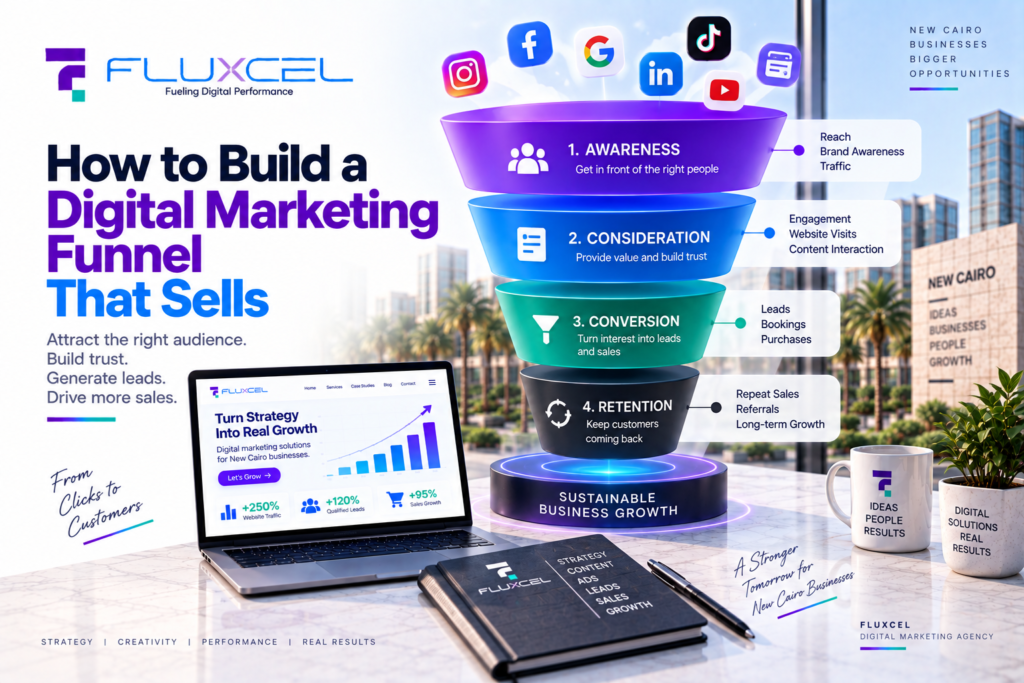
The exact journey varies depending on the business, but it can generally be simplified into four stages:
Awareness → Consideration → Conversion → Retention
At the top of the funnel, customers may know very little about your company.
As they move through the journey, they learn more about your offer, evaluate whether they trust you, and decide whether taking action makes sense.
The purpose of a funnel is not to force customers into a rigid process.
It is to provide the right information at the right moment.
Stage 1: Build Awareness With the Right Audience
Before customers can choose your business, they need to know it exists.
Awareness marketing introduces your brand to people who could eventually become customers.
This can happen through:
- Social media content
- Meta Ads
- Google Display campaigns
- YouTube
- SEO content
- Influencer collaborations
- Short-form video
- Educational blogs
At this stage, the objective is usually not an immediate sale.
You’re trying to earn attention and create familiarity.
Lead With the Customer’s Problem
One of the strongest ways to capture attention is to start with something the customer already cares about.
Instead of:
“We provide digital marketing services.”
You could lead with:
“Getting traffic but not enough customers?”
The second message immediately connects to a recognizable business problem.
Once you have someone’s attention, you can introduce your solution.
Stage 2: Turn Attention Into Interest
Awareness alone isn’t enough.
Now customers need a reason to learn more.
This is where educational and value-driven content becomes important.
Potential customers might visit your website, browse your Instagram account, read a blog, watch a video, or explore your services.
Your job is to make those interactions useful.
Answer the Questions Customers Are Already Asking
Create content around questions such as:
- How does your service work?
- Who is it designed for?
- What problems does it solve?
- What makes your approach different?
- What results can customers expect?
- How much does it cost?
- What happens after someone contacts you?
The easier it is for customers to understand your offer, the easier it becomes for them to continue through the funnel.
Stage 3: Build Trust During Consideration
This is where customers start comparing.
They know what they need and are evaluating possible providers.
At this stage, your marketing needs to answer a different question:
“Why should I choose you?”
Simply repeating your services isn’t enough.
Customers need evidence.
Use Trust-Building Content
This could include:
- Customer reviews
- Testimonials
- Case studies
- Previous projects
- Before-and-after examples
- Certifications
- Client logos
- Detailed service information
- Team expertise
- FAQs
If possible, show real results rather than relying only on general claims.
Instead of saying your company provides excellent service, demonstrate what that service has achieved for customers.
A Digital marketing agency New Cairo brands partner with should make trust-building a deliberate stage of the funnel rather than assuming customers will convert after seeing an advertisement.
Stage 4: Make Conversion Easy
Once a customer is ready to take action, don’t make the process difficult.
Conversion can mean different things depending on the business.
It might be:
- Making a purchase
- Booking an appointment
- Requesting a quotation
- Calling the company
- Sending a WhatsApp message
- Scheduling a consultation
- Completing a lead form
Whatever the action is, make it obvious.
Remove Unnecessary Friction
Review the conversion experience.
Is the website fast?
Does it work properly on mobile?
Is the CTA easy to find?
Is the lead form too long?
Are customers asked for unnecessary information?
Does the landing page clearly explain what happens next?
Small obstacles can become major conversion problems.
Customers should not have to work hard to give your business money.
Create Landing Pages for Different Campaigns
Sending every advertisement to your homepage can weaken your funnel.
Your homepage needs to introduce the entire business.
A campaign landing page can focus on one specific audience, service, problem, or offer.
This makes the customer journey more relevant.
For example:
Advertisement: Need More Qualified Leads?
Landing Page: Generate Better Leads With a Conversion-Focused Digital Strategy
The message continues naturally.
The visitor immediately understands why they arrived on the page.
Use Remarketing to Keep the Funnel Moving
Most people won’t convert after their first interaction.
That’s normal.
A customer may need several touchpoints before making a decision.
Remarketing helps businesses reconnect with people who have already demonstrated interest.
Match Remarketing to Previous Behavior
Not every visitor should receive the same advertisement.
Someone who watched a short video may still be learning about your company.
Someone who visited your pricing page several times is showing much stronger intent.
You can adapt your remarketing accordingly.
For example:
Video viewer → Educational content
Website visitor → Service benefits
Service-page visitor → Case study
High-intent visitor → Consultation or offer
This makes remarketing feel like a continuation of the journey rather than repetitive advertising.
Connect SEO With Your Funnel
SEO is often treated as a traffic channel.
But it can support several funnel stages.
Informational blogs can attract early-stage customers.
Comparison content can help people evaluating different solutions.
Service and location pages can capture customers with stronger purchasing intent.
Build Content for Different Searches
Someone searching:
“How can I get more leads?”
is probably earlier in the funnel.
Someone searching:
“Digital marketing agency New Cairo”
is showing much stronger commercial intent.
Both searches matter, but they require different content.
Understanding search intent helps you create pages that support customers at multiple stages.
Use Social Media Throughout the Funnel
Social media isn’t only an awareness channel.
It can influence customers throughout their journey.
At the awareness stage, use attention-grabbing educational or entertaining content.
During consideration, share testimonials, projects, expertise, FAQs, and case studies.
Closer to conversion, highlight services, offers, benefits, and clear CTAs.
This creates a more balanced content strategy than posting promotions every day.
Capture Leads Who Aren’t Ready Yet
Not everyone who visits your website will be ready to speak with your sales team.
That doesn’t mean you need to lose them.
Depending on your business, you might offer:
- A useful guide
- Newsletter signup
- Free consultation
- Product updates
- Webinar registration
- Downloadable resource
This gives interested visitors a lower-commitment way to stay connected.
You can then nurture those relationships through email, content, and remarketing.
Make Follow-Up Part of the Funnel
A funnel doesn’t end when someone submits a form.
What happens next can determine whether the lead becomes a customer.
If your marketing generates an inquiry at 10:00 AM but nobody responds until the following day, that potential customer may already be speaking with competitors.
Create a clear follow-up process.
Decide:
- Who receives new inquiries?
- How quickly should they respond?
- Which communication channel should they use?
- What happens if the customer doesn’t answer?
- How will lead quality and outcomes be recorded?
Marketing and sales need to work together.
Don’t Forget Existing Customers
Many funnels focus heavily on acquiring new customers and then stop immediately after the sale.
That misses a major opportunity.
Existing customers can generate repeat purchases, renewals, referrals, reviews, and additional services.
Create a Retention Stage
After conversion, continue the relationship through:
- Email marketing
- Loyalty programs
- Customer support
- Relevant offers
- Product recommendations
- Follow-up communication
- Educational content
- Review requests
Retention can increase the value generated from customers you’ve already paid to acquire.
Measure Every Stage of the Funnel
If you only measure final sales, you may struggle to understand where the funnel is failing.
Look at each stage separately.
For example:
Awareness: Reach, impressions, video views
Interest: Engagement, website visits, time on page
Consideration: Service-page visits, repeat visitors, case-study views
Conversion: Leads, appointments, sales, conversion rate
Retention: Repeat purchases, customer lifetime value, referrals
A Digital marketing agency New Cairo companies trust should connect these metrics instead of reporting them as unrelated numbers.
Find Where Customers Drop Out
The real value of funnel measurement is identifying problems.
If advertisements generate clicks but visitors leave immediately, the landing page may be weak.
If people spend time on the website but don’t submit inquiries, the offer or CTA may need improvement.
If many leads are generated but few become customers, lead quality or sales follow-up could be the issue.
Instead of assuming “marketing isn’t working,” identify exactly where the journey breaks.
Then fix that stage.
Don’t Expect One Ad to Do Everything
One advertisement shouldn’t have to introduce your brand, explain your service, establish credibility, overcome every objection, and close the sale simultaneously.
Different marketing activities should support different stages.
An awareness video earns attention.
A blog educates.
A testimonial builds confidence.
A landing page explains the offer.
A remarketing campaign reminds.
A strong CTA converts.
Together, they create a system.
Build a Funnel That Turns Attention Into Revenue
Successful digital marketing isn’t simply about generating more traffic.
It’s about moving the right people through a clear customer journey.
Attract relevant audiences. Give them useful information. Build trust. Make your value clear. Retarget interested customers. Remove conversion barriers. Follow up quickly. And continue the relationship after the first sale.
When these stages work together, marketing becomes much more predictable and measurable.
At Fluxcel Digital Marketing Agency, we help businesses connect content, SEO, paid advertising, social media, landing pages, remarketing, and conversion strategy into digital funnels designed around measurable growth.