
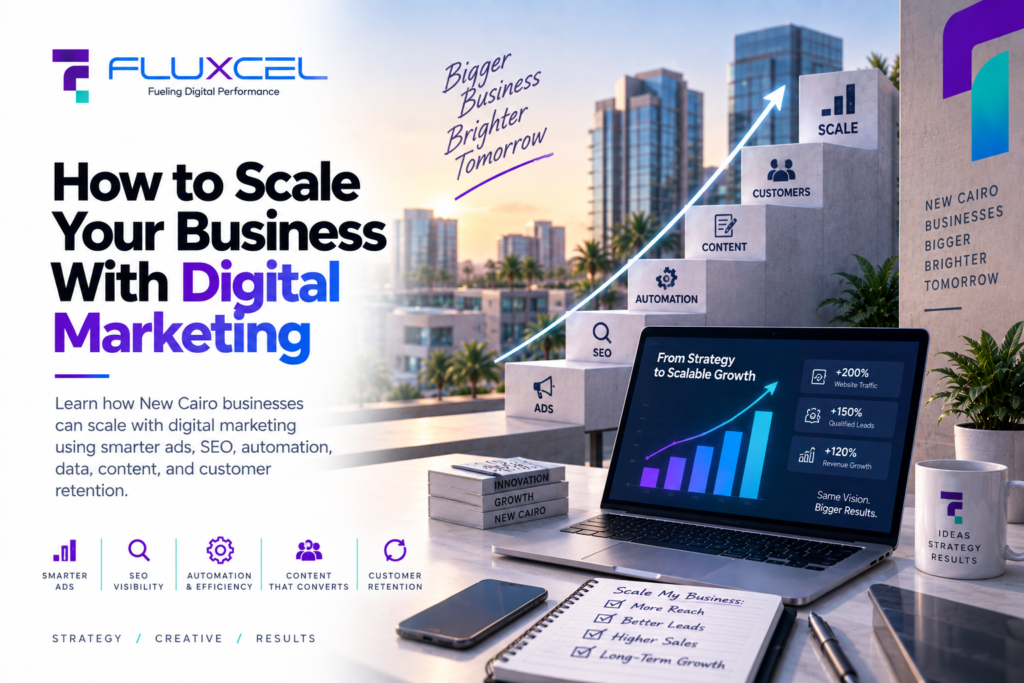
Growth and scaling aren’t exactly the same thing.
A business can grow by spending more money, hiring more people, launching more campaigns, or increasing its workload. But if costs rise just as quickly as revenue, that growth can become difficult to maintain.
Scaling is different.
It means building systems that allow your business to handle more customers, generate more revenue, and expand its marketing without increasing costs and complexity at the same rate.
Digital marketing can play a major role in making that possible.
But scaling doesn’t mean simply doubling your advertising budget.
If your existing marketing has weak targeting, low conversion rates, poor tracking, or inconsistent follow-up, increasing the budget can simply multiply those problems.
For businesses looking for a Digtial marketing agency new cairo, the focus should be on creating a marketing system that can grow efficiently — not just launching more campaigns.
Here’s what that looks like.
Make Sure Your Marketing Works Before You Scale It
Before increasing your investment, understand what’s already working.
Imagine you’re spending EGP 50,000 per month on advertising and generating leads consistently.
Increasing that budget to EGP 100,000 sounds like an obvious way to generate twice as many leads.
Unfortunately, marketing rarely works that neatly.
As spending increases, you may reach less relevant audiences, advertising costs may rise, and your sales team may struggle to handle the additional inquiries.
Find Your Strongest Growth Drivers
Start by identifying:
- Your highest-converting campaigns
- Your strongest audience segments
- Your most profitable services or products
- Your best-performing landing pages
- Your highest-quality lead sources
- Your most valuable customer groups
Scaling becomes easier when you know exactly what you’re trying to expand.
Don’t scale everything.
Scale what has already demonstrated value.
Build a Strong Conversion Foundation
More traffic won’t solve a weak conversion journey.
If 98% of your website visitors leave without taking action, bringing another 10,000 people to the same website may simply create more missed opportunities.
Before aggressively increasing traffic, improve what happens after someone clicks.
Review Your Conversion Journey
Look at the complete process:
Ad → Landing Page → Inquiry → Follow-Up → Sale
At every stage, ask whether something is creating unnecessary friction.
Your landing pages should communicate the offer clearly.
Forms should be easy to complete.
CTAs should be obvious.
Your website should work properly on mobile.
Sales teams should respond quickly.
Small improvements across this journey can significantly increase the value of your existing traffic.
That’s a much healthier foundation for scaling.
Expand Your Best-Performing Paid Campaigns Carefully
Paid advertising is one of the fastest ways to expand digital reach, but scaling ad spend requires control.
Avoid dramatically increasing budgets simply because a campaign performed well for a few days.
Instead, study the quality and consistency of the results.
Scale in Different Directions
Increasing the budget is only one way to grow a campaign.
You can also test:
- New audience segments
- New geographic areas
- Additional keywords
- Different creative concepts
- New placements
- Additional products or services
- Retargeting audiences
- Lookalike or similar audiences
This allows you to find new pockets of opportunity instead of depending entirely on one campaign.
A Digtial marketing agency new cairo strategy should also monitor what happens to lead quality as campaigns expand.
More leads aren’t useful if the percentage becoming customers drops significantly.
Use SEO to Reduce Dependence on Paid Traffic
Advertising can help businesses grow quickly, but relying entirely on paid media creates a major dependency.
When the advertising budget stops, traffic can fall immediately.
SEO can help create a more balanced acquisition strategy.
A well-optimized website can attract customers who are actively searching for relevant products, services, and information.
Build Search Visibility Over Time
Focus on developing valuable pages around:
- Core services
- Products
- Customer problems
- Local searches
- Frequently asked questions
- Industry topics
- Comparison searches
- Buying guides
The objective isn’t simply to produce large amounts of content.
Each page should target a genuine customer need or search intent.
As organic visibility improves, your business can attract additional traffic without paying directly for every click.
That makes SEO particularly valuable when building long-term scale.
Create Content Systems Instead of Random Posts
Scaling content doesn’t mean asking your team to create twice as many posts.
It means creating a better system.
Start with larger ideas and break them into multiple formats.
For example, one detailed guide could become:
- A blog article
- Three Instagram posts
- A LinkedIn post
- A Reel
- An email
- Several Stories
- An infographic
- A sales resource
One customer question could generate an entire week of useful content.
Create Repeatable Content Categories
Develop clear content pillars based on what your audience cares about.
These might include:
Education — answering common questions.
Expertise — sharing insights and professional knowledge.
Proof — testimonials, case studies, and results.
Brand — communicating your company’s personality and values.
Conversion — promoting products, services, and offers.
Repeatable systems make content easier to scale while maintaining consistency.
Use Automation to Handle Repetitive Work
As a business grows, manual processes become harder to manage.
Imagine receiving 20 leads per month.
A spreadsheet and manual follow-up may work.
Now imagine receiving 500.
The same process can quickly become chaotic.
Automation can help businesses manage higher volumes without losing consistency.
Automate the Right Tasks
Useful marketing automation can include:
- Lead notifications
- CRM updates
- Email sequences
- Appointment reminders
- Abandoned cart emails
- Customer segmentation
- Lead nurturing
- Reporting
- Retargeting workflows
Automation shouldn’t replace every human interaction.
Customers may still need conversations, advice, negotiations, or personalized support.
Use technology to handle repetitive processes so your team can spend more time on activities where human judgment actually matters.
Build a Better Lead Management System
Generating more leads is pointless if your business can’t handle them.
As marketing scales, sales processes need to scale too.
Every inquiry should have a clear journey.
For example:
New Lead → Contacted → Qualified → Opportunity → Customer → Follow-Up
Your team should know who owns each stage.
Track Why Leads Don’t Convert
Don’t simply categorize unsuccessful leads as “lost.”
Find out why.
Was the price too high?
Was the lead outside your target area?
Did they choose a competitor?
Was the response too slow?
Were they simply researching?
This feedback can improve marketing.
If a campaign repeatedly attracts people with unrealistic budgets, your advertising message may need to change.
Marketing and sales should continuously exchange this information.
Increase Customer Value, Not Just Customer Volume
Scaling doesn’t always require finding more new customers.
Sometimes the biggest opportunity exists among people who already know your business.
Acquiring a new customer often requires more marketing effort than communicating with someone who has already purchased from you.
Depending on your business model, you can explore:
- Repeat purchases
- Cross-selling
- Upselling
- Loyalty programs
- Customer referrals
- Re-engagement campaigns
- Email marketing
- Exclusive customer offers
For example, an e-commerce business could encourage previous customers to reorder.
A service company could introduce complementary services.
A B2B company could expand an existing client relationship.
A strong Digtial marketing agency new cairo strategy should consider customer retention alongside acquisition.
Use Data to Decide Where to Grow
Scaling based on assumptions can become expensive.
Scaling based on data gives you a much clearer direction.
Track the numbers that explain the health of your marketing system.
Depending on your business, these may include:
- Customer acquisition cost
- Cost per qualified lead
- Conversion rate
- Average order value
- Customer lifetime value
- Return on ad spend
- Lead-to-customer rate
- Repeat purchase rate
- Revenue by marketing channel
Don’t look at these numbers independently.
Connect them.
A campaign with a higher cost per lead might still be valuable if those leads convert at a significantly higher rate.
Similarly, a channel with expensive customer acquisition may make sense if customers from that channel generate greater long-term value.
Don’t Let Growth Damage the Customer Experience
There is another side of scaling that businesses sometimes overlook.
Can you actually deliver what you’re marketing?
If campaigns suddenly generate three times as many customers, your operations need to handle that demand.
Otherwise, growth can create:
- Longer response times
- Delivery delays
- Poor customer service
- Product shortages
- Missed inquiries
- Lower customer satisfaction
Marketing should therefore stay connected to the rest of the business.
Sometimes the right decision isn’t to increase advertising immediately.
It may be to strengthen operations first so the company is ready for the next stage.
Scale With a System, Not Just a Bigger Budget
Digital marketing can help businesses grow faster, but sustainable scaling requires more than increasing ad spend.
You need campaigns that already perform, landing pages that convert, content systems that can grow, automation that reduces repetitive work, reliable data, strong follow-up, and a customer experience capable of handling additional demand.
When those elements work together, marketing becomes easier to expand without creating unnecessary waste.
Choosing a Digtial marketing agency new cairo businesses can work with should therefore involve looking beyond individual campaigns. The bigger opportunity is creating a digital ecosystem that supports the next stage of the company.
At Fluxcel, we connect strategy, performance marketing, SEO, content, technology, and conversion optimization to help businesses build digital growth that can scale.