
Getting new customers is essential for business growth. But what happens when acquiring those customers becomes more expensive than expected?
You launch advertising campaigns, invest in social media content, improve your website, and generate inquiries. Yet, at the end of the month, your marketing expenses keep increasing while your profits remain almost unchanged.
Sound familiar?
This is a challenge many growing businesses face. Whether you’re managing an e-commerce store, real estate company, medical clinic, or professional services business, attracting customers is only valuable when the cost makes financial sense.
In 2027, businesses need to think beyond generating traffic and leads. They need to understand how efficiently their marketing investments turn potential customers into paying clients.
That’s where customer acquisition cost becomes important.
Working with a digital marketing agency New Cairo businesses trust can help companies evaluate marketing performance, identify unnecessary expenses, and develop strategies focused on profitable customer acquisition.
Let’s explore how businesses can reduce acquisition costs without sacrificing lead quality or long-term growth.
1. Understand Your Customer Acquisition Cost
Customer acquisition cost, commonly known as CAC, measures how much a business spends to acquire a new customer.
It’s one of the most important indicators of marketing efficiency.
How to calculate customer acquisition cost
The basic formula is:
CAC = Total Customer Acquisition Expenses ÷ Number of New Customers Acquired
For example, imagine a business in New Cairo spending EGP 60,000 on marketing and sales acquisition activities during one month.
If those activities generate 30 new customers, the average customer acquisition cost is:
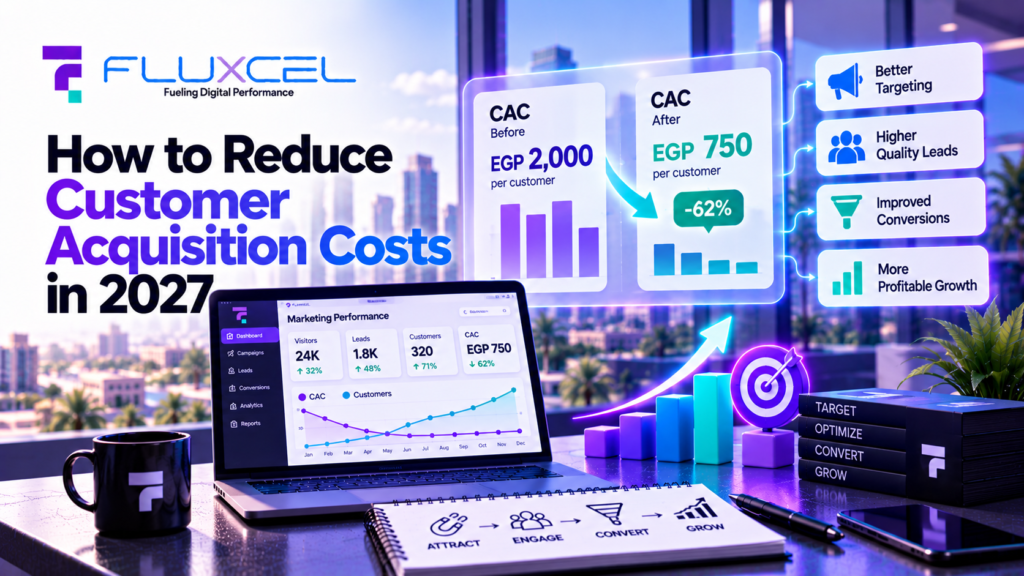
EGP 60,000 ÷ 30 = EGP 2,000 per customer
However, calculating CAC accurately requires including relevant expenses, not just advertising spend.
These may include:
Paid advertising expenses.
Marketing agency fees.
Content production costs.
Marketing software subscriptions.
Relevant sales team expenses.
Other acquisition-related costs.
The exact calculation should be consistent across reporting periods.
Why CAC matters
A business might generate hundreds of new customers and still struggle financially if acquiring them costs too much.
Understanding CAC helps companies evaluate whether their growth strategy is sustainable.
2. Focus on Customer Quality Instead of Lead Quantity
One of the most common marketing mistakes is assuming that more leads automatically mean better results.
Imagine two advertising campaigns promoting the same service.
Campaign A generates 200 leads at EGP 100 each.
Campaign B generates 100 leads at EGP 150 each.
At first glance, Campaign A appears more efficient.
But what happens when we examine actual customer conversions?
Example: Lead Cost vs. Customer Acquisition Cost
| Metric | Campaign A | Campaign B |
|---|---|---|
| Advertising spend | EGP 20,000 | EGP 15,000 |
| Leads generated | 200 | 100 |
| Cost per lead | EGP 100 | EGP 150 |
| Customers acquired | 10 | 20 |
| Advertising cost per customer | EGP 2,000 | EGP 750 |
Illustrative figures. Advertising cost per customer excludes other acquisition expenses.
Campaign B generates fewer leads at a higher cost per lead, but it acquires twice as many customers at a substantially lower advertising cost per customer.
This demonstrates why businesses shouldn’t judge campaign performance based entirely on lead volume.
How to improve lead quality
Start by identifying the characteristics of customers most likely to purchase.
Review previous sales data and look for patterns in successful conversions.
Then refine your advertising messages, targeting, and lead qualification process to attract prospects with relevant needs.
The objective isn’t simply to generate more inquiries.
It’s to attract customers who are more likely to purchase.
3. Improve Your Website Conversion Rate
Sometimes, the fastest way to improve acquisition efficiency isn’t increasing your advertising budget.
It’s improving what happens after someone visits your website.
Imagine your website receives 10,000 visitors per month.
If 1% become customers, you acquire 100 customers.
If you improve that conversion rate to 2%, you acquire 200 customers from the same traffic volume.
That doesn’t automatically mean your overall acquisition costs will be cut in half, but it demonstrates the potential value of conversion improvements.
Make your website easier to use
Focus on practical changes that improve the customer experience.
Clear messaging
Explain your products or services immediately.
Simple navigation
Help visitors find relevant information without unnecessary steps.
Mobile optimization
Ensure your website works smoothly on smartphones.
Strong calls to action
Make booking, purchasing, or requesting information straightforward.
Trust-building elements
Include genuine customer reviews, relevant credentials, and accurate business information.
Identify conversion barriers
Use analytics tools to understand where visitors leave your website.
Are customers abandoning forms?
Are product pages receiving traffic without generating purchases?
Are mobile users experiencing technical problems?
Addressing these issues can improve the return on existing marketing investments.
A professional digital marketing agency New Cairo businesses work with can help connect website analytics with conversion optimization priorities.
4. Use First-Party Customer Data More Effectively
Businesses often collect valuable information through website interactions, sales inquiries, and previous purchases.
However, much of this information remains unused.
First-party data is information collected directly through your own customer relationships and digital channels.
When collected and used appropriately, it can support more relevant marketing decisions.
Identify your strongest customer segments
Review which customer groups generate the highest conversion rates and most sustainable revenue.
For example, a furniture retailer might discover that customers purchasing complete bedroom sets generate higher average order values than customers purchasing individual accessories.
This doesn’t mean the business should ignore smaller purchases.
Instead, it can use the information to understand different customer segments and their potential value.
Improve your marketing decisions
Customer data can help businesses:
Identify profitable customer segments.
Understand repeat purchasing behavior.
Improve relevant product recommendations.
Evaluate acquisition channels.
Develop more effective customer communication.
Always follow applicable privacy requirements and respect customer consent.
The goal is to make marketing more relevant, not unnecessarily intrusive.
5. Invest in Organic Marketing to Support Long-Term Growth
Paid advertising can help businesses reach customers quickly, but relying entirely on paid campaigns may create financial pressure.
Organic marketing provides another way to attract potential customers.
Search engine optimization, educational content, and useful digital resources can help businesses develop visibility beyond individual advertising campaigns.
Build content around customer searches
Imagine operating an interior design company in New Cairo.
Potential customers might search for:
Modern apartment interior design ideas.
Interior design services in Fifth Settlement.
How to choose an interior designer.
Apartment renovation planning tips.
Creating useful content around relevant searches can help attract people who are researching these topics.
Think beyond immediate results
SEO generally requires ongoing effort and doesn’t guarantee specific rankings or traffic.
However, useful content can continue attracting visitors after publication.
Over time, organic channels may contribute to a more balanced acquisition strategy.
A digital marketing agency New Cairo companies partner with can help identify which organic opportunities deserve investment alongside paid advertising.
6. Reduce Wasted Advertising Spend Through Better Testing
Advertising campaigns often underperform because businesses continue investing in approaches that haven’t demonstrated meaningful results.
Testing can help identify stronger messages, creative formats, and audience strategies.
However, testing should be structured.
What should you test?
Advertising hooks
Compare messages that emphasize different customer problems or benefits.
Creative formats
Evaluate videos, carousels, and static advertisements.
Landing pages
Test different layouts, explanations, or calls to action.
Offers
Compare relevant service packages or promotional approaches.
Audience strategies
Evaluate different targeting signals and campaign structures.
Avoid changing everything simultaneously
When several variables change at once, understanding what caused a performance difference becomes difficult.
Where practical, test one major variable at a time.
Allow enough data to make reasonable comparisons.
Most importantly, evaluate results based on qualified leads, customers, and acquisition costs rather than clicks alone.
7. Improve Sales Follow-Up to Convert More Leads
Marketing teams can generate excellent leads, but those opportunities may disappear if the sales process is inefficient.
Imagine your business receives 100 qualified inquiries.
Your sales team successfully contacts only 60.
The remaining 40 represent potential opportunities that may never receive appropriate attention.
Improving sales follow-up can help businesses convert more of their existing inquiries.
Build a consistent follow-up process
Establish clear procedures for handling incoming leads.
Make sure inquiries reach the appropriate team.
Provide sales representatives with relevant customer information.
Use a CRM system to track conversations and next steps.
Monitor which leads become customers and identify recurring reasons for lost opportunities.
Connect marketing with sales outcomes
If a particular campaign generates many inquiries but few purchases, investigate the reasons.
Perhaps the advertising message attracts customers outside your intended budget range.
Maybe the offer isn’t explained clearly.
Or perhaps the sales team needs better information to respond effectively.
The solution may involve improving communication rather than spending more on advertisements.
8. Evaluate Customer Lifetime Value Alongside CAC
Reducing acquisition costs is important, but the lowest possible CAC isn’t always the best business objective.
Some customers generate greater long-term value than others.
Customer lifetime value, or CLV, estimates the value a customer contributes throughout their relationship with your business.
Example: Two customer segments
Consider an online retailer with two customer groups.
Customer Segment A
Acquisition cost: EGP 300.
Average purchase: EGP 600.
Average purchases per year: 2.
Customer Segment B
Acquisition cost: EGP 500.
Average purchase: EGP 1,200.
Average purchases per year: 4.
Segment B costs more to acquire, but its purchasing behavior may justify the additional investment.
However, revenue alone doesn’t determine profitability.
Businesses should consider gross margins, retention, servicing costs, and other relevant expenses when evaluating customer value.
Find the right balance
Rather than pursuing the cheapest customers, focus on acquiring customers whose expected value supports sustainable business growth.
This helps prevent short-term cost reductions from undermining long-term profitability.
9. Allocate Marketing Budgets Based on Real Performance
Not every marketing channel deserves the same investment.
Some channels may generate stronger immediate conversions, while others support brand discovery and future demand.
The challenge is understanding how each contributes to your business objectives.
Review your channel performance
Compare marketing channels using consistent metrics.
Look at customer acquisition costs, conversion rates, customer quality, and revenue contribution.
Also consider whether certain channels influence purchases that are eventually completed elsewhere.
For example, someone might discover your brand through Instagram and later purchase after searching on Google.
This makes attribution more complicated than simply crediting the final click.
Avoid making decisions from incomplete data
Before reducing investment in a channel, consider its role in the overall customer journey.
A campaign that doesn’t generate many direct conversions may still introduce valuable customers to your business.
Use multiple performance indicators to make informed budget decisions.
10. Create a Customer Acquisition Improvement Plan for 2027
Reducing customer acquisition costs requires consistent analysis and improvement.
Instead of making occasional changes, develop a structured process.
Month 1: Review Your Current Performance
Calculate your existing acquisition costs.
Evaluate marketing and sales expenses.
Identify your strongest customer segments.
Review channel performance and conversion tracking.
Month 2: Improve Conversion Efficiency
Optimize important landing pages.
Review advertising messages.
Improve lead qualification.
Address weaknesses in sales follow-up.
Month 3: Test and Refine
Compare campaign results.
Evaluate customer acquisition costs.
Identify improvements that can be sustained.
Adjust budget priorities based on available evidence.
This 90-day approach provides a practical starting point.
Actual timelines and results will depend on your industry, available data, marketing budget, and sales process.
Build More Profitable Growth With Fluxcel
Business growth isn’t just about attracting more customers.
It’s about acquiring the right customers at a cost that supports long-term profitability.
By improving lead quality, optimizing website conversions, using customer data responsibly, and connecting marketing with sales performance, businesses can identify opportunities to make their acquisition strategies more efficient.
At Fluxcel Digital Marketing Agency, we help businesses develop performance-focused marketing strategies built around measurable business objectives.
From Google Ads and Meta advertising to SEO, conversion optimization, and marketing analytics, our approach focuses on improving how marketing investments contribute to growth.
Whether you’re running an e-commerce store, service company, or growing business in New Cairo, understanding your acquisition costs is an important step toward making better marketing decisions.
Stop measuring success by how much you spend. Start measuring how efficiently your business grows.