
Imagine walking into a store where nobody greets you, explains the products, or helps you find what you’re looking for. You might browse for a few minutes, but there’s a good chance you’ll leave without buying anything.
The same thing happens online every day.
Businesses invest in advertisements, social media content, and websites to attract potential customers. But once someone shows interest, there isn’t always a clear process guiding them toward a purchasing decision.
Some customers visit a website and disappear. Others ask about prices but never receive a follow-up. Many interact with social media content without taking the next step.
This is where a marketing funnel becomes valuable.
A marketing funnel helps businesses understand how people move from discovering a brand to becoming paying customers. It connects different marketing activities into a structured journey rather than treating each campaign as an isolated effort.
For businesses operating in competitive areas like New Cairo, this approach can help improve customer acquisition and make marketing investments more effective.
Working with a digital marketing agency New Cairo businesses trust can help develop a marketing funnel that connects audience behavior, content, advertising, and sales activities.
Here’s how to build one that supports measurable business growth.
1. Understand What a Marketing Funnel Actually Is
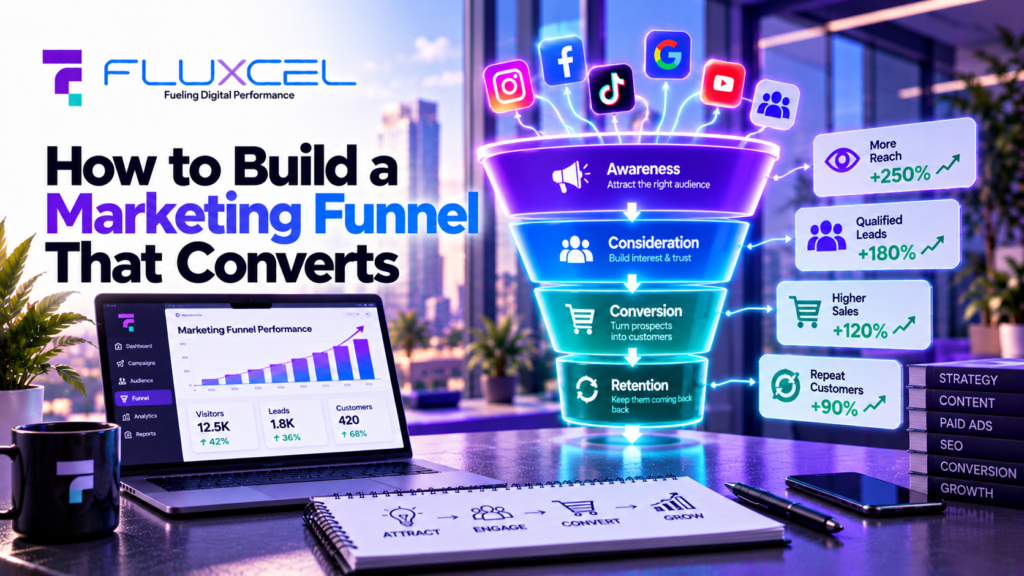
A marketing funnel represents the stages potential customers move through before completing a desired action.
These stages are often described as awareness, consideration, conversion, and retention.
However, real customer journeys aren’t always linear.
Someone might discover your brand through Instagram, search for reviews on Google, visit your website, leave, and return several days later to make a purchase.
The funnel provides a framework for understanding these interactions.
The four main stages of a marketing funnel
1. Awareness
Potential customers discover your business
2. Consideration
They explore and compare solutions
3. Conversion
They purchase, book, or inquire
4. Retention
They return and maintain the relationship
Each stage requires different communication.
Someone discovering your business for the first time may need basic information about your services.
A customer comparing providers may need pricing details, demonstrations, or evidence of your expertise.
Understanding these differences helps businesses communicate more effectively.
2. Attract the Right Audience at the Awareness Stage
The first stage of your funnel is about helping relevant customers discover your business.
This doesn’t mean reaching as many people as possible.
It means attracting people who are likely to have an interest in what you offer.
Choose awareness channels based on your audience
Businesses can use several approaches:
Educational social media content.
Search engine optimization.
Relevant video content.
Paid awareness campaigns.
Industry articles and guides.
Partnerships with complementary businesses.
For example, a New Cairo interior design company could publish short videos explaining common apartment layout mistakes.
These videos may attract homeowners who are planning renovations.
At this stage, viewers may not be ready to request a quotation.
The purpose is to introduce the business and demonstrate its relevance.
Avoid selling too aggressively
An audience discovering your brand for the first time may not have enough information to make a purchasing decision.
Focus on answering useful questions and communicating what makes your offering relevant.
Strong awareness content creates an opportunity for further engagement.
3. Build Interest During the Consideration Stage
Once potential customers become aware of your business, they may begin evaluating their options.
This is where more detailed information becomes important.
Imagine someone considering a gym membership in Fifth Settlement.
They’ve seen several advertisements and are now comparing facilities, training programs, membership conditions, and locations.
Generic motivational content may no longer be enough.
They need information that helps them make a decision.
Create content that answers buying questions
Useful consideration-stage content includes:
Service comparisons
Explain differences between available packages or solutions.
Product demonstrations
Show how products work and what customers can expect.
Frequently asked questions
Address common concerns about pricing, delivery, booking, or service requirements.
Case studies
Share real examples of previous work and outcomes, with appropriate permission.
Detailed service pages
Provide clear information about what your business offers.
A professional digital marketing agency New Cairo businesses work with can help identify common customer questions and develop content that supports informed purchasing decisions.
4. Make the Conversion Stage Simple
At the conversion stage, customers are considering taking action.
They may want to purchase a product, book an appointment, request a quotation, or contact your sales team.
The biggest mistake businesses make here is creating unnecessary complications.
Remove obstacles from the purchasing process
Consider an online retailer promoting a specific product.
A potential customer clicks the advertisement, visits the product page, and decides to purchase.
But the checkout requires too many fields, shipping information is unclear, and the payment process feels confusing.
These issues can discourage completion.
Improve your conversion experience
Focus on:
Clear product and service descriptions.
Transparent pricing where appropriate.
Simple forms and checkout processes.
Visible contact information.
Relevant customer reviews.
Clear calls to action.
Reliable mobile performance.
For service-based businesses, the conversion might be an appointment request rather than a completed sale.
Make sure customers understand what happens after submitting their information.
5. Connect Marketing Activities Across Channels
A marketing funnel becomes more effective when different channels support the same customer journey.
For example, someone might first discover your business through a Facebook advertisement.
Later, they search for your company on Google, read an article, and visit a service page.
After comparing options, they return to request a consultation.
Each interaction may contribute to their decision.
Example of a connected marketing funnel
Stage | Marketing activity | Customer action |
|---|---|---|
Awareness | Educational Instagram Reel | Discovers the business |
Consideration | Website service page | Explores available options |
Evaluation | Case study or FAQ | Assesses suitability |
Conversion | Consultation form | Submits an inquiry |
Retention | Relevant follow-up | Maintains the relationship |
The objective is to make the experience consistent.
Your advertising messages, website information, and sales communication should support one another.
If an advertisement promises a particular offer, the destination page should explain that same offer accurately.
6. Measure Where Customers Leave Your Funnel
One of the biggest advantages of a structured funnel is the ability to identify where potential customers stop progressing.
Instead of looking only at total website traffic or advertising clicks, you can evaluate how people move between stages.
Example: A hypothetical website funnel
Monthly customer funnel performance
Visitor-to-lead
3%
Lead-to-customer
20%
Customers
30
In this example, 400 people begin filling out a form, but only 150 complete it.
That suggests an area worth investigating.
Perhaps the form asks too many questions. Maybe it has a technical issue, or visitors don’t understand what will happen after submitting it.
The data doesn’t automatically explain the problem, but it helps identify where further investigation is needed.
Useful funnel metrics
Track landing page engagement, form completion rates, qualified inquiries, lead-to-customer conversion rates, and customer acquisition costs.
Choose metrics that reflect your actual business model.
7. Use Remarketing to Reconnect With Interested Customers
Not everyone who visits your website will make a decision immediately.
Some customers need more time to compare options, discuss purchases, or evaluate their budgets.
Remarketing can help businesses reconnect with eligible audiences who previously interacted with their digital channels.
Make remarketing relevant
Imagine someone visits a furniture retailer’s website and explores several dining tables.
A relevant follow-up advertisement might highlight available table collections or useful product information.
This can be more helpful than showing unrelated promotions.
Avoid excessive repetition
Remarketing should respect customer preferences, privacy requirements, and advertising platform policies.
Repeatedly displaying the same advertisement may create frustration.
Focus on useful information, appropriate audience exclusions, and reasonable campaign frequency.
The purpose is to remain relevant when customers are ready to continue their decision-making process.
8. Connect Your Funnel With Your Sales Team
A marketing funnel doesn’t end when someone submits an inquiry.
For many service-based businesses, that is only the beginning of the sales process.
Imagine a company generating 100 qualified leads through advertising.
If the sales team responds to only 60 of them, the business may lose valuable opportunities regardless of how effective the campaigns were.
Build a clear lead management process
Define how incoming leads are assigned.
Establish reasonable response expectations.
Record relevant customer requirements.
Track the progress of inquiries through the sales process.
Use CRM software where appropriate to organize conversations and follow-ups.
Share sales feedback with marketing
Your sales team can provide useful information about lead quality.
For example, they may discover that many inquiries come from customers seeking services outside your available price range.
This feedback can help improve advertising messages and qualification processes.
A digital marketing agency New Cairo companies partner with should consider the full customer journey, including what happens after marketing generates an inquiry.
9. Improve Your Funnel Through Continuous Testing
Even a well-designed funnel will need adjustments.
Customer behavior changes, new competitors enter the market, and business priorities evolve.
Regular testing helps identify opportunities for improvement.
What can you test?
You might compare different landing page headlines, inquiry form lengths, product explanations, advertising messages, or calls to action.
However, avoid changing everything simultaneously.
Testing one major element at a time, where practical, makes results easier to interpret.
Focus on meaningful improvements
A higher click-through rate isn’t always valuable if the additional clicks don’t generate relevant customers.
Similarly, reducing the number of form fields might increase submissions but lower lead quality.
Evaluate changes using the metrics that matter most to your business.
A successful funnel isn’t simply one that generates more activity.
It’s one that helps more suitable customers complete meaningful actions.
10. Build a Funnel That Fits Your Business Model
There is no universal marketing funnel that works equally well for every company.
An e-commerce business selling everyday products may have a relatively short purchasing journey.
A real estate developer or B2B consultancy may need several interactions before a customer makes a decision.
Adapt the process to your customers
For an online store, the funnel may focus on product discovery, browsing, checkout, and repeat purchases.
For a medical clinic, it might involve educational information, service evaluation, appointment booking, and appropriate follow-up.
For a corporate services company, the journey could include initial research, consultation requests, proposals, and internal approval processes.
Your funnel should reflect how customers actually make decisions.
Avoid adding unnecessary stages or complicated automation simply because another business uses them.
The best structure is one your team can manage, measure, and improve.
Build a Marketing Funnel That Drives Growth With Fluxcel
Attracting attention is important, but turning that attention into meaningful business results requires a connected customer journey.
A strong marketing funnel helps businesses understand how customers discover their services, evaluate options, make purchasing decisions, and maintain relationships.
By connecting content, advertising, website experiences, and sales processes, companies can identify opportunities to improve conversion performance and make better use of their marketing investments.
At Fluxcel Digital Marketing Agency, we help businesses develop performance-focused digital marketing strategies that connect customer behavior with measurable objectives.
From campaign planning and lead generation to website optimization, analytics, and conversion improvement, our approach focuses on making marketing activities work together.
Whether you’re managing an e-commerce business, professional services company, or growing brand in New Cairo, we can help you develop a more structured approach to customer acquisition.