
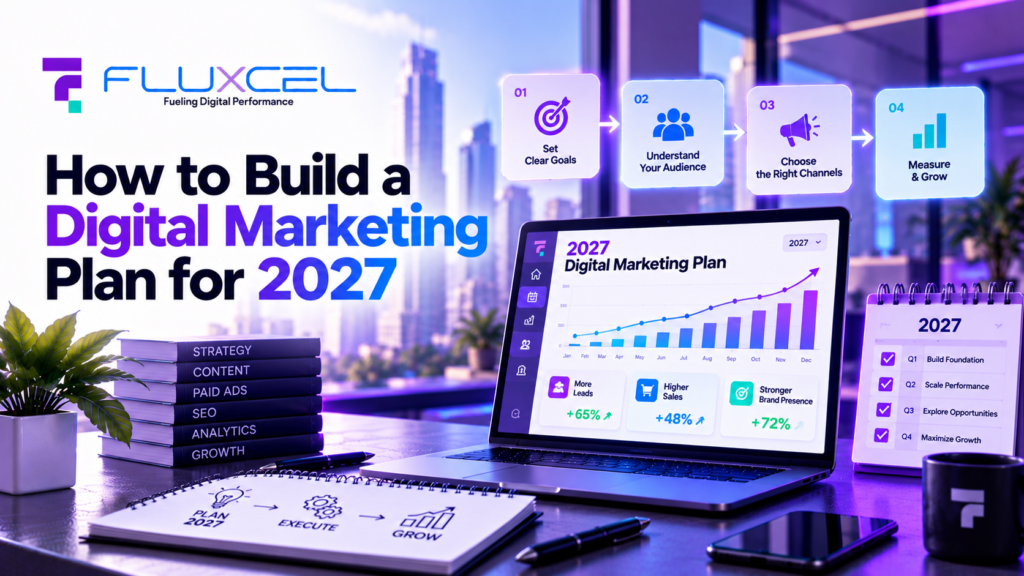
As 2027 approaches, businesses across New Cairo are preparing their budgets, reviewing their performance, and looking for new opportunities to grow.
But there’s a major difference between having a marketing budget and having a marketing plan.
Many businesses enter a new year with ambitious goals. They want more customers, stronger sales, better social media engagement, and improved brand visibility. Yet, without a clear strategy, these goals often turn into disconnected campaigns and unpredictable results.
A successful digital marketing plan isn’t about being active on every platform or spending more than your competitors. It’s about knowing where your business stands, understanding where you want to go, and identifying the actions that can help you get there.
Working with a digital marketing agency New Cairo businesses trust can help turn these ambitions into a structured marketing roadmap supported by realistic budgets, measurable objectives, and clear priorities.
Here’s how to prepare a practical digital marketing plan for 2027.
1. Review Your 2026 Marketing Performance
Before planning your next marketing activities, take a close look at what happened during 2026.
Which campaigns delivered the strongest results? Where did you spend money without achieving your objectives? Which channels generated the most valuable customers?
Your previous performance provides a starting point for making better decisions.
What should you review?
Focus on metrics that reflect actual business outcomes:
Total marketing investment across channels.
Leads and customers generated.
Revenue attributed to marketing activities.
Customer acquisition costs.
Website conversion rates.
Organic search traffic and visibility.
Customer retention and repeat purchases.
For example, a New Cairo furniture company might discover that Google Search campaigns generated fewer inquiries than Meta Ads but attracted customers with larger average purchases.
This information can influence how the business allocates its budget in 2027.
Identify what needs improvement
Don’t focus exclusively on successful campaigns.
Review underperforming activities to understand whether the problem came from targeting, creative messaging, offers, tracking, or customer experience.
The objective isn’t to repeat everything from the previous year. It’s to build on what worked and improve what didn’t.
2. Set Clear and Measurable Marketing Goals
One of the most common planning mistakes is setting vague objectives.
Goals such as “increase sales,” “grow our Instagram,” or “get more customers” sound positive, but they don’t provide enough direction.
A useful marketing goal should define what you want to achieve and how you’ll measure success.
Turn broad objectives into specific targets
Instead of:
“We want more leads in 2027.”
Try:
“Increase monthly qualified leads from 100 to 140 by the end of Q2 2027 while maintaining an acceptable customer acquisition cost.”
This goal gives your team a specific target and timeframe.
Connect marketing goals to business priorities
Your objectives might include increasing revenue, expanding into new geographic areas, launching products, improving profitability, or strengthening customer retention.
Each business will have different priorities.
For example, a newly established restaurant might prioritize local awareness and first-time visits.
An established e-commerce business may focus on increasing repeat purchases and average order value.
Your marketing plan should support your business goals, not operate separately from them.
3. Understand How Your Customers Are Changing
Customer expectations don’t remain the same every year.
People discover products through different channels, compare alternatives, and develop new preferences.
Businesses need to understand these changes rather than assume their customers will behave exactly as they did previously.
Update your customer research
Review recent customer inquiries, purchasing patterns, website analytics, and sales feedback.
Ask yourself:
What problems are customers trying to solve?
Which products or services are gaining interest?
What objections prevent purchases?
Which channels influence purchasing decisions?
What information do customers need before contacting us?
For a business operating in Fifth Settlement, customer preferences may vary depending on the service category, price range, and location.
Avoid building your 2027 strategy entirely around general marketing trends.
Use actual customer information wherever possible.
A professional digital marketing agency New Cairo companies partner with can help combine audience research with campaign performance data to identify relevant opportunities.
4. Choose the Right Marketing Channels for 2027
Every marketing platform offers different opportunities, but that doesn’t mean your business needs to invest in all of them.
The right channel mix depends on your audience, objectives, resources, and customer journey.
Evaluate the role of each channel
Channel | Potential role in your strategy |
|---|---|
Google Search Ads | Reach customers actively searching for solutions |
Meta Ads | Build awareness, generate leads, and support sales |
TikTok | Reach relevant audiences through engaging video content |
Connect with professional and B2B audiences | |
SEO | Develop long-term organic search visibility |
Email marketing | Maintain relationships with interested customers |
Support permission-based customer communication |
Prioritize effectiveness over popularity
Imagine managing a B2B consultancy in New Cairo.
LinkedIn, Google Search, and educational content may be more relevant to your business than investing heavily in entertainment-focused social media campaigns.
Meanwhile, a fashion retailer might benefit from visual storytelling, product-focused videos, and e-commerce advertising.
The objective is to select channels that can contribute meaningfully to your marketing goals.
Don’t allocate budgets simply because a platform is trending.
5. Build a Marketing Budget That Supports Your Goals
A digital marketing plan needs a realistic financial foundation.
Without a defined budget, businesses may overspend during certain months and reduce important activities later in the year.
Start by determining how much your business can sustainably invest.
Then divide that investment across the activities most relevant to your objectives.
Example: Monthly marketing budget allocation
Consider a hypothetical business with a monthly marketing budget of EGP 100,000.
Illustrative marketing budget allocation
Activity | Monthly budget |
| Paid advertising | EGP 50,000 |
| Content production | EGP 20,000 |
| SEO and website | EGP 15,000 |
| CRM and retention | EGP 10,000 |
| Testing | EGP 5,000 |
Total | EGP 100,000 |
Leave room for experimentation
A portion of your budget can be reserved for testing new creative approaches, audience strategies, or marketing channels.
However, experimentation should have clear objectives and performance criteria.
Your budget should also account for agency fees, production costs, software subscriptions, and other relevant expenses.
6. Plan Your Marketing Activities by Quarter
Trying to plan every advertisement and social media post for an entire year can become overwhelming.
A more practical approach is to create a high-level annual roadmap and break it into quarterly priorities.
Example: 2027 marketing roadmap
Q1 — January to March: Build the foundation
Review analytics, confirm targets, update website content, refine tracking, and launch priority campaigns.
Q2 — April to June: Improve performance
Evaluate early results, optimize campaigns, expand successful content, and improve conversion processes.
Q3 — July to September: Explore growth opportunities
Test suitable channels, develop new campaigns, and prepare for relevant seasonal demand.
Q4 — October to December: Maximize opportunities
Execute relevant seasonal campaigns, strengthen customer retention, evaluate annual performance, and prepare for 2028.
This structure gives your marketing team direction while allowing adjustments throughout the year.
Each quarter should include specific objectives, assigned responsibilities, budgets, and measurable targets.
7. Prepare Your Business for AI and Marketing Automation
Artificial intelligence and automation are already influencing how businesses manage marketing activities.
In 2027, businesses should evaluate where these technologies can improve efficiency without compromising quality or customer experience.
Practical areas to explore
Marketing reporting
Automate repetitive data collection and organize performance information.
Lead management
Route inquiries to the appropriate sales representatives and improve follow-up processes.
Content workflows
Use AI tools to support research, brainstorming, and initial content drafts.
Customer communication
Automate routine confirmations and reminders while maintaining human support.
Campaign analysis
Use available platform automation and analytics to identify opportunities for optimization.
Technology should support your strategy rather than determine it.
A digital marketing agency New Cairo businesses work with can help assess which tools are relevant to their operations and which may introduce unnecessary complexity.
8. Define How You Will Measure Success
A marketing plan becomes much more useful when everyone understands how performance will be evaluated.
Rather than waiting until the end of the year, establish a regular reporting process.
Create a monthly marketing scorecard
Track a focused set of indicators relevant to your objectives.
These might include:
Marketing expenditure versus budget.
Qualified leads generated.
Customer acquisition cost.
Revenue attributed to marketing.
Website conversion performance.
Organic search growth.
Customer retention indicators.
Turn reports into action
Suppose your monthly report shows increasing advertising costs but stable sales.
Instead of immediately increasing your budget, investigate the reasons.
Are clicks becoming more expensive? Are fewer leads converting? Has your product offer become less competitive?
Each report should help answer three questions:
What happened? Why might it have happened? What should we do next?
Data becomes valuable when it informs better decisions.
9. Assign Responsibilities and Create Accountability
Even the strongest marketing plan can fail without clear execution.
Businesses need to define who is responsible for each activity and how progress will be monitored.
For example, your internal team might manage customer service and sales follow-ups, while an external agency handles paid advertising, SEO, and content production.
The exact arrangement depends on your business.
Establish a practical workflow
Define who approves content, manages advertising budgets, reviews reports, and responds to leads.
Set reasonable deadlines and establish communication procedures.
Schedule regular performance meetings to discuss results and upcoming priorities.
Avoid creating approval processes so complicated that they delay every campaign.
The goal is to maintain quality while allowing your marketing activities to move forward efficiently.
10. Keep Your 2027 Strategy Flexible
A yearly marketing plan should provide direction, but it shouldn’t prevent your business from adapting.
Customer demand, competition, advertising costs, and business priorities may change throughout the year.
A campaign that performs well in January might require adjustments by June.
A new product launch may create unexpected opportunities.
A change in customer behavior might influence which platforms deserve more investment.
Review and adjust strategically
Revisit your marketing plan at least once per quarter.
Compare actual performance against your original targets.
Identify what has changed and whether your assumptions remain valid.
Make adjustments based on evidence rather than reacting to every short-term fluctuation.
A successful marketing plan isn’t one that never changes. It’s one that helps your business make better decisions as circumstances evolve.
Start Planning Your 2027 Growth With Fluxcel
A new year creates an opportunity to evaluate your business, refine your priorities, and approach digital marketing with greater clarity.
But sustainable growth rarely comes from random campaigns or last-minute budget decisions.
It comes from understanding your customers, setting measurable objectives, selecting relevant channels, and consistently improving performance.
At Fluxcel Digital Marketing Agency, we help businesses develop practical digital marketing strategies that connect creative execution with measurable business goals.
From paid advertising and SEO to content marketing, website optimization, and performance analysis, our approach focuses on building marketing plans that support your business priorities.
Whether you’re preparing to launch a new business in 2027 or looking to improve an established company’s performance, now is the time to start planning.