
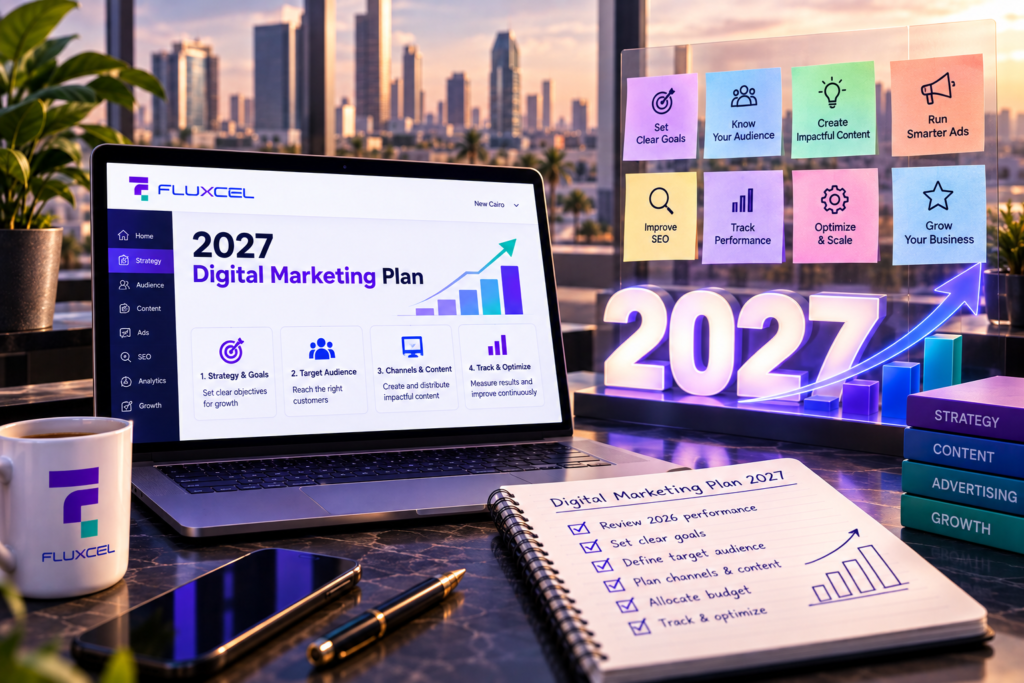
The end of the year is approaching, and for many businesses, that means one thing: it’s time to start thinking about next year’s marketing.
But here’s a question worth asking before setting your 2027 advertising budget: Are you planning for growth, or are you simply repeating what you did last year?
Many businesses enter a new year with ambitious sales targets, bigger advertising budgets, and plans to become more active on social media. Yet their marketing strategies often look almost identical to the previous year’s.
They continue using the same campaigns, targeting similar audiences, and publishing content without evaluating what actually contributed to business growth.
The problem isn’t necessarily a lack of effort. It’s the absence of a structured plan connecting marketing activities with clear business objectives.
For businesses operating in competitive markets like New Cairo, preparing early can make a meaningful difference.
Working with a digital marketing agency New Cairo businesses trust can help turn annual marketing goals into an actionable plan supported by research, realistic budgets, and measurable performance indicators.
Whether you’re managing an established company or preparing to launch a new business, here’s how to create a digital marketing plan that puts you in a stronger position for 2027.
1. Review Your 2026 Marketing Performance First
Before planning new campaigns, take time to understand what happened during the previous year.
It’s tempting to focus immediately on new ideas, platforms, and advertising opportunities.
However, your existing marketing data can reveal valuable lessons about customer behavior and campaign effectiveness.
Identify What Actually Worked
Review your marketing activities across Google Ads, Meta Ads, SEO, email marketing, and other relevant channels.
Look beyond surface-level metrics such as impressions and engagement.
Ask:
Which campaigns generated the most qualified leads?
Which marketing channels contributed to sales?
What was your average customer acquisition cost?
Which products or services generated the strongest demand?
Which campaigns consumed budget without delivering meaningful results?
For example, a company might discover that its Google Search campaigns consistently attracted high-intent inquiries, while social media campaigns contributed more to product discovery.
Both channels may have value, but their roles should influence future investment decisions.
Identify Opportunities for Improvement
Review campaigns that didn’t perform as expected.
Was the audience too broad? Did the advertisement communicate the wrong message? Was the landing page difficult to navigate?
Understanding these problems helps prevent the same mistakes from carrying into 2027.
2. Set Clear and Realistic Business Objectives
A marketing plan becomes difficult to execute when its objectives are vague.
Goals such as “increase awareness” or “get more customers” provide direction, but they don’t explain how success will be measured.
Connect Marketing Goals With Business Results
Start with your company’s commercial priorities.
For example:
Increase qualified inquiries by 25%.
Improve the website conversion rate.
Reduce customer acquisition costs.
Increase repeat purchases.
Expand into a new geographic market.
These are illustrative targets. Your actual goals should reflect historical performance, available resources, and business capacity.
Break Annual Goals Into Quarterly Milestones
Instead of treating 2027 as one long campaign, divide your plan into manageable periods.
For example, a business could focus on website improvements during the first quarter, campaign expansion during the second, customer retention during the third, and seasonal sales opportunities during the fourth.
Quarterly planning makes progress easier to evaluate and allows businesses to adjust their approach when circumstances change.
3. Understand How Your Customers Are Changing
Customer expectations don’t remain the same from one year to another.
People discover brands through different channels, compare products in new ways, and increasingly expect convenient digital experiences.
A marketing strategy based entirely on outdated assumptions may struggle to remain relevant.
Revisit Your Ideal Customer Profile
Review who purchased from your business during 2026.
Look for changes in:
Customer demographics and location.
Purchasing preferences.
Frequently requested products or services.
Common objections before purchasing.
Preferred communication methods.
For example, a business offering commercial office spaces might discover increasing interest in flexible rental arrangements.
That insight could influence its website content, advertising messages, and service presentation.
Listen to Your Sales Team
Customer research doesn’t always require expensive studies.
Your sales and customer service teams regularly hear questions, concerns, and objections from potential buyers.
These conversations can reveal opportunities that marketing dashboards might miss.
Use this feedback to refine your customer profiles and develop more relevant campaigns.
4. Choose Your Digital Marketing Channels Strategically
One of the most common planning mistakes is assuming that a business needs to be active on every available platform.
Being present everywhere can spread resources too thin.
A better approach is to prioritize channels based on customer behavior and business objectives.
Search Engine Optimization
SEO helps businesses become discoverable when potential customers search for relevant products, services, or information.
For companies targeting local audiences, location-specific search visibility can be particularly useful.
For example, someone searching for a digital marketing agency New Cairo may already be comparing providers and evaluating their services.
Relevant service pages, useful content, and local SEO improvements can help businesses connect with those searches.
Paid Advertising
Google Ads and Meta Ads can support customer acquisition, product promotion, and demand generation.
However, each platform should have a defined role within your marketing plan.
Google Search may be useful for capturing existing demand, while social advertising can help introduce products and services to relevant audiences.
Content Marketing
Helpful articles, educational videos, and practical social media content can strengthen your brand’s authority and support customer research.
Focus on subjects that reflect genuine customer questions rather than publishing content simply to maintain activity.
Email and Customer Relationship Marketing
Existing customers can represent valuable growth opportunities.
Relevant email campaigns and customer communication can support retention, repeat purchases, and long-term relationships.
The best channel mix depends on your business, not the popularity of a particular platform.
5. Build a Marketing Budget That Supports Your Priorities
Once you’ve established your goals and selected your channels, it’s time to determine how much you can realistically invest.
A marketing budget should support your objectives without creating unnecessary financial pressure.
Separate Different Marketing Expenses
Consider the full cost of your marketing activities, including:
Advertising media spend.
Creative production.
Website improvements.
SEO and content development.
Marketing software.
Campaign management.
This helps avoid situations where most of the budget is spent on advertising while important supporting activities receive insufficient investment.
Keep Room for Testing
Not every campaign will perform exactly as expected.
Reserve an appropriate portion of your budget for testing new audiences, creative concepts, and marketing opportunities.
Avoid committing your entire annual budget to untested assumptions.
Regular performance reviews can help determine where additional investment makes sense.
6. Prepare Your Website Before Increasing Traffic
Your website will likely play an important role in your 2027 marketing strategy.
Whether visitors arrive through search engines, social media, or paid advertising, their experience can influence whether they contact your business or make a purchase.
Review Your Website’s Performance
Before launching major campaigns, evaluate:
Mobile usability.
Page loading performance.
Navigation and content clarity.
Contact forms and booking processes.
Product or service information.
Conversion tracking.
A website that attracts visitors but makes inquiries difficult can limit the effectiveness of your advertising investment.
Improve Your Most Important Pages
Start with pages directly connected to business outcomes.
These might include service pages, product pages, quotation forms, and checkout pages.
Make sure visitors can quickly understand what you offer and how to take the next step.
Improving these experiences before increasing advertising budgets may help generate more value from future traffic.
7. Create a Content Calendar With a Clear Purpose
Content planning becomes easier when it supports defined business objectives.
Instead of deciding what to publish at the last minute, develop a calendar that reflects customer needs, seasonal opportunities, and upcoming business activities.
Organize Content Around Key Themes
A useful content calendar can include:
Educational content answering customer questions.
Product or service explanations.
Customer stories and testimonials.
Industry insights.
Seasonal campaigns and promotions.
Each theme should support a particular stage of the customer journey.
Plan Without Becoming Too Rigid
A content calendar provides structure, but it shouldn’t prevent your business from responding to relevant developments.
Leave room for timely announcements, customer feedback, and new opportunities.
Consistency matters, but relevance matters more than publishing simply because a date appears on the calendar.
8. Prepare for Changes in Search and AI-Driven Discovery
Search behavior continues to evolve as people use traditional search engines, AI-assisted search experiences, and other digital platforms to find information.
Businesses preparing for 2027 should consider how customers discover and evaluate information across these environments.
Focus on Useful, Reliable Content
Rather than chasing every new SEO trend, prioritize fundamentals that remain valuable.
Create content that demonstrates real expertise, answers specific questions, and provides accurate information.
Keep service pages updated and ensure important information is easy to find.
Clear website structure and appropriate technical SEO practices can also support discoverability.
Avoid Depending on One Traffic Source
Search platforms and advertising systems can change.
A business relying entirely on one channel may be more exposed to fluctuations in visibility or advertising costs.
Developing a balanced digital presence can help reduce that dependency.
This doesn’t mean investing equally in every channel. It means building a strategy that doesn’t rely on a single source of customer acquisition.
9. Connect Marketing Activities With Sales Performance
One of the most important improvements businesses can make in 2027 is strengthening the connection between marketing and sales.
A campaign generating hundreds of inquiries might appear successful.
But if very few inquiries become paying customers, the business needs to understand why.
Track the Complete Customer Journey
Where possible, connect marketing data with sales information.
Monitor how inquiries move through the sales process and identify which sources generate valuable customers.
Important measurements may include:
Qualified lead volume.
Lead-to-customer conversion rate.
Customer acquisition cost.
Revenue associated with marketing campaigns.
Customer retention and repeat purchase rates.
Improve Communication Between Teams
Marketing teams should receive regular feedback about lead quality.
Sales teams should understand the campaigns and offers generating inquiries.
This coordination helps identify problems earlier and supports better decisions about targeting, messaging, and budgets.
10. Create a Quarterly Marketing Roadmap for 2027
A successful annual plan needs a practical execution schedule.
Without clear responsibilities and review dates, even a well-researched strategy can become difficult to manage.
Here’s an example of how a business could organize its marketing priorities throughout 2027.
Quarter | Primary focus | Key activities |
|---|---|---|
Q1 | Build foundations | Website improvements, tracking, SEO audits, campaign planning |
Q2 | Expand acquisition | Test new audiences, optimize paid campaigns, develop content |
Q3 | Improve efficiency | Conversion optimization, retention campaigns, budget reviews |
Q4 | Maximize opportunities | Seasonal campaigns, customer reactivation, annual performance review |
This is a sample roadmap rather than a universal schedule.
A business with strong seasonal demand may need to shift its priorities significantly.
Review Performance Every Month
Don’t wait until the end of the year to determine whether your strategy is working.
Monthly reviews should identify what happened, what influenced performance, and what needs to change.
Quarterly reviews can focus on larger decisions such as channel allocation, growth priorities, and budget adjustments.
A digital marketing agency New Cairo businesses partner with can help coordinate these activities and maintain a clear connection between planning and execution.
Make 2027 a Year of Smarter Digital Growth
A new year creates opportunities to improve how your business approaches digital marketing.
But meaningful growth rarely comes from increasing advertising budgets or publishing more content without a clear direction.
It comes from understanding your customers, learning from previous performance, setting realistic objectives, and consistently improving your marketing activities.
Businesses that prepare early can enter 2027 with clearer priorities and a stronger foundation for decision-making.
At Fluxcel, we help companies build performance-focused digital marketing strategies that connect business goals with practical execution.
From SEO and paid advertising to content marketing, campaign analysis, and conversion optimization, our approach focuses on making marketing more strategic and measurable.
As a digital marketing agency New Cairo businesses can partner with, we work to help brands improve their digital presence, reach relevant audiences, and identify opportunities for sustainable growth.