
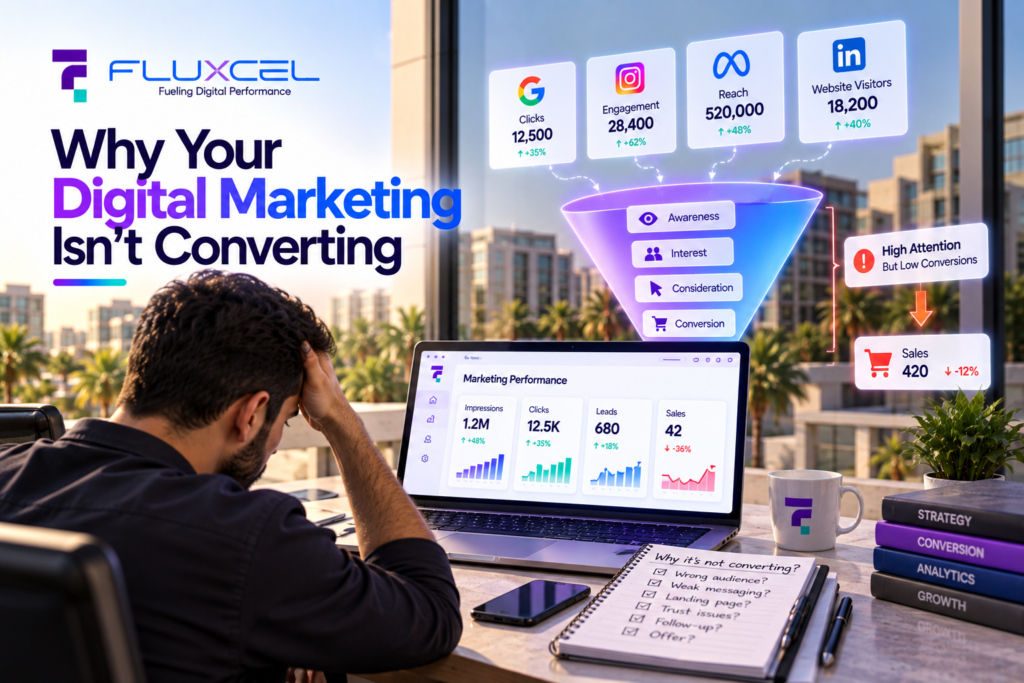
Your ads are getting clicks.
People are visiting your website.
Your social media content is receiving engagement.
Maybe your follower count is growing too.
But the sales aren’t following.
This is one of the most frustrating situations for a business investing in digital marketing. On the surface, the numbers may look positive, yet the activity isn’t translating into enough inquiries, bookings, purchases, or revenue.
The problem isn’t necessarily that digital marketing doesn’t work.
Often, something is breaking between attention and conversion.
For businesses competing in New Cairo, identifying that gap can be more valuable than simply increasing advertising budgets. A Digital marketing agency New Cairo businesses work with should understand the entire customer journey—not just how to generate impressions and clicks.
Here are some of the most common reasons digital marketing attracts attention without generating enough business.
You’re Attracting Attention From the Wrong People
More traffic isn’t always better traffic.
A campaign can reach hundreds of thousands of people and generate impressive engagement while attracting very few potential customers.
This happens when marketing is optimized for attention rather than relevance.
Imagine a premium service creating entertaining content that goes viral across Egypt.
The campaign might generate huge reach, but if most viewers aren’t potential customers, that visibility may have limited commercial impact.
Focus on Audience Quality
Ask:
- Are we reaching people who genuinely need our service?
- Are they located in areas we serve?
- Does our pricing match their purchasing ability?
- Are we targeting decision-makers?
- Are they likely to need the product now or later?
- What customer problem brought them to us?
Your ideal audience doesn’t need to be the largest audience.
It needs to be the audience most likely to create business value.
Your Message Is Too Generic
Visit several company websites and you’ll see similar phrases:
“Premium quality.”
“Best service.”
“Innovative solutions.”
“Your trusted partner.”
There’s nothing necessarily wrong with these statements, but they don’t give customers a strong reason to choose one company over another.
If your competitors are making similar claims, your marketing starts blending together.
Communicate Something Meaningful
Your messaging should explain:
What do you actually help customers achieve?
What problem do you solve?
Who is your service designed for?
Why is your approach different?
What evidence supports your claims?
Specific messages are usually more persuasive than broad promises.
Instead of trying to sound impressive, focus on being clear and relevant.
You’re Asking for the Sale Too Quickly
Not every customer who discovers your business today is ready to buy today.
Some people are still researching.
Others are comparing providers.
Some don’t completely understand their problem yet.
If every marketing message immediately says “Buy Now” or “Contact Us,” you may be ignoring customers who need more information before they’re comfortable taking action.
Create Content for Different Stages
Think about your audience in stages.
Early stage: “I think I have a problem.”
Create educational content.
Middle stage: “I’m researching possible solutions.”
Explain your approach, benefits, and services.
Decision stage: “I’m comparing businesses.”
Use reviews, case studies, offers, demonstrations, and strong CTAs.
Marketing becomes more effective when it helps customers move forward rather than expecting everyone to convert immediately.
Your Offer Isn’t Strong Enough
Sometimes customers understand your service perfectly.
They simply don’t see enough reason to act.
This doesn’t always mean you need a discount.
An offer is the complete value exchange you’re presenting to the customer.
That might include:
- A consultation
- Free delivery
- A personalized assessment
- A demonstration
- A bundle
- Flexible payment options
- A trial
- A quotation
- An introductory service
The right offer reduces hesitation and gives interested customers a clear next step.
Your Advertisement and Landing Page Don’t Match
Imagine seeing an advertisement for a specific service.
You click it.
Instead of reaching information about that service, you’re sent to a generic homepage.
Now you have to search for it yourself.
Some customers will continue.
Others will leave.
This is one of the easiest ways to waste advertising traffic.
Maintain Message Consistency
Your landing page should feel like a natural continuation of your advertisement.
If your ad promises something specific, the landing page should immediately reinforce it.
Keep the:
- Headline consistent
- Offer clear
- Visual direction familiar
- Benefits relevant
- CTA obvious
The customer should instantly know they’re in the right place.
Your Website Creates Too Much Friction
A potential customer has clicked your advertisement.
They’re interested.
Then they encounter:
A slow-loading website.
A confusing menu.
A long form.
Tiny mobile text.
No obvious WhatsApp button.
An unclear service description.
You can lose a conversion in seconds.
A Digital marketing agency New Cairo businesses partner with shouldn’t evaluate campaign performance without also considering what happens after someone clicks.
Simplify the Experience
Review the conversion journey on your phone.
Can you easily find the information you need?
Can you contact the company without searching?
Does the form actually work?
Are buttons easy to tap?
Is the website fast?
Small usability improvements can make existing marketing traffic significantly more valuable.
Customers Don’t Trust You Yet
People don’t convert based only on interest.
They also need confidence.
If your website and social media tell customers that your business is excellent but provide little evidence, potential customers may hesitate.
This is particularly important for high-value products and services where purchasing decisions involve more risk.
Build Trust With Evidence
Use:
- Real customer reviews
- Testimonials
- Case studies
- Previous projects
- Before-and-after examples where appropriate
- Team expertise
- Certifications
- Client logos
- Product demonstrations
- Clear contact information
Show people what makes your business credible.
Don’t expect them to simply take your word for it.
Your CTA Is Unclear
A customer reaches the end of your page and thinks:
“Okay… what now?”
That’s a conversion problem.
Every important piece of marketing should have an intentional next step.
It could be:
Request a Quote
Book Your Consultation
Shop Now
Talk to Our Team
Schedule an Appointment
Send Us a Message
The CTA should match the customer’s stage in the journey.
Asking someone to purchase immediately may be appropriate for a low-cost e-commerce product but unrealistic for a complex B2B service.
You’re Measuring the Wrong Success Metrics
A campaign receives 2 million impressions.
Great.
But how many customers did it create?
A Reel gets 100,000 views.
Excellent visibility.
But did viewers take another meaningful action?
Surface-level metrics can make campaigns look successful even when business outcomes are weak.
Connect Marketing Metrics to Revenue
Depending on your business, track:
- Qualified leads
- Cost per qualified lead
- Conversion rate
- Purchases
- Customer acquisition cost
- Lead-to-sale rate
- Revenue
- Return on ad spend
- Customer lifetime value
You don’t need to ignore engagement metrics.
You simply need to understand where they fit in the bigger picture.
Your Sales Follow-Up Is Too Slow
Sometimes the marketing isn’t the problem at all.
The campaign generates a qualified lead.
The customer submits their details.
Then nothing happens for hours—or days.
Meanwhile, they contact another business.
Digital marketing and sales cannot operate completely separately.
Create a Clear Lead Process
Your process might look like:
- Lead submits an inquiry
- Confirmation is sent immediately
- Sales team receives the lead
- Customer is contacted quickly
- Lead is qualified
- Proposal or next step is provided
- Follow-up continues when appropriate
CRM systems and automation can help make this process more consistent.
The goal is simple: don’t waste the opportunities your marketing worked to generate.
You’re Not Retargeting Interested Customers
Most people won’t convert during their first interaction.
That’s normal.
Someone might visit your website today and purchase three weeks later.
If you disappear completely after their first visit, a competitor may become more memorable.
Retargeting can help continue the conversation.
But don’t simply repeat the same advertisement.
Use the next interaction to introduce something new.
Show a testimonial.
Answer a common question.
Present a case study.
Explain a benefit.
Address an objection.
Each interaction should help move the customer closer to a decision.
You’re Changing Strategies Too Quickly
Businesses sometimes launch a campaign, wait a few days, don’t see immediate sales, and change everything.
Then they repeat the process.
Constant changes can make it difficult to understand what’s actually working.
Digital marketing requires testing, but testing needs structure.
Create Clear Experiments
Instead of changing five variables simultaneously, test one important factor.
For example:
Test A: Two different advertising hooks.
Test B: Two landing page headlines.
Test C: Two offers.
Test D: Short versus longer lead forms.
Measure the results and use what you learn in future campaigns.
Marketing improves when each campaign teaches you something.
Look at the Entire Conversion Funnel
When conversions are low, businesses often blame the advertising platform.
“Meta isn’t working.”
“Google Ads are too expensive.”
“Instagram doesn’t generate customers anymore.”
Sometimes the platform genuinely isn’t the right fit.
But before reaching that conclusion, examine the full funnel:
Audience → Creative → Click → Landing Page → Trust → CTA → Lead → Follow-Up → Sale
A problem at any stage can reduce overall performance.
If your creative is strong but your website is weak, conversions suffer.
If your website converts well but targeting is poor, lead quality suffers.
If marketing generates strong leads but sales follow-up is slow, revenue suffers.
Digital marketing works best when the entire system works together.
Turn Attention Into Action
The goal of marketing isn’t simply to make people notice your business.
It’s to create a path from discovery to action.
That requires the right audience, a clear message, strong creative, a convincing offer, an effective website, enough trust, simple conversion steps, and consistent follow-up.
If you’re getting traffic and engagement without enough customers, don’t immediately assume you need more advertising.
Find where the journey is breaking first.
Working with a Digital marketing agency New Cairo businesses can rely on should help connect advertising, content, websites, analytics, and conversion strategy around measurable business outcomes.
At Fluxcel, we focus on more than visibility. We look at how every part of your digital presence contributes to leads, customers, and sustainable growth.