
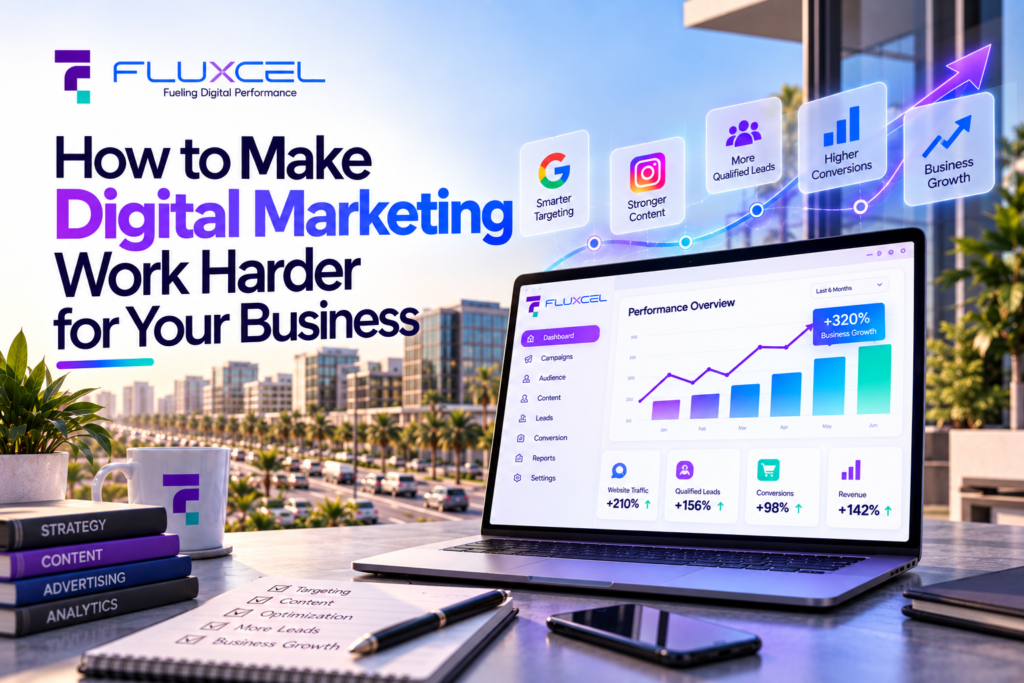
Many businesses are already investing in digital marketing.
They run social media accounts, boost posts, launch Meta and Google campaigns, publish content, improve their websites, and track monthly reports.
Yet one question keeps coming up:
Are we actually getting enough from what we’re spending?
Doing more marketing doesn’t always create more growth. Sometimes the biggest opportunity comes from making your existing marketing work harder.
That means improving how your channels connect, understanding which activities influence customers, eliminating wasted budget, and continuously optimizing the journey from first impression to final conversion.
For businesses operating in a competitive area like New Cairo, working with a Digital marketing agency New Cairo businesses can rely on should be about more than keeping accounts active. Every marketing activity should contribute to a clear business objective.
Start by Understanding What Is Already Working
Before launching another campaign or increasing your budget, look at what you already have.
Which channels generate your best customers?
Which campaigns produce qualified leads?
Which content attracts meaningful engagement?
Which landing pages convert?
Where are you spending money without seeing enough return?
Businesses sometimes move too quickly from one tactic to another without properly analyzing previous results.
Your existing data may already contain clues about where your next growth opportunity exists.
Look Beyond Surface-Level Metrics
Reach, impressions, followers, and engagement are useful indicators, but they don’t tell the whole story.
Depending on your objectives, look deeper at metrics such as:
- Cost per qualified lead
- Conversion rate
- Customer acquisition cost
- Revenue by marketing channel
- Return on ad spend
- Lead-to-customer conversion rate
- Average order value
- Repeat purchase rate
- Customer lifetime value
The objective isn’t to collect more numbers.
It’s to identify which numbers actually help you make better business decisions.
Give Every Marketing Channel a Job
One reason digital marketing becomes inefficient is that businesses expect every channel to accomplish the same thing.
Instagram may be excellent for discovery and brand building.
Google Search can capture people actively looking for a solution.
SEO can generate visibility around relevant customer searches.
Email marketing can reconnect with previous customers.
Retargeting can bring back people who visited your website without converting.
These channels can become significantly more effective when they support one another.
Think in Terms of a Connected Journey
Imagine a customer discovers your company through Instagram.
They watch several videos but don’t contact you.
A few days later, they search for the service on Google and find your website.
They read a case study.
Then they see a retargeting advertisement featuring a customer testimonial.
Finally, they request a quotation.
Which channel generated the customer?
The answer isn’t always just one.
The journey worked because several marketing touchpoints contributed to the final decision.
Improve Targeting Before Increasing Your Budget
If a campaign isn’t generating the right customers, spending more money on it may simply scale the problem.
Before increasing the budget, examine who you’re reaching.
Are these people genuinely relevant?
Do they have the problem your business solves?
Are they located in the right areas?
Does their purchasing ability match your offer?
Are they decision-makers?
For some businesses, narrowing the audience can actually improve performance.
Use Existing Customers to Learn
Your current customer base is one of your most valuable marketing resources.
Analyze your strongest customers.
Look for patterns in:
- Location
- Age groups
- Products or services purchased
- Acquisition channels
- Customer value
- Common problems
- Purchasing behavior
These insights can help refine targeting and messaging for future campaigns.
A Digital marketing agency New Cairo businesses partner with should use real performance data rather than relying entirely on broad assumptions about the target audience.
Strengthen Your Creative Before Blaming the Platform
Sometimes targeting isn’t the problem.
Your advertisement simply isn’t giving people a strong enough reason to stop scrolling.
Customers see huge amounts of content every day. Your creative needs to earn attention quickly.
That doesn’t necessarily mean making everything louder or more dramatic.
It means becoming more relevant.
Build Creative Around Customer Problems
Instead of starting with:
“What should our next design look like?”
Start with:
“What does our customer care about?”
Strong creative can focus on:
- A common customer problem
- A specific benefit
- A surprising insight
- A customer question
- A transformation
- A demonstration
- A real result
- A misconception
- A useful tip
The design, video, or format should support the message rather than become the message itself.
Make Your Content Support the Sales Process
Businesses sometimes treat content and sales as completely separate activities.
They shouldn’t be.
Your sales team probably answers the same customer questions repeatedly.
Those questions are excellent content opportunities.
If prospects regularly ask how your service works, create content explaining it.
If they’re concerned about quality, demonstrate your process.
If they’re comparing several solutions, explain what they should consider before choosing.
If customers don’t understand the value behind your price, create content that communicates that value.
Create Content for Different Stages
Not everyone seeing your content is ready to buy.
Your content strategy should account for different levels of awareness.
Discovery content attracts attention.
Educational content helps customers understand the problem.
Trust content provides evidence and credibility.
Conversion content encourages customers to take action.
A healthy content strategy uses all four.
Improve Your Landing Pages
Advertising performance doesn’t end when someone clicks.
That click is only the beginning.
If the landing page doesn’t continue the message that attracted the visitor, you’re losing potential conversions.
Suppose your advertisement promotes one specific service.
The visitor clicks and lands on a homepage containing ten unrelated services.
You’ve added unnecessary friction.
A focused landing page should continue the same conversation.
Keep the Page Focused
A strong landing page should clearly explain:
- What you’re offering
- Who it’s for
- The problem it solves
- The main benefits
- Why customers should trust you
- What they should do next
Avoid unnecessary distractions.
The easier the journey is to understand, the easier it becomes for interested visitors to take action.
Turn One Strong Idea Into Multiple Assets
Making digital marketing work harder also means getting more value from the content you already create.
One strong idea doesn’t need to become only one post.
For example, a detailed blog can become:
- Several social media posts
- A short Reel
- An email
- A carousel
- A LinkedIn post
- A remarketing creative
- A sales resource
This doesn’t mean copying the same content everywhere.
It means adapting one valuable idea for different platforms and stages of the customer journey.
Content becomes more efficient without becoming repetitive.
Use Retargeting More Intelligently
Most website visitors won’t convert during their first session.
Most people who watch your videos won’t immediately contact you either.
That doesn’t make those interactions worthless.
They’ve already shown some level of interest.
Retargeting gives you another opportunity to continue the conversation.
But avoid simply showing the exact same advertisement repeatedly.
Move the Message Forward
If the first advertisement introduced your service, the next one might show a case study.
Then you could highlight a testimonial.
Later, you might answer a common objection or introduce an offer.
Each touchpoint gives the potential customer another reason to trust your business.
Automate Repetitive Parts of the Customer Journey
Automation can help businesses respond faster and maintain communication without requiring someone to manually manage every interaction.
Depending on your business, automation might include:
- Lead confirmation emails
- CRM lead assignments
- Abandoned cart emails
- Appointment reminders
- Follow-up sequences
- Customer segmentation
- Repeat purchase campaigns
The important thing is to use automation where it improves efficiency without making communication feel impersonal.
Technology should support the customer experience, not replace it.
Connect Marketing Data With Sales Results
Marketing reports often stop too early.
They show how many leads a campaign generated and how much each lead cost.
But what happened next?
Suppose Campaign A generates 80 leads and Campaign B generates only 40.
Campaign A appears stronger.
But if Campaign B produces more paying customers and more revenue, the conclusion changes completely.
This is why businesses should connect advertising and analytics data with actual sales outcomes whenever possible.
A Digital marketing agency New Cairo companies work with should be asking:
Which campaigns create customers—not just leads?
That’s the information that allows smarter budget decisions.
Test One Variable at a Time
Optimization doesn’t mean changing everything whenever results decline.
If you change the audience, creative, offer, landing page, and campaign structure simultaneously, you may never know what actually improved performance.
Instead, test strategically.
You could test:
- One headline against another
- Video versus static creative
- Two different offers
- Short versus longer lead forms
- Different landing page headlines
- Different CTAs
Give tests enough data before drawing conclusions.
Digital marketing improves through learning, not constant random changes.
Find the Leaks Before Adding More Traffic
Imagine your marketing funnel as a pipe.
If the pipe has several leaks, increasing the amount of water entering it doesn’t solve the problem.
The same applies to digital marketing.
Before spending more to generate traffic, check whether you’re losing customers because of:
- Weak messaging
- Poor mobile experience
- Slow websites
- Complicated forms
- Lack of trust
- Slow sales follow-up
- Unclear offers
- Poor retargeting
Fixing these problems can sometimes improve performance without increasing media spend.
Focus Your Budget Where It Creates Value
Marketing budgets shouldn’t remain fixed simply because “that’s how we’ve always divided them.”
If one channel consistently generates high-value customers, there may be an opportunity to scale it.
If another consumes a significant budget without contributing enough to business outcomes, investigate whether it should be improved, repositioned, or reduced.
Budget allocation should respond to performance.
The objective isn’t to spend less at all costs.
It’s to make every pound work harder.
Build a Marketing System That Gets Smarter Over Time
Effective digital marketing isn’t about constantly adding more platforms, more campaigns, and more content.
It’s about improving the system.
Understand your customers.
Connect your channels.
Create stronger messages.
Optimize landing pages.
Follow up with leads.
Track sales outcomes.
Learn from the data.
Then use those insights to make the next campaign better than the last.
Working with a Digital marketing agency New Cairo businesses trust should help create that cycle of continuous improvement.
At Fluxcel, we approach digital marketing as a connected growth system. From paid advertising and social media to SEO, websites, content, analytics, and conversion optimization, each channel should support a measurable business objective.