
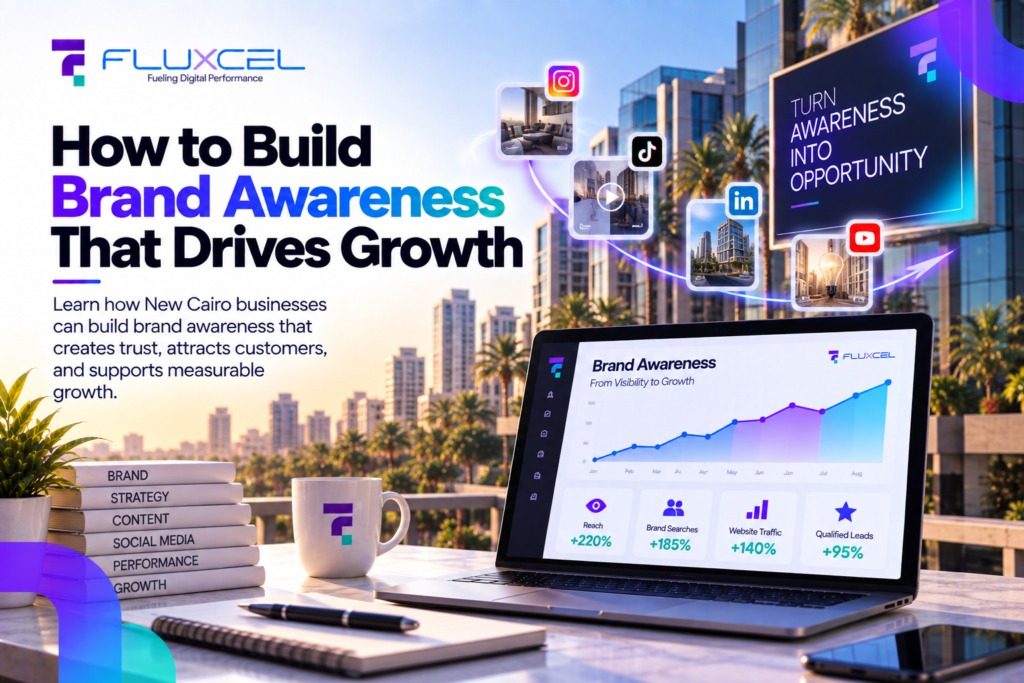
Brand awareness is often treated as the part of marketing that’s difficult to measure.
Businesses run social media campaigns, publish videos, sponsor content, and generate millions of impressions. The numbers look impressive, but eventually someone asks the important question:
Is all this awareness actually helping the business grow?
It can—but only when awareness is built strategically.
Being seen isn’t enough. Customers need to recognize your brand, understand what it represents, remember it when they have a need, and trust it enough to consider buying from you.
For a Digital marketing agency New Cairo businesses work with, brand awareness shouldn’t exist separately from performance marketing. The strongest strategies connect visibility with customer consideration, leads, sales, and long-term growth.
Brand Awareness Is More Than Reach
Reach tells you how many people potentially saw your content.
Awareness goes deeper.
Imagine seeing an advertisement today and forgetting the company name five minutes later.
Technically, the brand reached you.
But did it build meaningful awareness?
Probably not.
Strong brand awareness means customers begin connecting your company with a particular product, service, experience, or idea.
When the relevant need appears, your brand is more likely to come to mind.
That makes memorability just as important as visibility.
Start With Clear Brand Positioning
Before trying to make more people aware of your business, decide exactly what you want them to remember.
If your positioning isn’t clear internally, your audience is unlikely to understand it either.
Ask:
- Who do we serve?
- What problem do we solve?
- What makes our approach different?
- What should customers associate with our name?
- Why should someone choose us instead of an alternative?
The answers should influence your website, advertising, content, social media, and sales communication.
Avoid Trying to Mean Everything to Everyone
Brands often weaken their message by trying to communicate too many things simultaneously.
Premium.
Affordable.
Fast.
Personal.
Innovative.
Traditional.
For everyone.
When everything becomes a priority, nothing stands out.
Strong positioning creates a clearer place for your business in the customer’s mind.
Build a Consistent Visual Identity
Customers often recognize a brand visually before reading its name.
Color, typography, imagery, graphic elements, photography, and layout all contribute to recognition.
Consistency matters because repeated visual signals help people become familiar with your company.
That doesn’t mean every post should look identical.
It means your content should feel like it comes from the same brand.
Your:
- Website
- Advertisements
- Email marketing
- Presentations
- Videos
should share enough visual DNA to feel connected.
A Digital marketing agency New Cairo strategy should protect this consistency even when content is being adapted for different platforms.
Give People Something Worth Remembering
Posting frequently doesn’t guarantee awareness.
Customers remember ideas, stories, useful information, emotions, and distinctive creative much more easily than repetitive promotional messages.
Think about what your brand can consistently contribute.
Maybe you simplify complicated topics.
Maybe your content has a recognizable visual style.
Perhaps you share valuable industry insights.
Or your product solves a problem in a noticeably different way.
The objective is to create a reason for people to remember the brand beyond simply seeing its logo.
Create Content for Recognition, Not Just Engagement
Social media engagement can help distribute content, but engagement shouldn’t become the only objective.
A post can receive thousands of likes without building meaningful brand recognition.
Your content should reinforce something about the company.
Use Repeatable Content Themes
Develop several themes closely connected to your brand.
For example:
Educational content
Teach customers something useful within your area of expertise.
Problem-focused content
Discuss challenges your audience regularly experiences.
Brand stories
Show your values, approach, people, or process.
Customer stories
Demonstrate how real customers experience the brand.
Product or service content
Show what you offer in practical situations.
Repeated themes make your brand easier to understand over time.
Combine Organic Content With Paid Reach
Organic social media is valuable, but relying entirely on organic distribution can limit how many relevant people see your content.
Paid media can help expand that reach strategically.
Instead of simply boosting random posts, identify the creative that best communicates your brand.
Then use advertising to introduce it to audiences that matter.
This might include people based on:
- Location
- Interests
- Customer characteristics
- Previous website activity
- Existing customer data
- Engagement behavior
The objective isn’t to reach everyone in Cairo.
It’s to repeatedly reach the people who could realistically become customers.
Frequency Matters—but So Does Creative Variety
Customers often need several interactions before remembering a brand.
Seeing your company once may not be enough.
But showing someone the exact same advertisement 20 times can create the opposite effect.
The solution is consistent exposure with creative variety.
You might communicate the same positioning through:
- Short videos
- Carousels
- Customer stories
- Educational posts
- Static advertisements
- Case studies
- Reels
The central brand message stays consistent while the execution changes.
That helps maintain recognition without making your marketing feel repetitive.
Use Search to Capture the Awareness You’ve Created
Something interesting happens when brand awareness starts working.
People search for you.
Someone might see your Instagram Reel today and Google your company name next week.
Another person may hear about you from a friend and search for your services later.
This means your search presence needs to support your awareness campaigns.
Make sure customers can easily find:
- Your website
- Google Business Profile
- Relevant service pages
- Social profiles
- Contact information
- Reviews
Brand awareness creates interest. Search often captures that interest when customers decide to investigate further.
Build Trust Across Every Touchpoint
Recognition without trust has limited value.
Customers may know your name and still choose a competitor.
Trust is built through what they discover after becoming aware of you.
Your digital presence should support the promises made in your marketing.
That includes:
- Professional website experience
- Clear information
- Real customer reviews
- Consistent branding
- Useful content
- Responsive communication
- Transparent offers
- Strong customer experience
Every interaction either strengthens or weakens the impression your advertising created.
Connect Awareness Campaigns to Retargeting
People who interact with awareness campaigns don’t need to disappear once the campaign ends.
Some have already demonstrated interest.
Retargeting can help move them further through the customer journey.
For example, someone who watched most of a brand video might later see:
- A service explanation
- A customer testimonial
- A case study
- A product demonstration
- A conversion-focused offer
The first campaign introduces the brand.
The next gives people another reason to consider it.
This creates a bridge between awareness and performance marketing.
Measure More Than Impressions
Awareness is harder to measure than direct sales, but that doesn’t mean businesses should ignore measurement.
Look at several indicators together.
These may include:
- Reach
- Frequency
- Video completion rates
- Social engagement
- Direct website traffic
- Branded search traffic
- Returning website visitors
- Profile visits
- Website engagement
- Retargeting audience growth
- Leads influenced by multiple touchpoints
No single metric tells the complete story.
The goal is to understand whether increased visibility is creating stronger customer interest over time.
Don’t Expect Awareness to Behave Like Search Advertising
One common mistake is evaluating every campaign using exactly the same criteria.
A Google Search campaign may reach someone who is already looking for a solution.
An awareness video might reach that person weeks before they recognize they need the service.
Their roles are different.
This doesn’t mean awareness campaigns should escape accountability.
It means they should be evaluated according to the part of the customer journey they’re designed to influence.
The important question is whether awareness supports the wider customer acquisition strategy.
Turn Familiarity Into Customer Preference
Strong brands benefit from familiarity.
When customers repeatedly see a company delivering consistent messages and useful experiences, that familiarity can reduce uncertainty.
Then, when they’re ready to make a decision, the brand doesn’t feel completely new.
This is where awareness starts supporting performance.
Your paid ads may convert better because customers recognize you.
Your sales team may speak with leads who already understand the company.
Your branded search volume may increase.
Existing customers may become more likely to recommend you.
Brand and performance marketing begin reinforcing each other.
Build Awareness With a Business Purpose
Brand awareness shouldn’t be about becoming famous.
For most businesses, the objective is much more practical.
Become recognizable to the right people.
Give them a clear understanding of what you offer.
Build enough familiarity and trust that your company enters their consideration when a relevant need appears.
Then create an easy path from consideration to action.
For businesses searching for a Digital marketing agency New Cairo, awareness and performance shouldn’t be two disconnected strategies. Content, paid advertising, SEO, website experience, retargeting, and conversion campaigns should work together to move customers from discovering the brand to choosing it.
At Fluxcel, we build digital strategies that connect visibility with measurable growth—helping businesses become more recognizable while creating clear paths from attention to customer acquisition.