
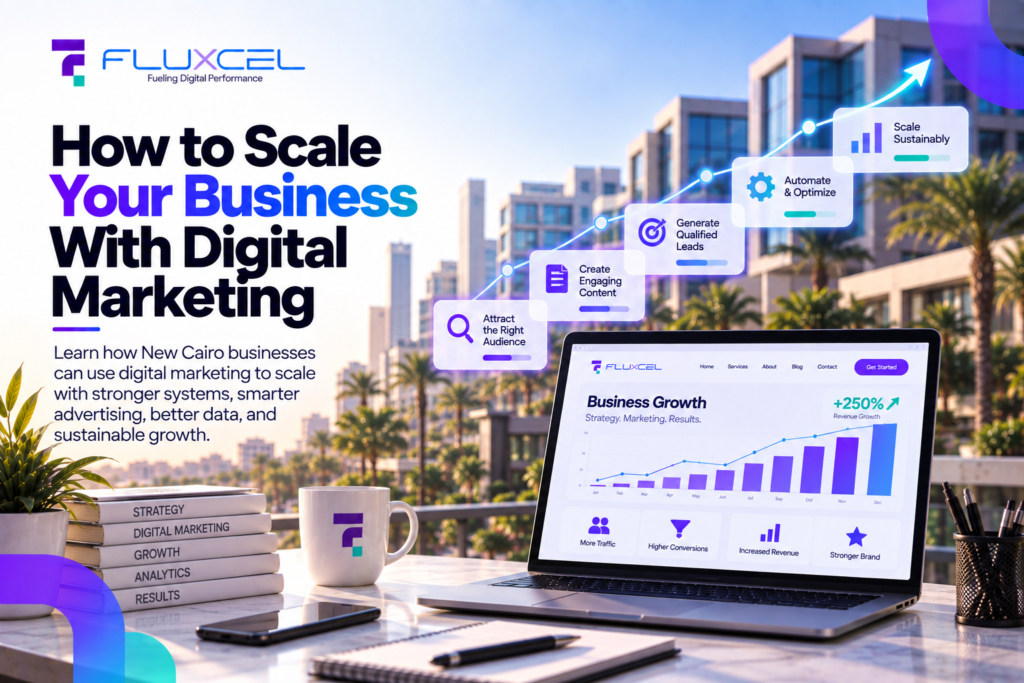
Growth and scaling are not exactly the same thing.
A business can grow by spending more money, hiring more people, generating more leads, and increasing its workload. But if every additional sale requires the same increase in time, resources, and cost, growth can eventually become difficult to maintain.
Scaling is about building systems that allow the business to handle more customers and more revenue efficiently.
Digital marketing can play a major role in that process.
The right strategy can create repeatable ways to attract customers, identify the strongest acquisition channels, automate parts of the customer journey, and use data to decide where additional investment makes sense.
For businesses working with a Digital marketing agency New Cairo, the goal shouldn’t simply be launching bigger campaigns. It should be building a marketing engine that can support the next stage of the business.
Make Sure Your Marketing Is Ready to Scale
Increasing your advertising budget doesn’t automatically create proportional growth.
If a campaign is already inefficient, giving it more money may simply create a larger inefficient campaign.
Before scaling, businesses need to understand what is already working.
Ask:
- Which channels generate the best customers?
- Which campaigns produce qualified leads?
- Which products or services have the strongest demand?
- What is the customer acquisition cost?
- How well does the website convert?
- How many leads become customers?
- Can the sales team handle more inquiries?
You need a reliable foundation before adding more volume.
Find Your Most Valuable Acquisition Channels
Not every digital channel deserves the same investment.
One business might generate its strongest customers through Google Search.
Another may perform better through Meta Ads.
A B2B company might see stronger opportunities from LinkedIn, SEO, email, or outbound campaigns.
An e-commerce business could depend heavily on paid social, Google Shopping, organic search, and email retention.
The goal is to understand the role each channel plays.
Don’t Scale Based on Traffic Alone
A channel generating 20,000 monthly visitors isn’t automatically more valuable than one generating 3,000.
The smaller channel might generate more purchases or higher-quality leads.
Compare channels using metrics connected to business performance, such as:
- Conversion rate
- Qualified leads
- Cost per acquisition
- Revenue
- Return on ad spend
- Average order value
- Customer lifetime value
Once you know where your strongest customers come from, you can make more informed decisions about where to invest.
Build a Repeatable Lead Generation System
Scaling becomes difficult when leads arrive unpredictably.
One month is excellent.
The next is quiet.
Then a successful post suddenly creates a spike in inquiries.
Businesses need a more repeatable process.
That can involve several connected channels rather than depending on one campaign.
For example:
SEO can build long-term organic demand.
Google Ads can capture people actively searching.
Social media can strengthen awareness and familiarity.
Paid social can introduce the brand to new audiences.
Retargeting can reconnect with interested prospects.
Email marketing can nurture existing leads and customers.
A Digital marketing agency New Cairo businesses partner with should help these channels support each other instead of treating them as completely separate activities.
Scale What Has Already Been Proven
One of the biggest mistakes businesses make is trying to scale too early.
A new campaign performs well for a few days, so the budget is immediately multiplied.
But short-term performance doesn’t always continue at a larger scale.
Before increasing investment significantly, identify whether the campaign has demonstrated consistent results.
Look at:
- Lead quality
- Conversion rate
- Cost per acquisition
- Sales results
- Audience size
- Creative performance
- Landing page performance
Once you have enough evidence that the system works, scaling becomes a more calculated decision.
Don’t Depend on One Winning Advertisement
A successful ad can produce excellent results, but creative performance rarely lasts forever.
Audiences see the same advertisement repeatedly.
Attention declines.
Competitors introduce new campaigns.
Customer behavior changes.
A scalable strategy needs a process for continuously producing and testing new creative.
Build a Creative Testing System
Test different:
- Hooks
- Visual styles
- Videos
- Headlines
- Offers
- Customer problems
- Benefits
- Calls-to-action
The goal isn’t to replace every advertisement constantly.
It’s to develop enough creative options that the business isn’t dependent on one asset.
When a strong concept is identified, variations can be developed around it.
Improve Conversion Rates Before Buying More Traffic
Imagine your website receives 10,000 visitors and generates 200 leads.
That’s a 2% conversion rate.
If you want 400 leads, one option is to double traffic.
But another option is to improve the conversion experience.
If the same 10,000 visitors convert at 4%, you’ve doubled lead volume without doubling traffic.
Of course, real performance is rarely that simple, but the principle matters.
Before spending aggressively to attract more visitors, optimize:
- Landing pages
- Website speed
- Mobile experience
- Forms
- Calls-to-action
- Offers
- Product pages
- Checkout experience
- Trust signals
Conversion improvements can make every traffic source more valuable.
Use Automation to Support Higher Volume
Processes that work manually with 20 leads per month may become difficult with 500.
This is where automation can support scaling.
Businesses can automate parts of the customer journey such as:
- Lead confirmations
- CRM data entry
- Email sequences
- Appointment reminders
- Customer segmentation
- Abandoned cart emails
- Lead assignment
- Performance reporting
Automation shouldn’t replace meaningful human interaction where it’s needed.
Instead, it should remove repetitive tasks and reduce the chance of opportunities being forgotten.
That allows teams to focus on areas where human judgment and communication create more value.
Connect Marketing With Your CRM and Sales Team
Scaling marketing without scaling lead management can create an expensive problem.
You generate more leads, but the sales team can’t respond quickly enough.
Potential customers wait.
Follow-ups are missed.
Lead quality becomes difficult to evaluate.
Eventually, marketing performance appears weaker even though the problem happens after the lead is generated.
A connected process should track the journey from:
Marketing source → Lead → Qualified opportunity → Customer → Revenue
This helps the business understand which campaigns actually produce valuable customers.
It also gives marketing teams better feedback.
Instead of optimizing only for form submissions, they can learn which campaigns produce leads that sales teams actually close.
Use Customer Data to Find New Growth Opportunities
As your business grows, your existing customer data becomes increasingly valuable.
Look for patterns.
Which customers buy most frequently?
Which services produce the strongest margins?
Which products are commonly purchased together?
Which customers return?
Which campaigns originally acquired your highest-value customers?
This information can influence future marketing.
For example, you may discover that one audience costs slightly more to acquire but generates significantly higher customer value.
That could justify increasing investment in that segment.
Data helps scaling become less dependent on assumptions.
Increase Customer Value, Not Just Customer Volume
Scaling doesn’t always require finding more new customers.
Sometimes the strongest growth opportunity exists within the customers you already have.
Depending on the business, you may be able to increase value through:
- Repeat purchases
- Cross-selling
- Upselling
- Service upgrades
- Loyalty programs
- Email marketing
- Customer reactivation campaigns
- Complementary products or services
Acquiring a new customer usually requires significant marketing effort.
Building stronger relationships with existing customers can help make growth more efficient.
Protect Your Brand While Scaling
When businesses grow quickly, marketing can become inconsistent.
Different campaigns use different messages.
New team members create content without clear guidelines.
Offers become overly promotional.
Brand identity starts changing from one platform to another.
This can weaken the trust that helped the business grow in the first place.
Create clear guidelines for:
- Brand voice
- Visual identity
- Core messaging
- Customer experience
- Offers
- Content quality
Scaling should increase your visibility without making the brand feel less recognizable.
Build Reporting Around Decisions
Reports shouldn’t simply describe what happened.
They should help determine what happens next.
Instead of only reporting that website traffic increased by 30%, ask:
Did the additional traffic convert?
Instead of celebrating lower cost per lead, ask:
Did those leads become customers?
Instead of focusing only on higher sales, ask:
Did customer acquisition remain profitable?
Useful reporting should help answer:
- What should we scale?
- What should we improve?
- What should we test?
- What should we stop?
- Where are we losing potential customers?
This creates a cycle of continuous improvement.
Sustainable Scaling Requires More Than Bigger Budgets
Digital marketing can help a business grow quickly, but sustainable scaling comes from building a stronger system behind that growth.
You need reliable acquisition channels, strong creative, optimized landing pages, effective lead management, automation, customer retention, and accurate performance data.
When these elements work together, increasing marketing investment becomes a strategic decision rather than a gamble.
For companies searching for a Digital marketing agency New Cairo, the right focus is not simply generating more traffic, followers, or leads. It’s creating a digital infrastructure that can continue performing as the business becomes larger.
At Fluxcel, we help businesses connect strategy, advertising, SEO, content, websites, automation, and analytics into digital systems designed to support sustainable growth.