
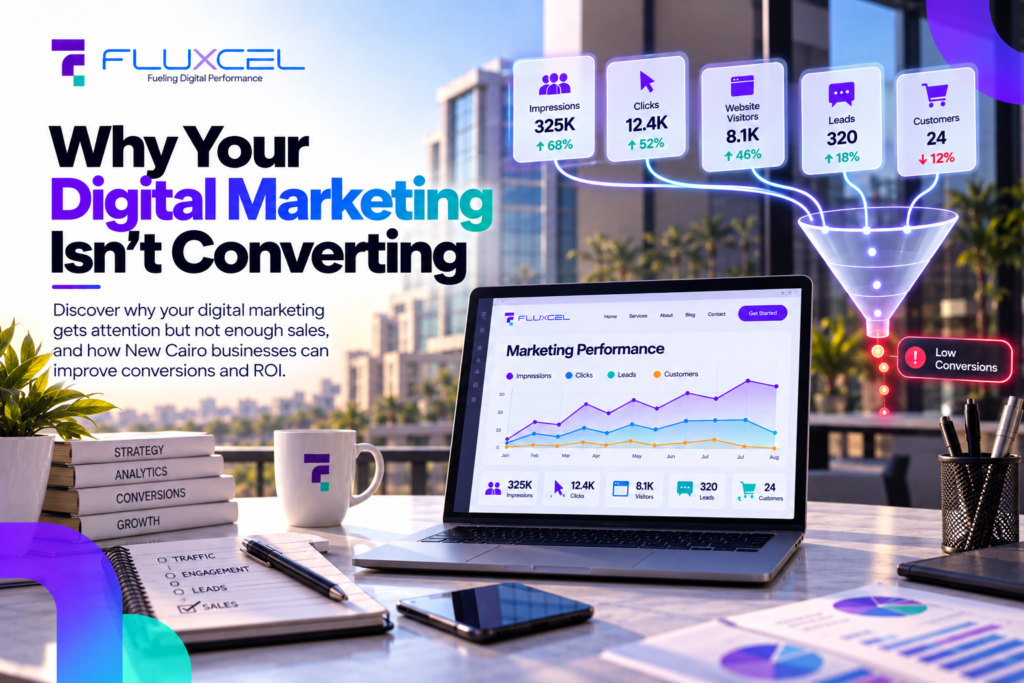
Your ads are running. People are visiting your website. Social media engagement looks healthy. Your brand is getting noticed.
But the sales aren’t following.
It’s one of the most frustrating situations for a business investing in digital marketing. On paper, the numbers can look positive: impressions are increasing, traffic is growing, and people are clicking.
Yet inquiries remain low, qualified leads are inconsistent, or customers simply aren’t buying.
The problem isn’t always a lack of marketing activity. Often, there is a conversion gap somewhere between getting someone’s attention and getting them to take action.
A Digital marketing agency New Cairo businesses work with should identify that gap before recommending more traffic, more content, or a larger advertising budget.
You’re Attracting Attention From the Wrong People
High reach doesn’t necessarily mean you’re reaching potential customers.
A campaign can generate thousands of clicks from people who have little intention of buying.
The same applies to organic traffic.
Ranking for a broad keyword might increase website visits, but if those visitors aren’t looking for the products or services you provide, traffic growth won’t necessarily produce revenue.
Look Beyond Audience Size
Ask:
- Who is clicking your ads?
- What are they searching for?
- Where are they located?
- What problem are they trying to solve?
- Are they potential customers?
- Which audiences actually convert?
The goal isn’t to reach the largest possible audience.
It’s to reach enough of the right audience.
Your Message Is Too Generic
Many businesses communicate in language that could belong to almost any competitor.
“High-quality solutions.”
“Professional service.”
“Your trusted partner.”
“Committed to excellence.”
These phrases sound positive, but they don’t give customers much reason to choose one company over another.
Strong marketing should answer a simple question:
Why should this customer care?
Your message needs to connect what you offer with something the customer actually wants.
That could be:
- Saving time
- Solving a specific problem
- Improving performance
- Making a process easier
- Getting better support
- Achieving a particular result
Specific messaging makes it easier for potential customers to understand why your offer is relevant.
Your Ads and Landing Pages Don’t Match
Imagine clicking an advertisement about one specific service and arriving on a general homepage containing ten different services.
Now you have to search for the information you expected to find.
Many visitors simply won’t bother.
This is known as a mismatch between ad intent and landing page experience.
If your advertisement makes a specific promise, the page should continue that conversation.
Keep the Journey Consistent
Your:
Ad → Landing page → Offer → Call-to-action
should feel like one connected experience.
The same headline, service, benefit, or offer that attracted the click should be immediately recognizable after the visitor lands.
Consistency reduces confusion and keeps customers moving forward.
You’re Asking for Action Before Building Trust
Customers don’t experience your business from your perspective.
You already know your team, products, expertise, and track record.
A new visitor doesn’t.
They may have discovered your company five minutes ago.
Before giving you their money or personal information, they may want reassurance.
Your website and content can provide that through:
- Customer reviews
- Testimonials
- Case studies
- Previous projects
- Certifications
- Detailed service information
- Clear contact details
- Genuine company information
- Frequently asked questions
Trust becomes even more important when customers are making expensive, long-term, or high-consideration decisions.
A strong Digital marketing agency New Cairo strategy should therefore treat trust-building as part of conversion optimization.
Your Website Creates Too Much Friction
Every unnecessary step between interest and action creates another opportunity for a potential customer to leave.
Imagine someone is ready to request a quotation.
They click the button.
The form asks for 12 fields.
Then they need to create an account.
Then they have to verify their email.
What started as genuine buying intent can quickly disappear.
Make Conversion Feel Easy
Review your website from a customer’s perspective.
Can someone quickly:
- Understand your offer?
- Find the right service?
- Contact your company?
- Complete a form?
- Call from mobile?
- Send a WhatsApp message?
- Purchase a product?
- Book an appointment?
Remove unnecessary steps wherever possible.
Convenience can have a significant impact on conversion rates.
Your Call-to-Action Is Too Weak
Sometimes customers don’t convert because they aren’t sure what they’re supposed to do.
A website might contain several pages of information without providing a clear next step.
Your call-to-action should guide visitors.
Depending on the business, that could be:
Request a Quote
Book Your Appointment
Schedule a Consultation
Shop Now
Talk to Our Team
Get Started
Calls-to-action should also appear naturally throughout longer pages rather than being hidden only at the bottom.
The objective isn’t to pressure visitors. It’s to make the next step obvious when they’re ready.
Your Offer Isn’t Strong Enough
Good targeting and attractive creative can’t compensate indefinitely for an offer that customers don’t find compelling.
If people consistently show interest but don’t convert, look at the offer itself.
Ask:
- Is the value clear?
- Does the offer solve an important problem?
- Is pricing aligned with expectations?
- Is the difference from competitors obvious?
- Are customers given enough information?
- Is there a strong reason to act?
Sometimes marketing isn’t the problem.
Marketing may simply be exposing an issue with the offer.
Understanding this distinction can prevent businesses from repeatedly changing campaigns when the underlying proposition needs attention.
Your Mobile Experience Is Losing Customers
Potential customers don’t always experience your carefully designed desktop website.
Many arrive from their phones.
Buttons may become difficult to tap.
Text may become too small.
Forms might break.
Large images may load slowly.
Pop-ups can cover the entire screen.
These seemingly small problems can significantly affect conversions.
Test your important pages on real mobile devices and complete the same journey you expect customers to complete.
Don’t stop at checking whether the page technically loads.
Ask whether the experience is genuinely convenient.
Your Website Is Too Slow
Customers expect websites to respond quickly.
A slow page creates friction before someone even sees your offer.
Heavy images, unnecessary scripts, poorly optimized plugins, or technical problems can all affect performance.
Speed is particularly important for visitors arriving from advertising.
You’re paying for that click.
If the customer leaves before the page becomes usable, part of that advertising budget has effectively been wasted.
Improving website performance can therefore support both user experience and marketing efficiency.
You’re Measuring the Wrong Success Metrics
Digital platforms make it easy to focus on numbers that look impressive.
Reach.
Impressions.
Followers.
Clicks.
Engagement.
These metrics have value, but they don’t automatically indicate commercial performance.
A campaign with fewer clicks could generate more qualified customers.
A social post with modest engagement could generate several serious inquiries.
A keyword with lower traffic could have significantly stronger purchase intent.
Connect Marketing Metrics to Business Outcomes
Where possible, track:
- Qualified leads
- Conversion rate
- Cost per qualified lead
- Customer acquisition cost
- Sales
- Revenue
- Return on ad spend
- Lead-to-customer conversion rate
This gives you a clearer understanding of which activities actually contribute to growth.
You’re Not Following Up Effectively
Marketing doesn’t stop when someone becomes a lead.
A customer may submit an inquiry and then wait hours—or days—for someone to respond.
During that time, they may contact competitors.
Businesses need a clear lead management process.
That includes:
- Capturing inquiries correctly.
- Responding quickly.
- Assigning leads to the right person.
- Recording follow-up attempts.
- Tracking lead status.
- Understanding why leads don’t convert.
Improving follow-up can sometimes increase sales without changing the advertising campaign at all.
You’re Treating Every Visitor the Same
A first-time visitor and someone who has viewed your service pages five times don’t have the same relationship with your brand.
Your marketing shouldn’t always treat them identically.
Retargeting allows you to communicate differently with people based on previous interactions.
Someone who read an educational article may need more information.
Someone who viewed pricing may need reassurance.
Someone who abandoned a cart may simply need a reminder.
Matching messages to customer behavior can create a more relevant experience.
You’re Changing Campaigns Too Quickly
Digital marketing needs optimization, but constant changes can make performance difficult to understand.
Businesses sometimes launch a campaign, wait a few days, decide it isn’t working, and completely change the creative, audience, budget, and offer.
Now there is very little useful information about what actually caused the result.
Create structured tests instead.
Change one major variable where possible, collect enough meaningful data, and compare results.
Marketing improves through learning, not constant guessing.
Fix the Conversion Gap Before Buying More Traffic
When marketing isn’t generating enough business, increasing traffic isn’t automatically the answer.
First understand what is happening between the click and the customer.
Is the wrong audience arriving?
Is the message unclear?
Does the website build enough trust?
Is the offer competitive?
Is the conversion process too complicated?
Are leads being followed up properly?
Answering these questions can reveal opportunities that additional advertising spend would never solve.
For businesses searching for a Digital marketing agency New Cairo, the focus should extend beyond generating reach and traffic. Strong digital marketing connects targeting, creative, content, website experience, conversion optimization, sales follow-up, and measurement into one customer journey.
At Fluxcel, we look at the complete digital journey to identify where attention is being lost and where performance can be improved.