
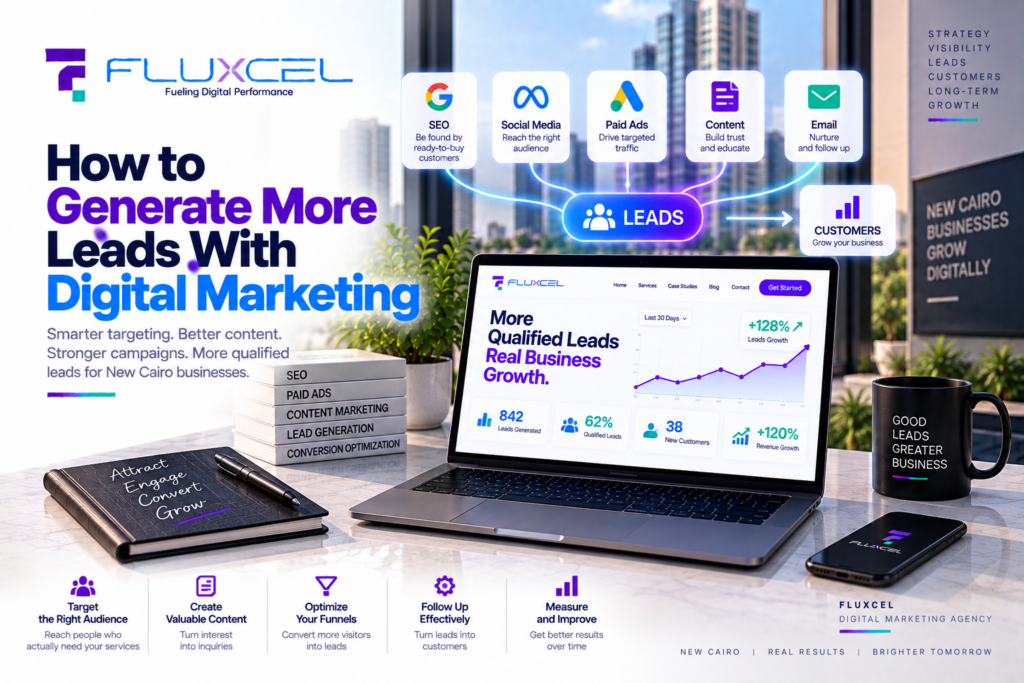
Generating leads is easy to talk about.
Generating the right leads is much harder.
A campaign can produce hundreds of form submissions and still fail to generate meaningful business. Some leads may not have the budget. Others may be looking for a completely different service. Some may submit their details and never respond again.
This is why successful lead generation should not be measured only by volume.
The real objective is to attract people who have a genuine need, fit your target customer profile, and have a realistic possibility of becoming customers.
For businesses in New Cairo, digital marketing provides several ways to reach these audiences—from Google Search and SEO to Meta Ads, content marketing, landing pages, and remarketing.
But these channels perform best when they work together.
A Digital marketing agency New Cairo businesses work with should build a complete lead-generation system rather than simply launch advertisements and count form submissions.
Start by Defining What a Qualified Lead Means
Before trying to generate more leads, decide what a good lead actually looks like.
Marketing and sales teams often have different definitions.
Marketing might celebrate 200 leads.
Sales might say only 20 were relevant.
Without an agreed definition, campaign performance becomes difficult to evaluate.
Build Your Ideal Lead Profile
Depending on your business, qualification factors might include:
- Location
- Budget
- Company size
- Industry
- Service required
- Purchase timeframe
- Decision-making authority
- Specific customer need
You don’t necessarily need to ask prospects all of these questions in a form.
But understanding them internally helps you target and evaluate campaigns more effectively.
Understand Where Lead Intent Comes From
Not every digital channel generates the same type of lead.
Someone searching Google for a specific service may already know what they need.
Someone who discovers your business through an Instagram Reel may still be learning about the problem.
Both can eventually become customers, but they are at different stages.
High-Intent Leads
These people are actively searching for a solution.
They may use searches such as:
“Digital marketing agency New Cairo”
“Dentist near me”
“Office space in New Cairo”
Search campaigns and SEO can be particularly effective for capturing this demand.
Lower-Intent Leads
These customers may not be actively searching yet.
Social media, video, display advertising, and educational content can introduce the problem and create interest.
Your messaging should reflect the difference.
Create Offers That Give People a Reason to Act
Sometimes targeting isn’t the problem.
The offer is.
An advertisement can reach exactly the right customer but still generate weak results if there is no compelling reason to take the next step.
Your offer should answer:
“Why should I contact this company now?”
Depending on the business, an offer might include:
- Free consultation
- Free assessment
- Product demonstration
- Personalized quotation
- Trial
- Downloadable guide
- Limited-time promotion
- Appointment
The offer needs to match both the service and the customer’s level of intent.
Use Google Ads to Capture Active Demand
Google Search can be particularly effective for lead generation because it reaches people while they are actively searching.
But not every keyword has equal value.
A broad informational keyword might generate traffic without generating customers.
A more specific commercial keyword may receive fewer searches but produce stronger leads.
Focus on Search Intent
Consider the difference between:
“What is digital marketing?”
and:
“Digital marketing company in New Cairo.”
The second search demonstrates much stronger commercial intent.
Your keyword strategy should prioritize searches that align with your business goals.
A Digital marketing agency New Cairo companies partner with should evaluate keywords based on lead quality and customer acquisition—not traffic alone.
Build SEO for Long-Term Lead Generation
Paid search can generate immediate visibility, but SEO can build an additional source of leads over time.
A strong SEO strategy helps your business appear when customers search for relevant information and services.
This can include:
- Service pages
- Local landing pages
- Blog content
- FAQs
- Case studies
- Comparison pages
- Industry guides
Different pages can target different stages of the buying journey.
Educational content attracts customers early.
Service pages capture stronger commercial intent.
Together, they create a broader organic lead-generation system.
Use Social Media to Create Demand
Not every customer wakes up and searches for your product.
Sometimes customers need to discover a problem, opportunity, product, or brand first.
That’s where social media can play an important role.
Meta, Instagram, LinkedIn, TikTok, and other platforms can help businesses reach relevant audiences before they begin actively searching.
Don’t Start With the Sales Pitch
For colder audiences, start with something meaningful.
A problem.
A question.
A surprising insight.
A customer frustration.
For example:
“Getting leads but struggling to turn them into customers?”
Once you capture attention, introduce the solution.
This approach can feel more relevant than immediately asking someone to “Book Now.”
Build Landing Pages for Lead Generation
Sending paid traffic to a general homepage can create unnecessary friction.
The visitor clicked because of one specific message.
Continue that message on the landing page.
A strong lead-generation page should clearly explain:
- The problem
- The solution
- Key benefits
- Why the customer should trust you
- The offer
- The next step
Avoid unnecessary navigation and distractions when the page has one clear conversion objective.
Make Your Forms Easy to Complete
Long forms can discourage potential customers.
But extremely short forms may generate too many low-quality inquiries.
The right balance depends on your business.
For a straightforward consumer service, name and phone number might be enough.
For a high-value B2B service, asking about company size, budget, or requirements could help qualification.
Ask Only What You Need
Every field should have a purpose.
If your sales team doesn’t use a piece of information, consider removing that field.
A simpler form often creates a smoother experience.
Use Content to Pre-Qualify Leads
Content can do more than attract visitors.
It can help customers decide whether your business is right for them before contacting you.
Detailed service pages, FAQs, case studies, pricing information, and educational content can answer common questions.
This can improve lead quality.
For example, clearly explaining who a service is designed for may discourage unsuitable inquiries while increasing confidence among ideal customers.
That saves time for both the customer and your sales team.
Build Trust Before Asking for Contact Details
Customers are often cautious about submitting their information to unfamiliar businesses.
Give them reasons to trust you.
Use:
- Testimonials
- Customer reviews
- Case studies
- Certifications
- Previous projects
- Client logos
- Clear contact information
- Real company information
Trust is particularly important when the service is expensive, complicated, or requires a long-term commitment.
Use Remarketing to Recover Interested Visitors
Most website visitors won’t become leads immediately.
They may be interested but not ready.
Remarketing allows your business to reconnect with these visitors later.
Instead of showing the same advertisement repeatedly, use different messages.
Someone who visited a service page might see a case study.
Someone who read a blog might receive a more detailed guide.
Someone who visited a contact page could see a stronger consultation CTA.
This helps move customers gradually toward action.
Respond to Leads Quickly
Generating a lead is not the finish line.
It is the beginning of the sales process.
If someone submits an inquiry and waits too long for a response, their interest can decline.
They may also contact several competitors during that time.
Create a clear process for handling leads.
Determine:
- Who receives the lead
- Who is responsible for responding
- How quickly they should respond
- Which channel they should use
- What happens if the customer doesn’t answer
- How follow-ups are recorded
Speed and consistency can significantly influence lead conversion.
Connect Marketing With Your CRM
As lead volume grows, managing inquiries through spreadsheets, WhatsApp chats, and individual inboxes becomes difficult.
A CRM can help organize the process.
Depending on the system, businesses can track:
New Lead → Contacted → Qualified → Meeting → Proposal → Won/Lost
This gives both marketing and sales teams greater visibility.
Marketing can see which campaigns generate real opportunities.
Sales can see where each lead came from.
This feedback improves future campaigns.
Automate Without Losing the Human Experience
Automation can improve lead management.
You might automate:
- Confirmation emails
- Lead notifications
- Appointment reminders
- Follow-up sequences
- CRM updates
But avoid turning every interaction into an automated message.
Customers often expect personal communication when making important decisions.
Use automation to improve speed and organization while keeping meaningful conversations human.
Track Lead Quality by Campaign
Cost per lead is useful, but it should never be the only lead-generation metric.
Consider tracking:
Campaign → Leads → Qualified Leads → Customers → Revenue
This changes how you evaluate performance.
Campaign A might generate leads at 100 EGP.
Campaign B might generate them at 180 EGP.
If Campaign B generates significantly more customers, its higher CPL may be completely justified.
The cheapest lead is not always the most valuable lead.
Improve Lead Generation With Continuous Testing
Lead generation is rarely perfect from the first campaign.
Test different elements systematically.
These might include:
- Audience targeting
- Keywords
- Advertising creative
- Hooks
- Offers
- Landing-page headlines
- Form length
- CTAs
Every test should answer a specific question.
Over time, these learnings can help reduce wasted budget and improve lead quality.
Measure What Happens After the Lead
One of the biggest improvements a business can make is connecting marketing data with sales results.
Don’t stop reporting at:
“We generated 300 leads.”
Ask:
How many were qualified?
How many booked meetings?
How many received proposals?
How many became customers?
How much revenue did they generate?
A Digital marketing agency New Cairo businesses trust should use this information to optimize campaigns around real business outcomes rather than form submissions alone.
Build a Lead-Generation System, Not Just a Campaign
Generating more leads does not require being everywhere online.
It requires creating a connected process.
Define your ideal lead. Understand customer intent. Create a relevant offer. Capture demand through search. Build long-term visibility with SEO. Create demand through social media. Use focused landing pages. Strengthen trust. Retarget interested visitors. Respond quickly. Track leads through your CRM. And measure which campaigns actually create customers.
When these elements work together, lead generation becomes more than a monthly advertising activity.
It becomes a repeatable growth system.
At Fluxcel Digital Marketing Agency, we help businesses connect SEO, paid advertising, social media, content, landing pages, remarketing, tracking, and conversion strategy to generate leads with genuine business potential.