
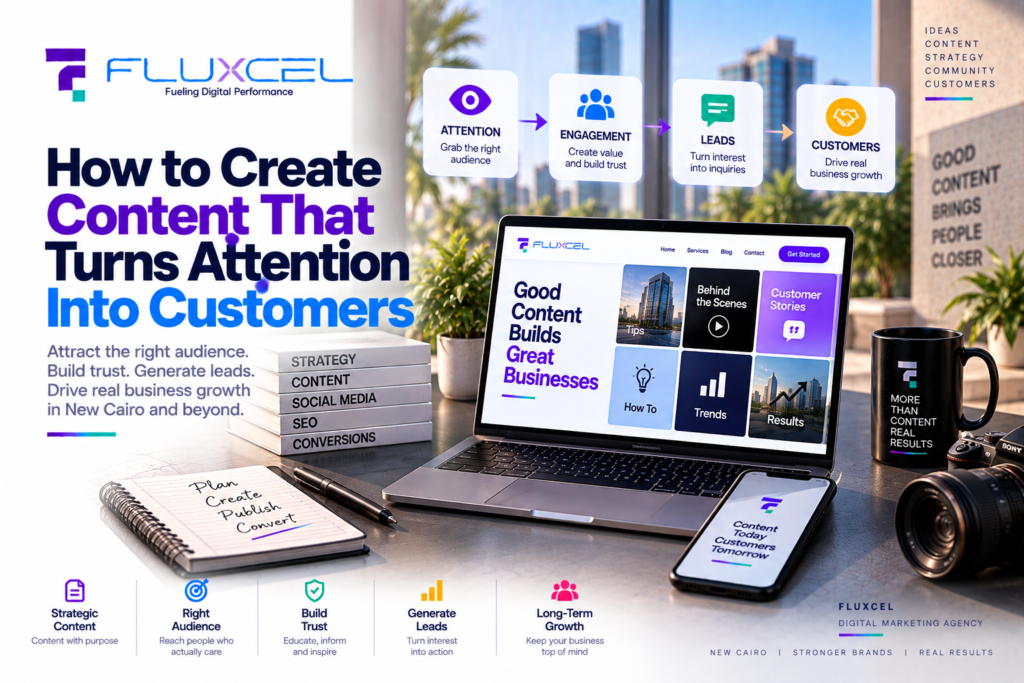
Getting attention online has never been easier.
Businesses can publish Reels, create TikTok videos, write blogs, post carousels, send emails, and launch paid campaigns within hours.
But attention alone does not guarantee business growth.
A video can receive thousands of views without generating a single inquiry. A social media post can get hundreds of likes while contributing almost nothing to sales. A blog can attract website traffic without moving visitors any closer to becoming customers.
The challenge is not simply creating more content.
It is creating content that has a clear role in the customer journey.
For businesses in New Cairo, where customers are constantly exposed to competing brands and marketing messages, content needs to do more than fill a monthly calendar.
A Digital marketing agency New Cairo businesses work with should connect content strategy with audience needs, brand positioning, search visibility, lead generation, and sales.
Start With the Customer, Not the Content Format
One of the most common content planning mistakes is starting with the format.
“We need three Reels.”
“We need another carousel.”
“We should publish four blogs.”
The format matters, but it should come later.
Start by asking:
What does our customer need to know?
A potential customer may have questions about pricing, quality, features, results, processes, alternatives, or whether your solution is right for them.
These questions should influence your content strategy.
Find the Questions Customers Already Ask
Speak with your sales and customer service teams.
Look at:
- Sales conversations
- Social media comments
- Direct messages
- Search queries
- Website searches
- Customer reviews
- Frequently asked questions
These sources can reveal exactly what customers want to understand.
Instead of guessing what content might perform, start with real customer interests and concerns.
Give Every Piece of Content a Purpose
Not every piece of content needs to generate an immediate sale.
But every piece should have a reason to exist.
Content can help you:
- Increase awareness
- Educate customers
- Build credibility
- Answer objections
- Demonstrate expertise
- Generate website traffic
- Capture leads
- Support sales
- Retain existing customers
The objective determines how the content should be structured.
An awareness Reel and a conversion-focused landing page shouldn’t communicate in exactly the same way.
Create Content for Different Stages of the Journey
Customers don’t all arrive with the same level of knowledge or intent.
Someone discovering your brand today may need very different information from someone who has already visited your website three times.
A useful structure is:
Awareness → Consideration → Conversion → Retention
Awareness Content
At this stage, your goal is to earn attention from relevant people.
Content might include:
- Educational tips
- Short videos
- Industry insights
- Problem-focused posts
- Search-optimized blogs
Focus on topics customers already care about rather than immediately pushing your service.
Consideration Content
Now customers understand the problem and are evaluating possible solutions.
Useful content can include:
- Case studies
- Comparisons
- FAQs
- Testimonials
- Service explanations
- Product demonstrations
This is where you begin answering:
“Why should I consider this company?”
Conversion Content
When customers are ready to act, make the decision easier.
Use:
- Clear offers
- Service pages
- Product pages
- Landing pages
- Customer results
- Strong CTAs
Remove distractions and clearly communicate what happens next.
Retention Content
Content shouldn’t disappear once someone becomes a customer.
Continue providing value through:
- Product tips
- Guides
- Updates
- Relevant offers
- Customer education
Retention content can encourage repeat business and strengthen customer relationships.
Write Stronger Hooks
Before content can educate or persuade, it needs attention.
This is particularly important on social media, where people can scroll past your content within seconds.
Avoid wasting the opening on unnecessary introductions.
Get directly to something relevant.
For example:
“Getting website traffic but no sales?”
“Before increasing your ad budget, check this.”
“Your social media isn’t supposed to generate likes only.”
“Why are your leads not becoming customers?”
Each hook introduces a recognizable problem.
The rest of the content should then deliver on the promise.
Focus on Customer Problems, Not Just Your Services
Businesses naturally want to talk about themselves.
Their experience.
Their services.
Their products.
Their technology.
But customers are usually more interested in their own problems.
Instead of starting with:
“We provide SEO services.”
You could begin with:
“Your customers are searching for your service. Can they find you?”
The service hasn’t changed.
The perspective has.
Customer-focused communication makes it easier for people to understand why your offer matters.
A Digital marketing agency New Cairo brands partner with should translate services into outcomes customers actually care about.
Build Trust Through Educational Content
Customers are more likely to consider businesses they believe understand their needs.
Educational content is one way to demonstrate that expertise.
If you consistently answer useful questions and explain complicated topics clearly, customers can begin viewing your business as a reliable source of information.
This is particularly important for professional services, healthcare, B2B, real estate, technology, and other industries where decisions require research.
Don’t Hide All Your Knowledge
Some businesses worry that providing too much useful information means customers won’t need them.
Usually, the opposite happens.
Good educational content demonstrates expertise.
It shows potential customers that you understand the subject deeply enough to explain it clearly.
Use Social Proof as Content
One of the strongest forms of content may already exist inside your business.
Your customers.
Reviews, testimonials, case studies, results, and customer stories provide evidence that your marketing claims are real.
Instead of saying:
“We generate great results.”
Show a genuine example of what happened.
Turn Results Into Stories
A case study doesn’t need to be a long corporate document.
A simple structure can work:
Challenge → Strategy → Execution → Result
This format can become a blog, carousel, Reel, LinkedIn post, email, or sales presentation.
One strong customer story can support multiple marketing channels.
Create Searchable Content
Social media content can disappear from feeds quickly.
Search-focused content can continue attracting visitors much longer.
SEO blogs, guides, FAQs, and optimized service pages help your business appear when customers actively search for information.
Target Questions With Real Intent
Don’t choose blog topics only because they sound interesting.
Research what customers are actually searching for.
Create content around:
- Customer questions
- Problems
- Comparisons
- Services
- Locations
- Purchasing decisions
For example, a person searching for a Digital marketing agency New Cairo is likely much closer to choosing a provider than someone searching for a general definition of marketing.
Both types of content can be useful, but they serve different stages.
Repurpose Strong Ideas
Creating quality content takes time.
Don’t let a strong idea disappear after one post.
Suppose you publish a detailed blog about improving conversion rates.
That blog could become:
- A LinkedIn post
- An Instagram carousel
- Three short Reels
- An email
- Several Stories
- An advertising concept
- An FAQ section
The message remains consistent while the format changes.
This allows businesses to produce more content without constantly starting from zero.
Build Recognizable Content
Content should also strengthen brand recognition.
Use consistent visual and verbal elements.
These might include:
- Brand colors
- Typography
- Photography style
- Graphic elements
- Tone of voice
- Recurring content formats
The goal is not to make every post identical.
It’s to make the brand recognizable.
Someone scrolling quickly should gradually learn to identify your content before seeing the account name.
Connect Content With SEO
Content and SEO should support each other.
A strong blog strategy can attract people searching for information related to your products and services.
But keyword placement alone is not enough.
Search engines ultimately need content that genuinely addresses the user’s query.
Create useful, structured pages that answer questions clearly.
Use relevant headings, internal links, descriptive titles, and natural keyword placement.
Avoid repeating the same phrase unnaturally just to increase keyword density.
Connect Content With Paid Advertising
Organic content can also provide valuable insights for advertising.
If one topic consistently generates strong engagement, saves, comments, or website visits, it may contain an angle worth testing in paid campaigns.
Similarly, paid advertising data can reveal which messages attract customers.
Use these insights across both sides.
Turn Successful Messages Into Campaigns
A strong organic post could inspire:
- A lead-generation ad
- A video campaign
- A landing page
- A remarketing creative
- A new content series
Content performance should inform future creative decisions.
Give Customers a Clear Next Step
Content can successfully earn attention and still fail to create results if customers don’t know what to do next.
The CTA should match the content.
An educational blog might invite readers to explore a related service.
A case study might encourage them to request a consultation.
A product demonstration could lead directly to the product page.
A social post might encourage users to send a message.
Avoid forcing the same CTA everywhere.
Match the next step to the customer’s readiness.
Measure Content Beyond Likes
Engagement is useful, but content performance should be evaluated according to its purpose.
Depending on the objective, track:
- Reach
- Watch time
- Saves
- Shares
- Website visits
- Search traffic
- Leads
- Conversion rate
- Purchases
- Assisted conversions
A post with 100 likes and ten qualified leads could be more valuable than a viral post with 10,000 likes and no meaningful customer action.
Context matters.
Learn From What Performs
Content strategy should evolve.
Review your strongest and weakest content regularly.
Ask:
Which topics generate the most interest?
Which hooks keep people watching?
What content drives website traffic?
Which posts generate inquiries?
Which blogs attract organic search traffic?
What questions keep appearing in comments?
These patterns help you create future content based on evidence rather than assumptions.
Quality Matters More Than Constant Publishing
Businesses sometimes believe they need to post every day to remain relevant.
Frequency matters, but publishing weak content more often rarely solves the problem.
Three useful, well-planned posts can sometimes create more value than seven rushed ones.
Focus on consistency without sacrificing quality.
A strong content system should be sustainable for your team and useful to your audience.
Turn Content Into a Business Asset
Great content does more than keep social media active.
It helps customers discover your business, understand their problems, learn about your solutions, trust your expertise, compare their options, and eventually take action.
Start with customer needs. Create content for different stages of the journey. Use stronger hooks. Educate rather than constantly sell. Build social proof. Optimize for search. Repurpose strong ideas. Connect organic and paid media. And measure performance against real business objectives.
At Fluxcel Digital Marketing Agency, we help businesses connect content strategy, SEO, social media, paid advertising, creative, and conversion optimization to turn content into measurable growth.