
Generating leads sounds simple.
Run an ad, send people to a landing page, collect their contact details, and pass them to the sales team.
But businesses quickly discover that more leads do not always mean more customers.
A campaign might generate 200 inquiries at an attractive cost, yet only a small percentage may actually be interested, ready to buy, or suitable for the business. Meanwhile, another campaign could generate 50 leads at a higher cost but produce significantly more sales.
That difference comes down to lead quality.
For businesses competing in New Cairo, the goal should not simply be to fill a spreadsheet with names and phone numbers. Digital marketing should attract people who have a genuine need, fit the target customer profile, and have a reasonable chance of becoming customers.
A Digital marketing agency New Cairo businesses work with should therefore look beyond cost per lead and focus on what happens after each lead enters the sales process.
What Makes a Lead Qualified?
A qualified lead is someone who is not only interested in your business but is also reasonably aligned with what you offer.
The exact definition depends on the company.
For a real estate business, qualification could depend on budget, preferred location, property type, and purchase timeline.
For a dental clinic, it might depend on the treatment the patient needs and whether they are ready to book a consultation.
For a B2B company, qualification could include company size, industry, requirements, and decision-making authority.
Before launching campaigns, marketing and sales teams should agree on what a good lead actually looks like.
Look Beyond Contact Information
A name and phone number tell you very little.
Consider factors such as:
- What service is the person interested in?
- Does their budget match your offer?
- How soon do they need the service?
- Are they located in an area you serve?
- Are they a decision-maker?
- What problem are they trying to solve?
Understanding these factors helps businesses evaluate campaign performance based on real opportunities rather than raw lead volume.
Start With Better Audience Targeting
Lead quality often starts before someone ever sees your advertisement.
If your targeting is too broad, your campaign may attract plenty of attention from people who are unlikely to become customers.
That can make the numbers look impressive while creating additional work for your sales team.
Know Exactly Who You’re Trying to Reach
Develop a clear picture of your ideal customer.
Think about demographics, location, interests, purchasing behavior, needs, challenges, and buying intent.
But don’t rely only on platform targeting.
Your creative and message can also qualify the audience.
For example, mentioning a specific service, location, starting price, customer type, or requirement can discourage irrelevant users while attracting people who are a stronger fit.
Sometimes generating fewer leads is actually a better result.
Create Offers That Attract the Right People
Offers have a major influence on lead quality.
A very broad promotion may generate large numbers of inquiries simply because people want the discount or free benefit.
That doesn’t necessarily mean they want the actual product or service.
Instead, create offers that are valuable to your ideal customer.
Match the Offer to Customer Intent
Different audiences need different offers.
Someone discovering your company for the first time may respond to an educational guide or consultation.
Someone already comparing providers might respond better to a specific service offer, quote, demonstration, or appointment.
The closer your offer matches the customer’s current need, the stronger the lead is likely to be.
A Digital marketing agency New Cairo brands partner with should consider both lead volume and the type of people each offer attracts.
Use Content to Pre-Qualify Potential Customers
Content can do more than create awareness.
It can help customers decide whether your business is right for them before they contact you.
Detailed service pages, FAQs, educational videos, case studies, pricing information, and comparison content can answer important questions in advance.
By the time someone submits an inquiry, they may already understand your service and what makes your business different.
Answer Questions Before the Sales Call
Think about the questions your sales team hears repeatedly.
These could include:
- How does the service work?
- Who is it suitable for?
- How much does it cost?
- How long does the process take?
- What results can customers expect?
- What makes your company different?
- What happens after someone contacts you?
Turn those questions into content.
Educated prospects often enter conversations with clearer expectations, making the sales process more productive.
Build Landing Pages Around One Audience
Generic landing pages can weaken lead generation campaigns.
If you target several audiences with different needs but send all of them to the same page, the message may not feel particularly relevant to anyone.
Instead, align landing pages with specific campaigns.
The headline should reflect what attracted the visitor.
The page should then explain the relevant benefits, provide supporting evidence, answer likely objections, and lead toward one clear CTA.
Keep the Journey Consistent
Imagine someone clicks an advertisement promoting a specific service in New Cairo.
They should arrive on a page focused on that same service—not a homepage containing ten unrelated options.
Consistency reduces confusion and reassures visitors that they are in the right place.
Use Forms to Improve Lead Quality
Short forms often generate more leads, but that does not mean every business should ask only for a name and phone number.
Adding one or two carefully chosen qualification questions can provide valuable information.
For example:
Which service are you interested in?
When are you planning to get started?
What is your approximate budget?
The right questions depend on the business.
The goal is not to create a long questionnaire. It is to collect enough information to help the sales team understand the opportunity.
Combine Google and Social Media Strategically
Different channels can generate different types of leads.
Google Search is particularly powerful for capturing existing demand because users are actively searching for something.
Social platforms such as Meta can help businesses create demand, introduce offers, build awareness, and reach audiences based on interests and behavior.
Neither channel is automatically better.
Match the Channel to Intent
A person searching:
“digital marketing agency in New Cairo”
is showing very different intent from someone who happens to see a marketing agency advertisement while scrolling through Instagram.
Both could eventually become customers, but their journeys may require different messaging.
Understanding that difference helps businesses set realistic expectations and build campaigns around the customer’s stage in the buying process.
Don’t Ignore Lead Follow-Up
Sometimes marketing gets blamed for poor sales when the real problem happens after the lead is generated.
If someone submits an inquiry and receives no response for several hours—or even days—their interest can quickly disappear.
They may contact competitors in the meantime.
Create a Clear Follow-Up Process
Businesses should define:
- Who receives new leads?
- How quickly should they respond?
- Which channel should they use?
- How many follow-up attempts should be made?
- How will the outcome be recorded?
Fast, organized follow-up can significantly improve the value of existing campaigns without increasing advertising spend.
Connect Marketing Data With Sales Results
Marketing teams often optimize around cost per lead because it is easy to measure.
But the cheapest campaign is not always the most profitable.
Imagine:
Campaign A: 100 leads at 200 EGP each
Campaign B: 50 leads at 300 EGP each
Campaign A appears better if you stop at cost per lead.
But what happens if Campaign A generates five customers while Campaign B generates fifteen?
Suddenly, the more expensive leads are far more valuable.
This is why a Digital marketing agency New Cairo companies trust should look deeper into the funnel.
Track the Metrics That Show Lead Quality
To understand whether lead generation is actually working, businesses should track metrics such as:
- Cost per lead
- Qualified lead rate
- Cost per qualified lead
- Lead-to-appointment rate
- Lead-to-sale conversion rate
- Customer acquisition cost
- Revenue by campaign
- Return on ad spend
These metrics help identify which audiences, campaigns, keywords, and offers are producing real business value.
Improve Lead Quality Over Time
Lead generation is not something you optimize once.
As campaigns collect data, patterns start to appear.
You may discover that one audience produces more sales, one keyword attracts stronger prospects, or one creative generates plenty of leads but very few customers.
Use those insights.
Shift budgets toward stronger sources. Exclude irrelevant audiences. Refine messaging. Improve landing pages. Test qualification questions. Share sales feedback with the marketing team.
The more information flows between marketing and sales, the smarter your campaigns can become.
Generate Leads That Have Real Business Potential
The goal of lead generation should never be to produce the biggest number on a report.
It should be to create genuine opportunities for the business.
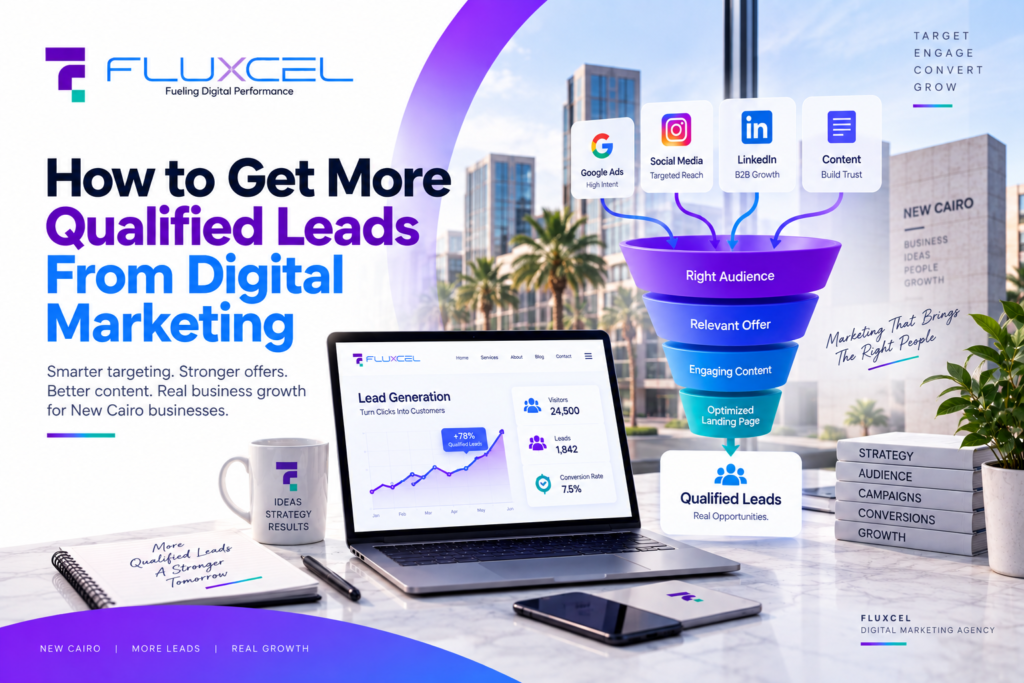
That means targeting the right audience, communicating a relevant offer, creating useful content, building focused landing pages, qualifying inquiries, following up quickly, and measuring what happens all the way through to the sale.
At Fluxcel Digital Marketing Agency, we help businesses connect targeting, content, paid advertising, SEO, conversion strategy, and performance data to generate leads with stronger business potential.