
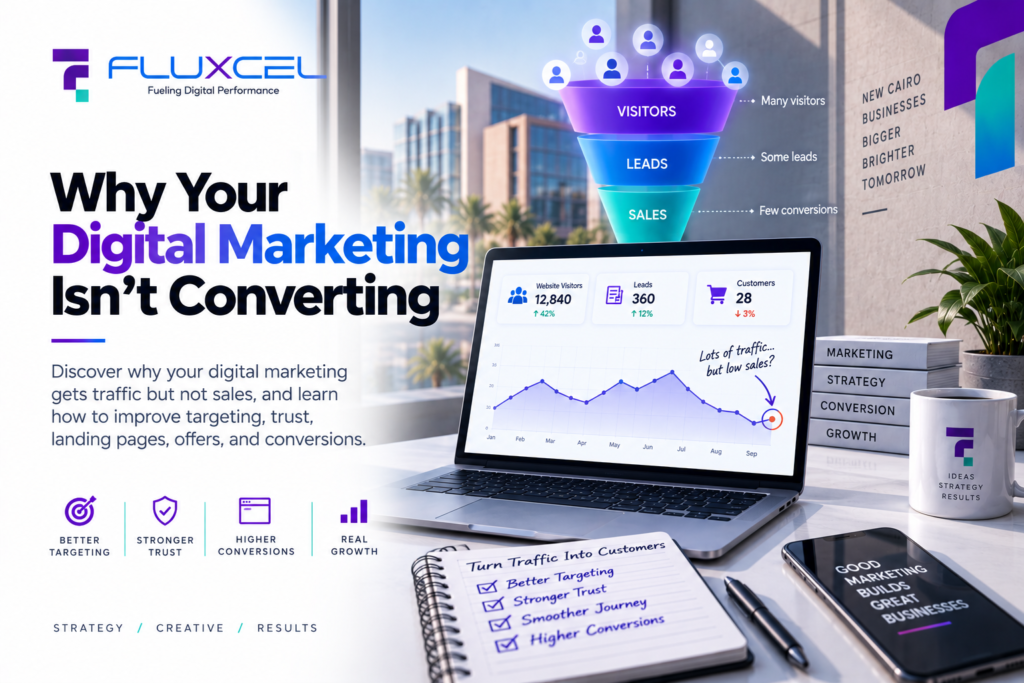
Your ads are getting clicks.
People are visiting your website. Your social media posts are reaching thousands of users. Maybe you’re even receiving messages and inquiries.
But sales?
They’re not growing at the same pace.
It’s one of the most frustrating situations for any business because, on the surface, the marketing seems to be working. Traffic is coming in, engagement looks healthy, and campaigns are active.
The problem is that attention and conversion are two completely different things.
Getting someone to notice your business is only the beginning. You still need to convince that person that your solution is relevant, trustworthy, valuable, and worth taking action on.
For businesses working with a Digtial marketing agency new cairo, improving conversions often means looking beyond the advertising dashboard and examining the entire customer experience.
Here are some of the most common reasons digital marketing generates attention without enough customers — and what you can do about them.
You’re Attracting Traffic, Not the Right Traffic
More website visitors can look impressive in a monthly report.
But 10,000 visitors who aren’t interested in your offer are less valuable than 1,000 visitors with strong buying intent.
This is why traffic volume alone shouldn’t define marketing success.
Understand Where Your Visitors Are Coming From
Different traffic sources can produce very different customer behavior.
Someone who searches Google for a specific service may already be considering a purchase.
Someone who discovers your brand through a Reel might simply be curious.
Neither audience is necessarily better. They’re just at different stages.
Your message and expectations should reflect that.
Look beyond clicks and ask:
- Which audiences generate qualified leads?
- Which keywords produce customers?
- Which campaigns generate revenue?
- Which traffic sources have stronger conversion rates?
- Which audiences engage but rarely purchase?
The answers can help you redirect your budget toward the people who are more likely to become customers.
Your Marketing Message Is Too Generic
You’ve probably seen advertisements that say things like:
“Quality You Can Trust.”
“Your Trusted Partner.”
“The Best Solutions for You.”
These statements aren’t necessarily wrong.
They’re simply difficult to differentiate.
Your customers are constantly exposed to competing messages, so vague claims can easily disappear into the background.
Be Specific About the Value
Instead of telling customers you’re good, explain why your offer matters.
Focus on:
- The problem you solve
- The result customers want
- What makes your approach different
- Who the service is designed for
- Why customers should choose you
Specific messages tend to feel more credible because they give customers something concrete to evaluate.
A Digtial marketing agency new cairo strategy should connect advertising messages directly to customer needs instead of relying only on general brand claims.
Your Landing Page Doesn’t Match the Advertisement
Imagine clicking an advertisement for a specific product and being taken to a homepage containing 20 different products.
Now you have to find the product yourself.
Most people won’t bother.
This gap between the advertisement and the destination is one of the easiest ways to lose potential customers.
Maintain Message Consistency
If your advertisement promotes a specific service, the landing page should immediately continue that conversation.
The headline, imagery, offer, and CTA should feel connected.
For example:
Ad: “Book Your Free Business Consultation.”
Landing page: “Schedule Your Free Business Consultation.”
That’s a clear journey.
If the landing page instead opens with a generic company introduction, the visitor may wonder whether they clicked the right advertisement.
Reducing that confusion can improve conversion performance.
Your Website Creates Too Much Friction
Sometimes customers want to convert.
The website simply makes it difficult.
Slow loading times, complicated navigation, broken buttons, long forms, unclear pricing, and poor mobile layouts can all interrupt the journey.
Every unnecessary obstacle gives visitors another reason to leave.
Test the Journey Yourself
Open your website on your phone and pretend you’ve never seen the company before.
Try to complete the main action.
Can you easily:
- Understand what the company offers?
- Find the service you’re interested in?
- Contact the business?
- Submit a form?
- Find a phone number?
- Send a WhatsApp message?
- Complete checkout?
- Book an appointment?
If something feels unnecessarily difficult to you, it may be even more frustrating for a first-time visitor.
Customers Don’t Trust You Yet
Customers don’t only ask:
“Do I want this?”
They also ask:
“Do I trust this company?”
Trust becomes even more important when you’re selling expensive products, professional services, healthcare services, property, or anything involving a significant commitment.
Add Proof Throughout the Journey
Don’t leave all your trust signals on one testimonials page.
Integrate them naturally throughout the website and marketing journey.
You can use:
- Customer reviews
- Testimonials
- Real project examples
- Case studies
- Certifications
- Client logos
- Before-and-after examples
- Clear contact information
- Team information
- Guarantees or policies
Real evidence is usually more persuasive than repeatedly describing your business as “trusted.”
Your Offer Isn’t Strong Enough
Sometimes the marketing isn’t the main issue.
The offer is.
You can create excellent ads and send highly relevant traffic to a beautiful landing page, but customers still need a compelling reason to act.
Ask yourself:
Why should someone choose this offer instead of doing nothing?
Then ask:
Why should they choose it from us instead of a competitor?
Improve Perceived Value
A stronger offer doesn’t always mean a bigger discount.
Value can come from:
- Convenience
- Faster delivery
- Better support
- Free consultations
- Flexible payment options
- Bundled services
- Guarantees
- Exclusive features
- Added services
The right approach depends on your product, audience, and positioning.
Discounting isn’t automatically the answer.
Sometimes explaining the existing value more clearly is enough.
You’re Asking for Too Much Too Soon
Imagine seeing a company for the first time and immediately being asked to commit to an expensive service.
You may not be ready.
Many businesses treat every visitor as though they’re at the final stage of the buying journey.
They’re not.
A potential customer may need to read more, compare options, watch a demonstration, understand pricing, or see evidence before taking action.
A Digtial marketing agency new cairo strategy should therefore create different pathways for different levels of intent.
For example:
New visitor → Educational content → Service page → Testimonial → Retargeting → Consultation
That journey may take days or weeks depending on the purchase.
Give customers enough information to move forward at their own pace.
Your CTA Is Easy to Miss
Customers shouldn’t have to figure out what to do next.
If you want them to contact you, make that obvious.
If you want them to buy, make purchasing simple.
If you want appointments, highlight booking.
Good CTAs are clear and action-oriented.
Examples include:
- Book Your Consultation
- Request a Quote
- Get Started
- Shop Now
- Talk to Our Team
- Schedule an Appointment
- Send Us a Message
Avoid filling one page with five equally important CTAs.
Choose the action that matters most and guide customers toward it.
You’re Losing Leads After They Convert
A website conversion isn’t necessarily a sale.
Someone submits their phone number.
What happens next?
If the answer is “someone from sales will eventually call them,” you’ve found another possible conversion problem.
Treat Follow-Up as Part of Marketing
Track:
- Response time
- Contact rate
- Lead qualification
- Follow-up attempts
- Sales conversion rate
- Reasons leads don’t purchase
This information can reveal whether the problem is marketing, sales, or somewhere between the two.
For example, marketing may be producing strong leads while slow response times are reducing sales.
Without connecting the data, the advertising campaign might incorrectly receive the blame.
You’re Optimizing the Wrong Metrics
A campaign can have an excellent click-through rate and still generate poor business results.
A social media post can receive thousands of likes without producing a single customer.
A low cost per lead can look fantastic until you discover that almost none of those leads convert.
That’s why businesses need to measure deeper into the funnel.
Instead of stopping at clicks and leads, look at:
Click → Lead → Qualified Lead → Opportunity → Customer → Revenue
A Digtial marketing agency new cairo businesses work with should ideally help connect marketing performance to these deeper outcomes.
That makes optimization much more meaningful.
Conversion Optimization Is an Ongoing Process
There usually isn’t one button you can change to suddenly double your sales.
Conversion improvement comes from identifying friction and testing better alternatives.
You might experiment with:
- Headlines
- Offers
- Landing page layouts
- CTAs
- Forms
- Advertising creatives
- Audiences
- Testimonials
- Pricing presentation
- Follow-up processes
Small improvements across several stages can produce a much larger improvement overall.
The important thing is to test intentionally and learn from actual customer behavior.
Turn More Attention Into Customers
If your digital marketing is getting attention but not generating enough sales, spending more money isn’t automatically the solution.
First, understand where the customer journey is breaking.
You may need better targeting, clearer messaging, stronger trust signals, a more compelling offer, an easier website experience, faster follow-up, or better measurement.
When those pieces work together, existing traffic can become much more valuable.
Choosing a Digtial marketing agency new cairo businesses can partner with should therefore involve more than finding someone who can generate impressions and clicks. The focus should extend to what happens after those clicks — and whether marketing ultimately contributes to business growth.
At Fluxcel, we connect strategy, creative, media, websites, and performance around the complete customer journey.